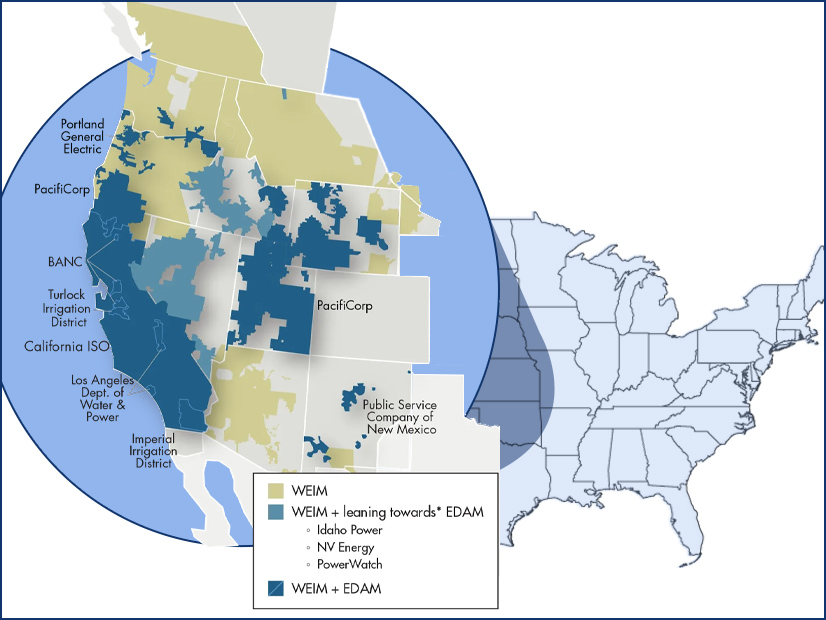
The Public Utilities Commission of Nevada voted April 3 to approve NV Energy’s application to join CAISO’s Extended Day-Ahead Market — a move that some stakeholders view as a pivotal moment for Western electricity markets.
The commission approved a draft order released March 31 that allows NV Energy to join EDAM in fall 2028. (See Draft Nevada PUC Order Would Allow NV Energy to Join EDAM.)
“I do view this order as a very important step for NV Energy and our state,” Commissioner Tammy Cordova said.
Cordova had proposed changes to the draft order, which she described as mainly wordsmithing, but she was outvoted on the proposed amendments.
Stacey Crowley, vice president of CAISO external affairs, provided a statement acknowledging the PUCN vote.
“CAISO appreciates the careful consideration of regional collaboration and looks forward to continued coordination with NV Energy, regulators, and stakeholders as EDAM implementation efforts advance,” Crowley said.
CAISO and NV Energy now will work together on an EDAM implementation agreement.
EDAM Launching May 1
EDAM is set to launch May 1 with PacifiCorp as its first participant. It will be followed by Portland General Electric in October 2026; Public Service Company of New Mexico, Turlock Irrigation District, Los Angeles Department of Water and Power, and Balancing Authority of Northern California in 2027; and Imperial Irrigation District in 2028.
Brian Turner, senior director with Advanced Energy United, described Nevada as “a critical hub connecting the Northwest, Southwest, and Interior West.”
“The state’s participation in EDAM will allow power to be seamlessly shared across these regions … boosting reliability, lowering costs, and making the most out of the West’s naturally abundant resources,” Turner said in a statement.
The PUCN decision comes at a critical time, Turner added, as the West remains split between two competing day-ahead markets. SPP plans to launch its Markets+ day-ahead offering in October 2027.
“Nevada’s move signals strong support for EDAM as the region’s most expansive day-ahead market, and helps move the West towards the broadest footprint, supporting a reliable and affordable grid,” he said.
Idaho Power and PowerWatch (formerly BHE Montana) have said they are leaning toward EDAM. But energy officials in Idaho as well as in Utah and Wyoming voiced concerns in March about the data-sharing practices of the Regional Organization for Western Energy ROWE), saying failure to provide full access to data and market information risks infringing on states’ rights and undermining public confidence. (See ROWE’s Bylaws Must Ensure Market Data Transparency, States Say.)
Governance Transition
NV Energy filed its request to join EDAM on Oct. 22 as an amendment to its 2025/27 Energy Supply Plan. (See NV Energy Files Request to Join EDAM.)
In approving the request, PUCN listed factors including NV Energy’s successful participation in CAISO’s Western Energy Imbalance Market (WEIM), its transmission connectivity with other EDAM participants and diverse energy resources available through EDAM.
Some parties in the proceeding raised questions about the independence of EDAM’s governance. (See EDAM Governance Questioned During NV Energy Hearing.) Under Step 2 of the West-Wide Governance Pathways Initiative, governance of EDAM and the WEIM are expected to be transferred to ROWE.
“The commission anticipates that Pathways Step 2 will further increase independent oversight,” the commission said in its order.
Some of Cordova’s proposed wording changes, which the commission rejected, were related to EDAM governance.
Although the commission’s approved order lists “CAISO’s governance structure” as a factor supporting NV Energy’s EDAM entry, Cordova had proposed removing that phrase.
The approved order says, “the Pathways Initiative has begun the process to establish the ROWE board and [the commission] finds this board will provide independent regional governance of EDAM and will enhance transparency and fairness for market participants.”
Cordova had proposed saying the ROWE board “has the potential to” provide independent regional governance.
Conditions of Approval
As part of the order, the commission approved a $16.15 million budget for NV Energy’s initial EDAM implementation and a $16.52 million annual participation budget. Commission approval would be needed for any costs above those amounts. The costs will be split evenly between NV Energy subsidiaries: Nevada Power Co. and Sierra Pacific Power in southern and northern Nevada, respectively.
Under the order, NV Energy must develop a way to measure annual adjusted production cost savings from EDAM participation. The order requires the company to file reports on the progress of its stakeholder process for revisions to its Open Access Transmission Tariff.
The order also notes that if NV Energy incurs surcharges for not meeting EDAM’s daily resource sufficiency evaluation, those costs will be paid by shareholders.
Nevada requires NV Energy to receive PUC approval to join an organized energy market. Utility regulators in some other states play more of an advisory role in market decisions.
For example, the New Mexico Public Regulation Commission issued a set of “guiding principles” described as advice rather than a mandate for utilities to consider in choosing a day-ahead market. (See NM PRC Issues ‘Guiding Principles’ for Electricity Market Participation.)
Public Service Company of New Mexico ultimately decided on EDAM, while El Paso Electric, which the PRC regulates, announced it will join Markets+.