

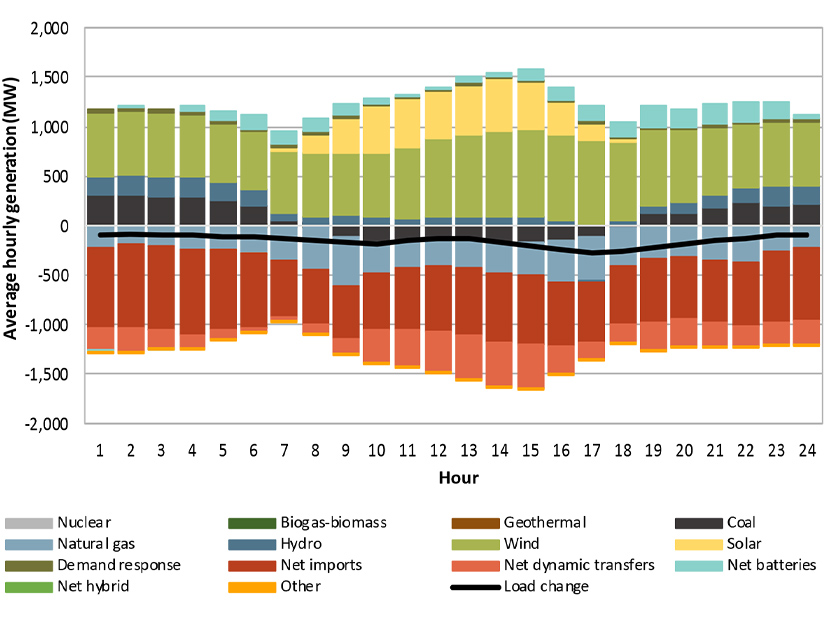
The Western Energy Imbalance Market’s Intermountain West region saw its hourly exports increase by an average of 780% — or 680 MW — in Q4 2025 versus the same period a year earlier.
The region shifted from being a net importer in most hours of Q4 2024 to a net exporter in all hours of Q4 2025, DMM said in a March 30 market issues and performance report.
Wind, solar and hydropower generation increased significantly in the region, up 170 MW (30%), 740 MW (38%) and 120 MW (8%) year-over-year, respectively. Load decreased by about 1.8%. The primary resources in the Intermountain West continue to be coal and natural gas.
California experienced the opposite trend. The state imported a more significant amount of electricity in Q4 2025 compared with Q4 2024, with net imports increasing by about 32%, or 1.13 GW.
California’s imports increased during the morning hours — i.e., when solar generators are starting up and batteries are often waiting to charge. Solar generation, along with battery charging, started around 8 a.m. – leaving demand in the early morning hours to be met by imports, according to DMM’s report.
In the rest of the West, exports increased in Q4 2025 versus Q4 2024. The Desert Southwest saw its net imports decrease by about 33%, or about 350 MW. Most of this reduction happened during the evening and when battery storage discharge increased. Natural gas continued to be the largest source of generation in the Desert Southwest, but battery storage and solar generation increased significantly, DMM said.
Hydroelectric generation in the Pacific Northwest accounted for about 70% of total generation, increasing by about 1,270 MW, or 8%, in each hour from Q4 2025 to Q4 2024. Net imports and natural gas generation decreased across all hours, DMM said.
In total, net interchange after dynamic transfers increased in California by approximately 1,130 MW and decreased in the Desert Southwest by about 240 MW, Intermountain West by about 920 MW, and Pacific Northwest by about 690 MW, the report says.
DMM also found the congestion impact on price separation between WEIM areas was lower than a year earlier. Pacific Northwest balancing areas experienced more frequent price separation than other market regions, being transferred-constrained for about 18% of market intervals in the import direction and 16% of intervals in the export direction.


