ERCOT staff say they are about to transfer work on the transitional batch study process to streamline the interconnection of large loads, as most of the rule is laid out in a Planning Guide revision request.
The grid operator is holding a final batch study workshop April 9. The rule’s development then will be handed off to the Reliability and Operations Subcommittee (ROS) (59142).
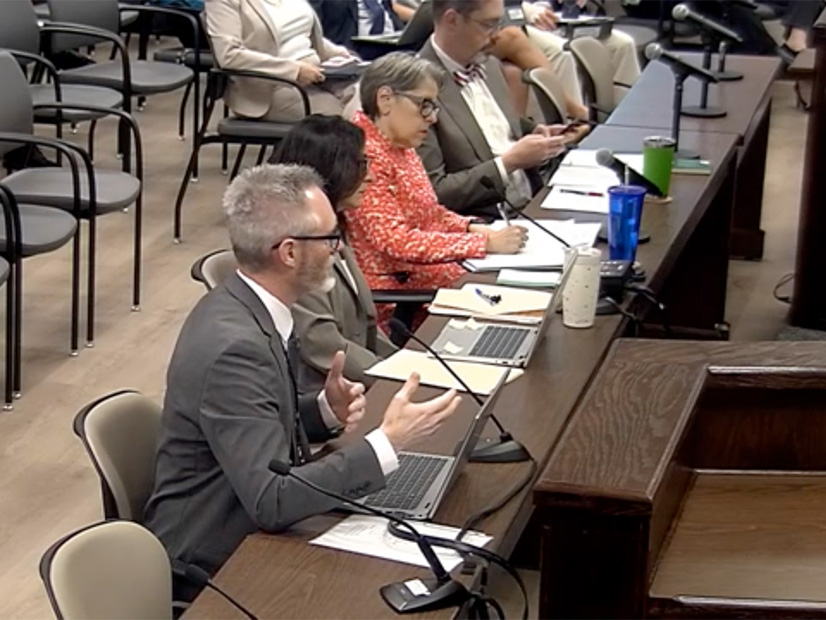
“That is the appropriate stakeholder body that that will vote on [the rule]” before it goes to the Technical Advisory Committee, ERCOT’s Jeff Billo, vice president of interconnection and grid analysis, told the Public Utility Commission during its April 2 open meeting.
ROS has scheduled two special meetings in April to consider the rule before sending it up to TAC. That key stakeholder body has scheduled meetings May 13 and May 19-20 so it can move the rule to the ERCOT board for its June 1-2 meeting.
ERCOT has incorporated stakeholder comments in the revision request in question (PGRR145). It establishes the transitional Batch Zero that staff will use to evaluate large loads’ reliability effects on a systemwide basis. PGRR145 transitions large load interconnections from individual studies to a cluster-based approach that allocates available transmission capacity for studied and committed large loads.
The change was created by forklifting PUC staff’s proposal establishing interconnection standards for large load customers. They commended large load customers execute an intermediate agreement that makes certain disclosures before their inclusion in an interconnection study and to post $50,000/MW in financial security (58481). (See Texas PUC Proposes Large Load Interconnection Standards.)
“We are continuing to refine this as we go, as we take feedback from the comments and through the workshops,” Billo said.
He said staff plan more filings on April 8 for controllable-load resources (CLR) and bring-your-own generation (BYOG) concepts. Billo said a load-only CLR rule change, excluding batteries for the time being, can be included with Batch Zero. It would allow loads to commit to being CLR in return for being allocated their full megawatts, even though their full request may not be available immediately.
“Stakeholders have proposed a lot of interesting ideas. I would even say ERCOT is excited about some of the ideas,” Billo said.
The BYOG concept staff are most optimistic about, he said, is self-limiting facilities. Loads bringing generation would be studied to determine how much load they can pull from the system at a time. The burden would be on the load centers not to pull more than they are allowed to.
Assuming board and PUC approval of PGRR145 and other changes, the Batch Zero study would begin July 10 and run into 2027. Loads that had validated studies as of March 4 will be eligible for Batch Zero. Loads without validated studies will have to wait until March 1, 2027, when Batch 1 is scheduled to begin.
Rule for T&Ds’ ESR Capacity
The PUC proposes a rule change that would allow transmission and distribution utilities to contract with generation companies for energy storage capacity to ensure reliability for distribution customers. The rule also would establish how T&D utilities would recover the contracts’ cost and the generation companies’ responsibilities (59523).
The commissioners asked for stakeholder feedback during the comment period on whether a utility’s cost recovery should be limited to comprehensive base-rate cases or also be permitted in interim proceedings. They also asked for input on whether contracts should satisfy relevant accounting standards for a capital lease or finance lease or whether the criteria be required only if a utility seeks recovery, plus a reasonable return under the contract.
In other proceedings, the PUC:
-
- Approved in part and rejected in part El Paso Electric’s request to build and operate a 100-MW solar facility and a 100-MW storage system at its Newman Power Station. The commissioners revised an administrative law judge’s decision by adding a production guarantee for the solar facility to “help ensure ratepayers see the full benefits of that facility, given its functional limitations” (57501).
- Remanded back to docket management a proposed order approving Texas-New Mexico Power’s acquisition of a privately owned 138-kV transmission line and an associated substation in West Texas. The commissioners asked TNMP to amend the application to include whether or not ERCOT endorses the project (58416).
- Consented to EPE’s request for a $1.26 billion rate hike but lowering the utility’s requested 10.7% return on equity to 9.35 to 9.4% after four years (57568).