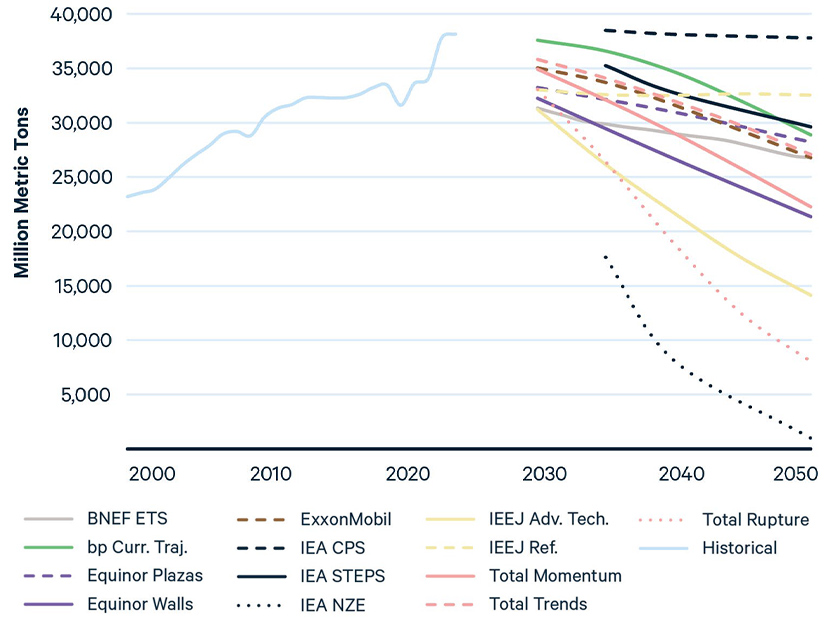
Too many emissions are baked in to the atmosphere for the world to limit global average temperature rise to 1.5 degrees Celsius, which was the target for the 2015 Paris Agreement, Resources For the Future said in its Global Energy Outlook 2026 report.
The report summarized and compared eight reports with 14 forecasts on energy and the environment out to midcentury from groups and companies such as the International Energy Agency, Bloomberg New Energy Finance, BP and ExxonMobil. RFF harmonized those results to provide an apples-to-apples comparison, Senior Research Associate Emily Joiner said during a webinar April 7.
The scenarios include six baseline projections in which current trends continue, six based on announced policies and two ambitious climate scenarios where warming is held to 2 C by the end of the century.
“It’s evident from current emissions trajectories and still peaking emissions that the world will exceed 1.5 C of warming, and because of this, we chose to exclude 1.5 C scenarios this year,” Joiner said. “Second, global energy demand continues to grow strongly, with projections of generation to 2050 being revised upwards over the past few years of outlooks. Third, as electricity demand has grown, so too has the demand for electricity generated from coal, leading to a slower-than-previously-predicted transition away from the fuel.”
There is some variation in the numbers, but the report notes that the world has either already reached the 1.5-degree target, or it will soon.
“In the last three years, global temperatures averaged between 1.44 and 1.55 C above preindustrial levels,” the report said. “Although average temperatures could temporarily recede due to natural fluctuations in Earth systems, it is clear that the world cannot meet its 1.5 C goal.”
The fourth major trend is how different parts of the world are diverging, with the report splitting it into the west (the Americas, Europe, and Russia and its Commonwealth of Independent States) and the east (the rest of Asia, Africa, the Pacific and the Middle East).
Coal in the U.S. is getting a boost from the Trump administration and the growing demand for electricity. Emergency orders under Section 202(c) of the Federal Power Act are keeping about 21 GW of plants open, while plant owners have announced $175 million for upgrades to other plants, making them more likely to stay open, the report says. By 2050, cumulative carbon emissions from longer-lived coal could be 4,125 million metric tons by midcentury, which is equal to almost 90% of U.S. emissions from 2024.
“While the east and west consumed similar amounts of coal at the turn of the century, by 2024 the east used almost six times more,” Joiner said. “Coal declines in both regions under all scenarios, but the pace varies pretty widely.”
China and India are still building more coal plants than they retire, but projections are for China’s coal use to drop by midcentury, while India’s shows some growth in the next decade before leveling out. The studies RFF tracks in the report have revised their forecasts for Asian coal use upwards since 2024.
Power demand globally has been growing this century, and that trend is expected to continue for the next quarter century.
“From 2000 to 2024, world power generation roughly doubled,” the report says. “Over the next 25 years, growth ranges from a low of 59% … to more than doubling again under ambitious climate scenarios.”
Renewables are projected to make up most of that growth, with wind and solar accounting for 40 to 72% of world electricity generation by 2050. Nuclear generation grows under all scenarios, but the projections vary widely, from 31% to doubling under the ambitious climate scenarios.
While the world is not going to limit climate change to 1.5 C, and net-zero emissions by 2050 also is off the table, the goal was always going to be a stretch even when it was hatched at the 2009 U.N. Climate Change Conference in Copenhagen, RFF CEO Billy Pizer said.
“Even when we were talking about 1.5 degrees in 2009, we knew it was very aspirational,” Pizer said on the webinar. “It was going to be very difficult to achieve. I would also just note, you know, the 1.5-degree target, or the 2-degree target, those were always sharing the stage with net zero, at least over the last decade, as a way to articulate what we really mean.”
The world is at a dynamic place for climate negotiations and activity, he added. The report was released as the Iran War continues, and it is unclear how long the disruption to global oil and gas flows will last.
Climate negotiators are unlikely to revisit the 1.5 C target anytime soon, especially given that it is existential for some island nations, University of Michigan professor Jennifer Haverkamp said.
“I don’t think it would be the best use of the negotiators’ time and energy to be trying to revise the targets now,” she added. “Maybe some years from now, after we get past the Iran War and the Trump administration and figure out just how big an issue AI is for electricity demand, countries might want to revisit it.”