A proposal by Amazon Web Services to build a major data center next to a nuclear plant in Maryland has sparked scrutiny from local officials and the state ratepayer representative over its potential impact.
The data center arm of the online retail giant has yet to file a formal proposal, but plans outlined by Amazon officials at a March 26 public meeting described the eight-building project next to the Calvert Cliffs Nuclear Power Plant on the Chesapeake Bay.
The power plant, which produces 1,790 MW, is owned by Constellation Energy and is a potential partner on the data center project, Amazon officials said. The 50-year-old plant is Maryland’s only nuclear facility, accounting for 40% of the state’s energy, according to the U.S. Department of Energy.
The proposal is one of two data center projects being floated for development in Calvert County. Developer Natelli Holdings at a public meeting April 6 outlined a 300-MW project with four 200,000-square-foot buildings to house “computing, networking, routing and storage systems” for tasks, including AI work on a 133-acre site about five miles from the nuclear plant.
Existing Transmission Lines
Nicole Morales, spokeswoman for Amazon, told RTO Insider the hearing was part of its “due diligence” to ensure its project “won’t impact how other customers receive power and that we continue to pay for our full cost of electricity to power our operation.”
Amazon has released scant details about the project but emphasized the economic and employment benefits while highlighting the advantages of the site.
“This campus is unique in that it’s located directly adjacent to an existing nuclear power facility,” Michael Fredette, an Amazon representative, said at the hearing.
“It’s crosscut by three different extra-high-voltage transmission lines, which provides a good opportunity for a data center to come in and secure highly reliable, scalable power to both continue to scale up the overall generation capacity in the region, as well as to serve that load for data center purposes,” he said.
David Lapp, who heads the Maryland Office of People’s Counsel that protects ratepayer interests, told RTO Insider his agency is “sort of waiting to see what happens next.”
“We are very concerned about the impacts on existing customers,” he said. “The impacts can be through higher capacity market prices, higher energy prices, as well as transmission costs. So, we’re concerned about all three of those.”
If the project requires power from existing energy capacity, “there are significant risks” that may increase costs for existing customers, he said.
Economic Benefits vs. Burden
The Amazon proposal has emerged as data center developments are facing local responses, such as opposition over the heavy use of electricity, who pays for infrastructure upgrades, and the extensive water use for cooling.
After the AWS project became public, which surprised members of Calvert’s Board of County Commissioners who knew little about the project, a commissioner called for a 24-month moratorium on granting data center approvals to ensure public input on such projects is gathered.
Maryland, like other states, is evaluating how to reap the economic benefits of data centers, while balancing their burden on local infrastructure and ensuring the added demand does not push up electricity prices.
PJM estimated that data centers will grow from 4% of Maryland’s power demand in 2024 to 12% in 2029 and 16% in 2039. (See Maryland: The State Where ‘Transmission Has Come to Die’.)
A report by the Maryland Tech Council, a pro-technology trade group, noted the state faces a $3 billion budget deficit and concluded data centers “represent a transformative economic opportunity” at a critical moment.
“These capital-intensive development projects can help the state address the fiscal challenges that are being exacerbated by looming federal job and spending cuts,” the report said.
Another data center planned for Adamstown, Md., faced vigorous opposition from residents concerned about the disruption, noise and burden on utilities.
Transmission Investment
Becky Ford, speaking for Amazon at the meeting, said the proposal is a “potential project” that is “not a done deal” but one the company is “evaluating as part of our initiative to support our customer requirements.”
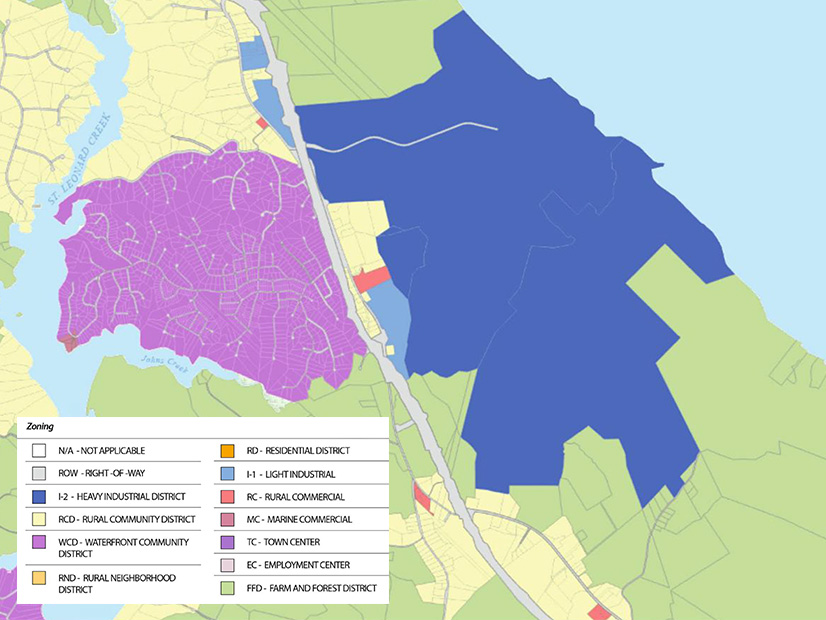
Because the target area is zoned “heavy industrial,” no new zoning will be required. She also addressed concerns that data centers typically have heavy water consumption.
The AWS plans say no new water will be required to cool the data center beyond the amount already used by the Constellation plant, she said.
“Once it’s been through their cooling system, it will come over to our facility and be used to cool our data centers, and then it will be sent back through the same process and at the same standards that currently exist,” Ford said.
Fredette said the company is “committed to continue paying our full share for electricity costs to power our data centers and provide the services to our customers.”
He said Amazon would “need to make a long-term revenue commitment to the transmission operator in this scenario, [Baltimore Gas and Electric], where we will have to pay for transmission-related costs regardless of if our load shows up. So, if a megawatt never spins, we are still contributing to existing and future transmission-related costs.”