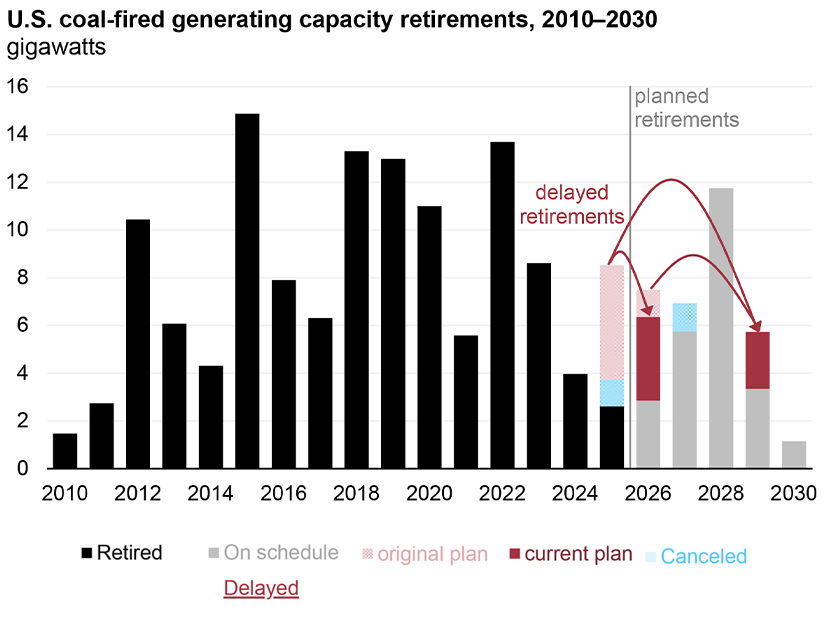
Coal generation retirements dropped to a 15-year low in 2025 as the energy industry tried to maintain existing capacity and the Trump administration sought to halt coal’s decline.
The U.S. Energy Information Administration (EIA) reported April 13 that coal plant operators began 2025 with plans to retire 8.5 GW of capacity but then retired only 2.6 GW — or about 1.5% of the U.S. fleet:
-
- Indian River Generating Station Unit 4 in Delaware (410 MW);
- Cholla Units 1 and 3 in Arizona (383 MW);
- Intermountain Power Project Units 1 and 2 in Utah (1,800 MW); and
- Prairie Creek Unit 1 in Iowa (15 MW).
It was the least since 2010, EIA said, and is a small fraction of the total in 2022, when 13.7 GW of coal capacity was retired (about 6.5% of the U.S. fleet).
In 2025, operators canceled plans to shut down 1.1 GW of coal-fired capacity and deferred plans to retire 4.8 GW.
The deciding factor in some of the changes was the U.S. Department of Energy (DOE) acting in response to President Donald Trump’s Day 1 declaration of a national energy emergency, his vision of U.S. energy dominance and his initiative to reinvigorate “beautiful clean coal.”
DOE has kept several generating units from being retired through temporary orders under Section 202(c) of the Federal Power Act:
-
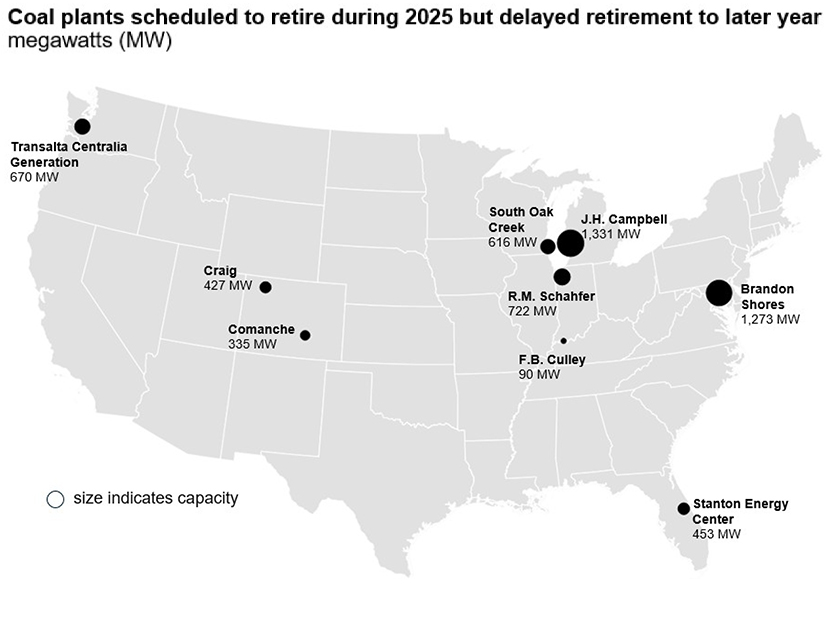
- J.H. Campbell Units 1, 2 and 3 in Michigan (1,331 MW);
- Transalta Centralia Unit 2 in Washington (670 MW);
- R.M. Schahfer Units 17 and 18 in Indiana (722 MW);
- F.B. Culley Unit 2 in Indiana (90 MW); and
- Craig Unit 1 in Colorado (427 MW).
Environmental and ratepayer advocates have criticized the 202(c) orders because of the financial and environmental impacts of continuing the operation of these plants. Regulatory debates and litigation continue. (See States, Environmentalists Argue DOE is Usurping Authority via 202(c).)
Meanwhile, some operators decided to delay retirements of 2.2 GW of capacity that had been scheduled in 2025:
-
- Brandon Shores in Maryland;
- South Oak in Wisconsin; and
- Comanche in Colorado.
The EIA reports the energy industry plans to retire 6.4 GW of coal generation in 2026, or nearly 4% of the U.S. fleet, but notes that regulatory actions and economic factors could cause those plans to change. (See Coal’s Decline Slows Amid Demand Growth in 2026, Trump’s Support.)
Coal has been on a sharp, sustained decline in the 2000s in the U.S. power sector because of the advent of cheaper natural gas and imposition of stricter environmental regulations. Statistics previously produced by the EIA quantify the slide:
-
- U.S. coal production has dropped from 1.17 billion short tons in 2008 to 513 million in 2024.
- From 2015 through 2024, U.S. coal-fired generation dropped from 1,352 TWh to 652 TWh per year, with every year but one lower than the year before. (The total jumped to 737 TWh in 2025 amid higher gas prices.)
- The number of U.S. coal-fired plants dropped from 491 in 2014 to 219 in 2024.
- From 2015 through 2024, the time-adjusted capacity of the U.S. coal fleet dropped from 286 GW to 176 GW, and its capacity factor fell from 54.3% to 42.6%. (The fleet capacity factor also saw a rebound in 2025, jumping to 48.7%.)