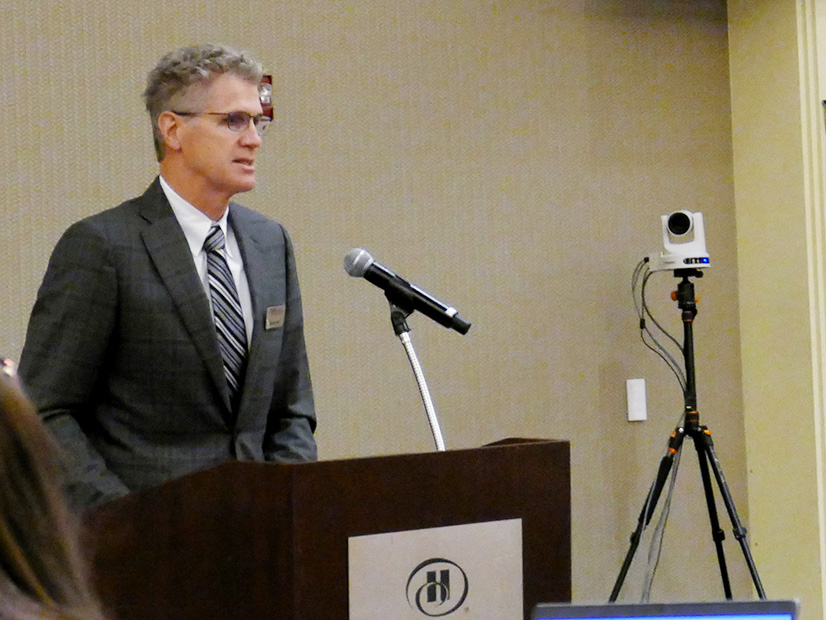
OMAHA, Neb. — 2025 has turned out to be “quite a challenging year” for SPP, Bruce Rew, the grid operator’s senior vice president of operations, said recently.
“I think every month we’ve had a challenging event,” Rew said during the RTO’s quarterly Joint Stakeholder Briefing May 5.
It began in January with several cold snaps that led to a conservative operations alert and 10 days of resource advisories. During Winter Storm Kingston in February, SPP set a new winter peak load record of 48.14 GW, exceeding the previous mark of 47.26 GW, set in 2022. Net load also surpassed 40 GW during the storm, reaching a high of about 43 GW.
Rew said forced outages were low during the storm, but several weeks later, low wind output of 3 GW caused the tightest conditions. With nearly all available generation online, SPP relied on non-firm imports to avoid declaring an energy emergency alert.
“We were close to an EEA. We were a couple of small units away,” Rew said.
SPP also survived high winds and wildfire concerns in the spring. However, during March, SPP had a small load shed in New Mexico and then two larger ones in Louisiana in April. Rew promised reports on the outages. (See SPP Addresses 3rd Load Shed Since March 31.)
Rew said SPP also is looking into the Iberian Peninsula’s mass blackout in April that plunged Spain, Portugal and part of France into darkness for 18 hours. Spain’s grid operator has said the outages began with two separate generation losses. (See NERC Offered to Help with Iberia Outage Investigation, Robb Says.)
“We want to make sure that there’s anything we learned from that event that we can apply to SPP, especially with the high renewable penetration levels that we see in SPP,” he said, adding that the RTO wanted to determine “if it’s something that we might need to be concerned about, not only for today but also in the future, if we continue to see the generation-dispatch change in the SPP footprint.”
Carrie Simpson, SPP vice president of markets, said the RTO’s Western expansion is on schedule but in a “yellow” status because the software development has been delayed and is 57% complete, she said.
Meanwhile, staff and vendors are building out the market systems. FERC has approved the RTO expansion’s tariff, but SPP is waiting to hear back on its compliance filing.
Staff Losses at FERC
Matt Jackson, a former SPP staffer and now FERC’s liaison to the grid operator, told stakeholders the agency has lost staff as part of the new administration’s push to slash federal jobs. However, he declined to give a number of lost jobs when asked by board member Steve Wright.
“Obviously, with the new administration, all agencies are being impacted in some capacity,” Jackson said. “FERC has had individuals who opted to take the deferred retirement option. Without putting too much information out, the approach that we have been given to date is that leadership is looking at possible realignments without any agency shrinkage, per se.”
As a senior energy policy and regulatory analyst for the commission, Jackson’s role is to serve as the point of contact between FERC and the SPP region and to help communicate information and policy development between FERC, the RTO and state regulators.
“I had a military commander once tell me, ‘Be brief. Be brilliant. Be gone,’” Jackson said in opening his report. “I will definitely try my best to do at least two.”
MMU’s Draft Market Report
Carrie Bivens, vice president of SPP’s Market Monitoring Unit, shared a draft version of the 2024 State of the Market report. It includes a discussion of the January winter weather event, an EEA alert in August, escalating load growth, increasing renewables penetration and resource adequacy.
Gas prices last year averaged $1.81/MMBtu at the Panhandle Eastern hub, a 16% decrease from 2023. That contributed to a 4% drop in average real-time prices, from $27.56/MWh in 2023 to $26.18/MWh in 2024.
Wind resources’ nameplate wind capacity stood at 34.81 GW at the end of 2024, accounting for 34% of installed nameplate capacity in the market. A little over 1 GW of wind capacity was added during the year. The generator interconnection queue contains about 30 GW of wind resources, which is overshadowed by the 83 GW of solar, battery and hybrid resources in the queue that potentially could be added to the market.
The MMU has issued four new recommendations to go along with 19 existing proposals that date back to 2017:
-
- Ensure daily availability of adequate accredited capacity to meet daily load by using market-based or ex post solution mechanisms to incentivize capacity to be available.
- Use a transparent sufficiency valuation curve to ensure that the values used in developing the curve and the clearing price are published publicly.
- Adopt a requirement for market participants to identify affiliates registered in SPP’s Integrated Marketplace.
- Address concerns that the cost-of-new-entry’s value is outdated.
Membership Changes at RSC
Pat O’Connell, chair of the New Mexico Public Regulation Commission and president of the Regional State Committee, welcomed guest commissioners and honored outgoing RSC members during the committee’s meeting that preceded the quarterly briefing.
Wyoming’s Mary Throne and New Mexico’s Greg Nibert watched the RSC conversation and stayed over for the board meeting on May 6. Nibert will replace O’Connell on the committee when the latter’s term expires at the end of 2025.
“Thanks for being at the table, and I think you’ll see that it’s an important table,” CEO Lanny Nickell told the commissioners.
O’Connell and the RSC honored Iowa’s Sarah Martz and Texas’ Lori Cobos for their tenure on the committee. Martz is joining the Organization of MISO States and will be replaced by Josh Byrnes; Cobos resigned from the Texas commission and the RSC in 2023.
“You’ll be in good hands with [Byrnes],” Martz told the RSC of her fellow Iowa Utilities Board commissioner. “As an engineer, I tend to get bored when things aren’t challenging and changing all the time, and it definitely has been here.”