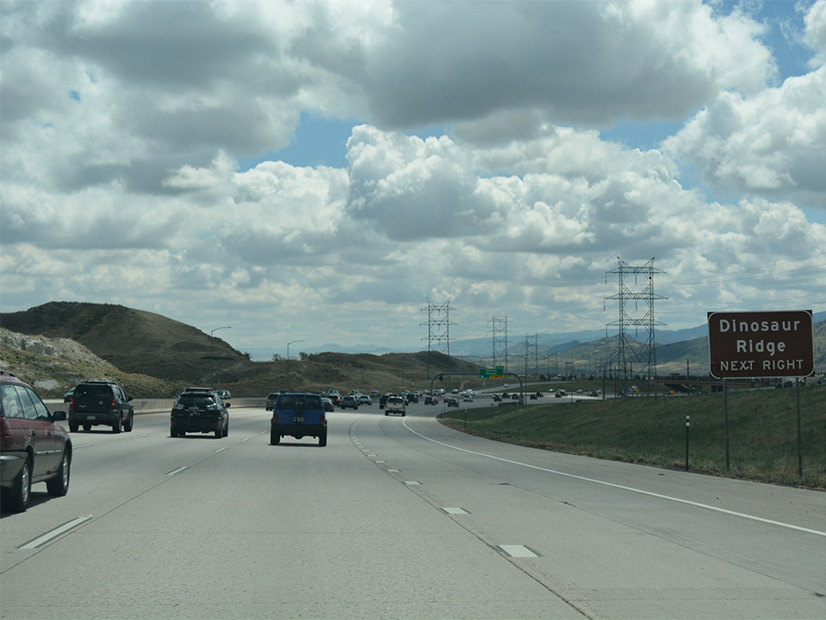
Colorado Gov. Jared Polis signed a bill that proponents say will streamline the building of new transmission lines within state highway rights-of-way.
Colorado Gov. Jared Polis signed a bill May 9 that proponents say will streamline the building of new transmission lines within state highway rights-of-way.
House Bill 25-1292 lays out a series of steps for a transmission developer and the Colorado Department of Transportation to take if the two agree that a state highway right-of-way may be a suitable site for a new transmission line.
“By building in existing rights-of-way, transmission developers in Colorado can avoid the kind of political and legal pushback that slows projects down,” said Randy Satterfield, executive director of NextGen Highways. The group promotes the use of existing rights-of-way such as highways as corridors for electric and communications infrastructure.
The bill aims to “open channels of communication that will allow for more coordinated and efficient planning between transportation officials and utilities,” NextGen Highways said in a release.
Renewable energy industry group Advanced Energy United said HB 25-1292 would facilitate coordination among utilities, state agencies and transmission developers looking to build in highway rights-of-way, “enabling faster, cost-effective solutions that will support Colorado’s clean energy goals.”
And the text of the bill notes that building transmission lines in highway rights-of-way potentially could reduce impacts on wildlife and habitat, compared to building across undeveloped areas.
“This will accelerate project timelines while reducing disruption to communities and the environment,” bill co-sponsor Rep. Junie Joseph (D) said in a statement after the House passed the bill. “By establishing a clear and responsible permitting process, we’re supporting a safer, more sustainable transition to clean energy.”
Other bill sponsors include Rep. Andrew Boesenecker (D) and Sen. Faith Winter (D).
Multistep Process
HB 25-1292 applies to transmission developers including private parties, the Colorado Electric Transmission Authority (CETA), utilities, and generation and transmission cooperatives.
Upon the request of a transmission developer, the DOT must provide its best available information on future state highway projects that could have an impact on transmission line placement.
If the DOT and the developer agree a site seems suitable for a transmission line, the DOT will develop a pre-construction plan review schedule. A developer that meets pre-construction requirements would submit a constructability, access and maintenance report. The report must include strategies for mitigating impacts on wildlife, habitat and communities, including disadvantaged communities, along with a community engagement process.
The developer also must post project information, including the route selection process, on a publicly accessible website.
The bill also contains provisions for a developer to compensate the DOT for use of the highway right-of-way. Options include a $600/mile surcharge each year of a 20-year term or a $12,000 lump sum payment. DOT may adjust the surcharge according to inflation. Access can be renewed at the end of the 20-year term.
Another compensation option is an in-kind infrastructure exchange in a public-private agreement.
The DOT will conduct rulemaking related to transmission lines in highway rights-of-way.
CETA Partnership
NextGen Highways and CETA worked together to launch an effort last year called NextGen Highways Colorado.
The coalition represents energy, transportation electrification, business, environmental and wildlife interests. It provided input on HB 25-1292, which also is known as the NextGen Highways bill.
The effort comes as CETA has identified the need for up to $4 billion in transmission investment to ensure that the state’s power grid can keep up with demand.
“Co-location of transmission in existing rights-of-way is an important tool that will assist the Colorado Electric Transmission Authority with avoiding property rights conflicts and building needed infrastructure,” CETA Executive Director Maury Galbraith said in a statement.