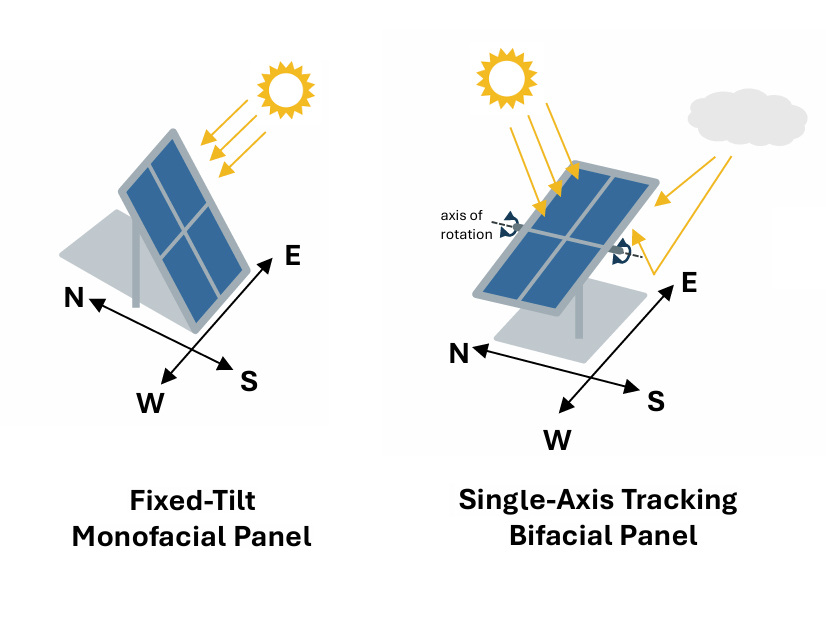
New research by ISO-NE indicates bifacial solar panels with tracking capabilities could reduce the cost of decarbonizing New England’s generation mix by about $3.7 billion.
The findings came out of a stakeholder-requested scenario in ISO-NE’s 2024 Economic Study. The study is intended to evaluate the “economic and environmental impacts of New England regional policies, federal policies and various resource technologies on satisfying future resource needs in the region.” (See “2024 Economic Study,” ISO-NE Details Evaluation Models for Transmission Solicitation.)
Single-axis tracking, bifacial panels are more expensive than fixed-tilt, monofacial panels, but they can generate about 45% more power by absorbing light on both sides of the panel and adjusting the tilt angle throughout the day. The more advanced panels are particularly effective at increasing power production during periods of indirect sunlight in the morning and early evening.
While the base case of the Economic Study modeled only fixed-tilt, monofacial PV resources, ISO-NE found that modeling solar resources with tracking, bifacial panels would reduce the overall capacity buildout requirement by 5.4 GW and build costs by about 2.5%.
Bifacial, tracking panels would more cost-effectively reduce emissions compared to the lower-cost alternative until about 2045, ISO-NE found. After 2045, ISO-NE projected that increased congestion would make fixed-tilt panels the more cost effective of the two options.
“At high levels of renewable penetration, new PV resources are curtailed frequently regardless of panel type, which diminishes the benefits from the additional production of bifacial tracking panels,” ISO-NE told stakeholders at its Planning Advisory Committee (PAC) on May 14.
The RTO also found that bifacial, tracking panels would reduce energy market costs in 2050 due to “more energy coming from zero-cost resources.”
Also at the PAC, ISO-NE discussed the results of an Economic Study model sensitivity regarding accelerated decarbonization. Unsurprisingly, the RTO found that meeting the study’s 1-million-ton carbon constraint by 2040 instead of 2050 would increase the cost and scale of the required resource buildout.
The accelerated decarbonization scenario increased cumulative build costs by about 8% relative to the base case, pushing costs from $615 billion to $666 billion, ISO-NE found.
Moving up the decarbonization timeline caused the model to build more long-duration storage resources and fewer small modular reactors (SMRs). This is due in part to the model’s assumption that the cost of SMRs will decline significantly in the 2040s, reducing the cost difference between SMRs and other low-carbon resources.
The RTO plans to discuss more policy scenario results at the PAC in July and publish the final 2024 Economic Studies Report in the third quarter of 2025.