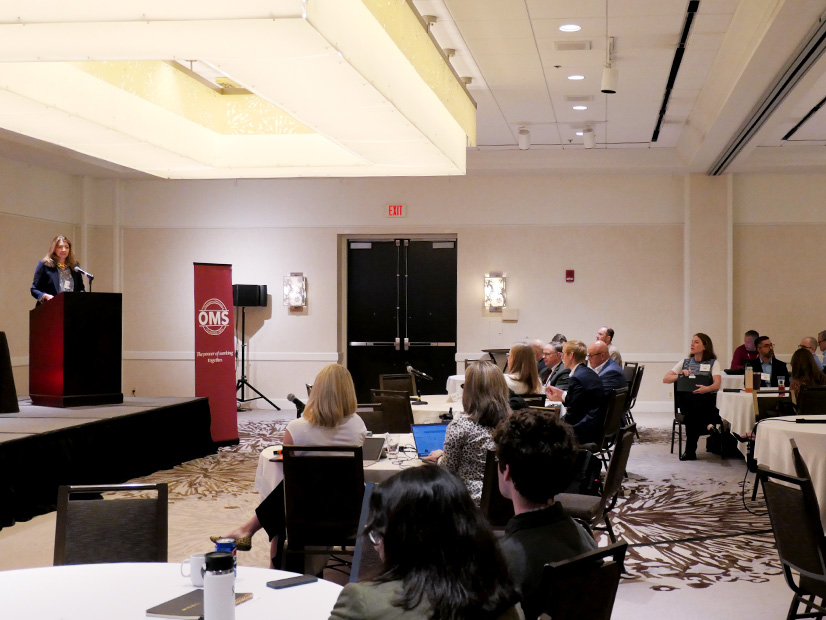
ROSEMONT, Ill. — MISO CEO John Bear put a positive spin on the grid operator making do with little cushion in its supply.
During the Organization of MISO States’ annual Resource Adequacy Summit on May 13 in Chicagoland, Bear said it’s not necessarily a bad thing that MISO has only thin excesses on top of its margins. Other speakers posed ideas on how to beef up supply.
Bear said even though NERC and the industry might say MISO is “on fire” in terms of resource adequacy, MISO is managing nicely while operating ever closer to its planning reserve margins.
“Being glass half full, I’d say we’re pretty efficient,” Bear said.
Bear said last year, the RTO and the Organization of MISO States’ joint resource adequacy survey “gave us some warning lights” and members reacted accordingly to avert a potential 2.7-GW capacity deficit the survey showed arriving as soon as summer 2025. (See OMS-MISO RA Survey: Potential 14-GW Capacity Deficit by Summer 2029.)
Nevertheless, Bear said MISO and the stakeholder community must get comfortable with enacting market and planning changes swiftly to continue to be resource sufficient.
“Eighteen months to redo the futures is incredible. We’ve got to do it in six,” Bear said, referencing the several months MISO has set aside to update the set of 20-year scenarios it relies on to chart big-ticket transmission projects.
MISO Vice President of System Planning Aubrey Johnson said MISO was inspired to add its supply-constrained fourth future to its existing trio of scenarios because staff noticed a few years ago that generation was not coming online as scheduled. (See MISO Forming 4th Tx Planning Scenario Based on Supply Chain Barriers.) Johnson said to finish the futures, MISO needs to “move,” meaning MISO gets its futures information in front of stakeholders and makes sure they understand and are mostly comfortable with them before finalizing them.
“Those that are not quite there, we can’t let them hold up the pace of change,” Johnson said.
Bear acknowledged that achieving the cooperation to move fast is “tough” across the country right now. But he added that MISO would be challenged even if load growth continued at a docile 1% per year and data center projections didn’t jump exponentially.
“We’ve got a lot of old power plants that aren’t performing well. That’s changing, by the way, thankfully,” he said. “We’re going to have to get more energy on the system … even if the data centers don’t show up.”
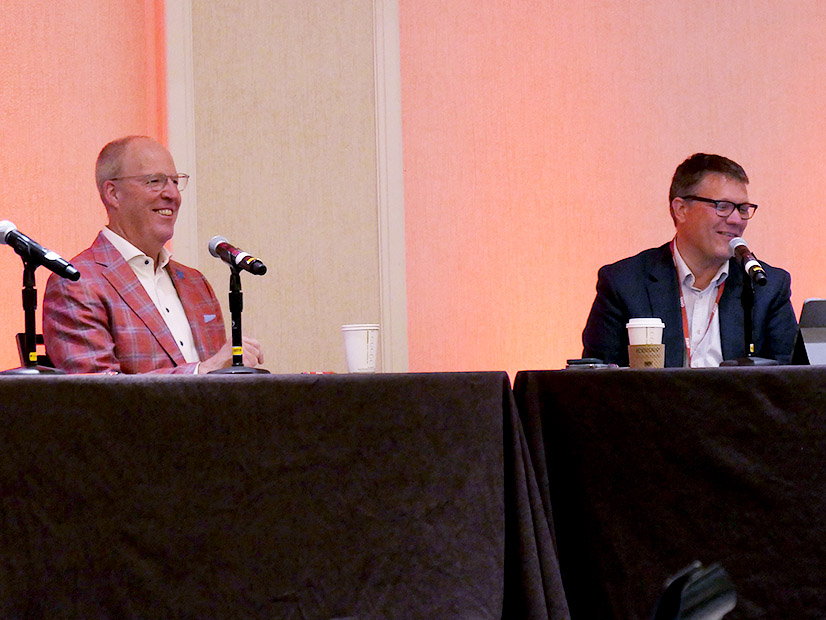
Bear said MISO is poised to double its 13-GW solar fleet over the next two years. However, he cautioned that MISO must be thoughtful about balancing its inverter-based resources. He said the risk posed by inverter-based resources is very real, exemplified by the frequency issues that likely were the culprit behind the late April blackout in Portugal and Spain.
MISO has noticed it increasingly encounters challenging operations in spring and fall on days when renewable energy output is high, Bear said. He said MISO is keeping tabs on its changing needs and will investigate adding frequency products or accrediting resources differently around frequency and inertia.
Bear also said MISO’s proposed fast track in the queue for proposed generators deemed indispensable to resource adequacy by state authorities should get key projects online sooner. (See MISO Fast Lane Proposal Disadvantages IPPs, Retail Choice States, Critics Tell FERC.)
Bear said MISO has devoted considerable time to planning transmission so wind and solar can be dispatched efficiently across the footprint. He pointed out MISO doesn’t need to track a significant number of curtailments, like the graph CAISO maintains.
MISO Independent Market Monitor David Patton asked the audience if anyone was surprised by the capacity auction’s $666.50/MW-day clearing price for the upcoming summer. MISO’s capacity auction left all but 300 MW of offers unused. (See MISO Summer Capacity Prices Shoot to $666.50 in 2025/26 Auction.)
He was met with silence.
“If you haven’t been tuned in, capacity prices went up manyfold from past years,” Patton said.
Patton said MISO buying 2% beyond the absolute summer minimum capacity standards is good for the health of the system.
“It was a bargain to buy it. … It’s not a bad thing that we bought beyond the minimum requirement,” he said. Patton also said states were instrumental in getting the auction clearing on a sloped demand curve.
“We saw how powerful I was, recommending this for 10 years,” Patton joked.
However, Patton said the “full” signal to build generation won’t arrive until MISO institutes its new, availability-based capacity accreditation beginning in mid-2028. He said the accreditation will deliver a final puzzle piece and allow the footprint to better meet long-term resource adequacy objectives.
Under the new accreditation, most resources’ capacity values are set to fall, as evidenced by MISO’s evaluation of this year’s supply had the accreditation been in place.
“It’s going to change how people plan, it’s going to change how merchant generation is built, how [integrated resource plans] are made,” Patton said.
IMM: Problem Remains with ‘Not Real’ DR
However, Patton said he remains deeply concerned about demand response gaming MISO’s markets. He said MISO’s recently filed suite of stricter rules should close some loopholes that allow DR to collect payments for doing nothing. (See Stakeholders Ask FERC to Soften MISO’s Proposed DR Accreditation.)
He said MISO is right to “aggressively” confirm that DR resources are genuine. He said if MISO does that, DR should function more like MISO traditional generation, which responds when called upon. Patton said MISO carrying only authentic and responsive DR ultimately should reduce costs.
Patton hinted at more referrals to FERC’s Office of Enforcement. He said an audit of MISO’s DR fleet turned up a retail customer that was registered under multiple market participants and a data center that has offered demand reductions and collected payments for about two years despite not yet being built.
“If you look at the site, it’s a really pretty greenfield with weeds,” Patton said. “We cannot allow people to sell us something that’s not real.”
Other Perspectives
Other speakers at the OMS meetup had plenty to say with resource adequacy risk at MISO’s doorstep. Alliant CEO Lisa Barton struck a decidedly graver tone in her keynote address.
Barton said she was sure the audience “was glued to their phones on April 28,” tracking the Iberian outage as it unfolded. She said she was sure attendees are focused on “making sure what happened there doesn’t happen here.”
Barton said industry players should be dedicated to at least holding up or bettering today’s levels of reliability and resiliency. She said “one of the unfortunate things” is people eventually forget grid disasters like Winter Storm Uri.
“We need to remind ourselves that’s out there,” Barton said.
Barton said there’s value in assessing events that “might not have happened in our backyard” and committing to learning from them. She said Spain and Portugal are dealing with a $1.7 billion fallout and a handful of deaths from just “one day of the lights not being on.”
Barton said the event should reinforce the idea that resource adequacy takes all kinds of generation, with some types more consequential than others.
Barton praised MISO for proposing an interconnection queue fast lane to get select generation online faster.
“I know it’s not a universally popular decision, but it’s action,” Barton said, adding that “not acting is a far greater risk.
“I remember saying to my daughters, ‘Not making a decision is a decision.’”
Barton said it can’t be ignored the U.S. population is benefiting and living on grid investments made decades ago. She said no matter your politics, nearly all can agree the industry needs to expand generation to support American innovation.
“What I think we can agree on is, we have to win the technology war,” she said.
Barton said MISO members should be insistent on striking flexible load arrangements to handle incoming large loads. She warned that it “all can’t be fixed with transmission.”
Finally, Barton said it’s not a good idea for data centers to strike out on their own and secure their own generation construction. She said data center developers likely would seek components that utilities also are vying for, likely exacerbating supply chain problems. Barton said independent generation construction is reminiscent of a pre-RTO world, where utilities planned in isolation and transmission and generation redundancies existed. It’s possible, Barton said, to work in protections for ratepayers while still offering attractive rates to data centers.
Data Center DR?
Despite the IMM’s indication to expect more enforcement against DR double-dealing, some are bullish that data centers are a new frontier.
Duke University fellow Tyler Norris said the idea that data centers are strictly inflexible and need firm service 24/7 isn’t true, as evidenced by a 2024 report from the Secretary of Energy’s Advisory Board. He said there could be some load flexibility found when the system needs it most.
“Outside of the 15 to 20 hours across the year … during cold snaps or heat waves, there’s a lot of headroom” on the system, Norris said.
He said Duke’s recent research found that if data centers could curtail load annually at just 0.25% of their potential maximum use, it could allow the existing grid to support about 76 GW of new load across the U.S., with 11.6 GW of that in MISO. (See US Grid Has Flexible ‘Headroom’ for Data Center Demand Growth.) Some in the industry are skeptical those figures can be achieved without co-located generation.
Norris pointed out that the country’s grid is built around the “few hours per year of extreme demand” and outside of demand peaks, about half of generation capability can go unused. Norris said while regulators might think data centers are running at a 100% utilization rate, they’re more likely to be running in the order of 40 to 50%. He said some of the unrealized use stems from data centers’ tendency to overstate interconnection needs.
“There’s a lot of potential there,” Norris said, but added that the flexibility from data centers will look different from traditional DR. He said grid operators will need to “get creative” to design different service tiers of DR to accommodate them.
He also said flexibility tradeoffs are being hammered out between data center developers and power suppliers.
“We know that those negotiations are happening, but on a purely bilateral basis, without a tariff,” Norris said. He said regulators might decide to outline some regulations for use agreements.
Nevertheless, Norris acknowledged the industry is in a “real crunch for the next five to seven years” to get generation built. He said construction probably will be more difficult because of the Trump administration’s repeal of Biden-era tax credits.
Surplus Interconnection Service and Batteries
GridLab’s Casey Baker said in MISO, there’s a possible “double-digit energy and capacity” solution in MISO in the form of using surplus interconnection across the sites of the RTO’s approximately 50 GW of renewable energy. He said members could build companion battery storage across those sites or, conversely, build wind or solar resources at some of MISO’s seldom-used and aging peaker plants to make the most of their little-used interconnection service.
Baker said building to use more interconnection service wouldn’t require network upgrades or the intense study and permitting that greenfield construction would require.
“We have this perception that the grid is tapped out, and that’s true in certain hours, but that’s not true in most hours,” Baker said.
Baker called batteries the “Swiss Army knife” of resources and said they can bolster resource adequacy, work as a transmission asset and provide inertia and grid-forming services, if customers are willing to pay for those models.
Mia Adams, of Ulteig Engineering and a MISO alum, added that MISO needs better participation rules for energy storage. She said though most believe that lithium-ion batteries have a four-hour limit, some can last up to 16 hours now.
“If you have the need, there’s a solution if you’re willing to pay for it,” she said. However, she added that most storage projects “in MISO don’t pencil out because of the market design.”
Adams said a 100-MW battery could be built within four months. Along with companion wind and solar generation, Adams said the footprint could host inexpensive, dependable new generation quickly.
Adams asked the audience to embrace new technologies sooner. She warned that data centers aren’t the only ones lining up for load treatment, nothing that heavy industry like aluminum smelters and steam crackers are looking to electrify.
And Adams said political instability in the form of will-they-won’t-they tariffs is upending plans for new generators.
“It’s not just batteries that come from China. It’s a very intermingled supply chain,” she reminded the audience.
Laura Schepis, an executive director at the National Electrical Manufacturers Association, agreed the volatility wrought by tariffs is anathema to planning and building resources.
Electric Power Research Institute’s Director of Power Systems Aidan Tuohy agreed that data centers aren’t the only growth the industry is facing, invoking increasingly electrified transportation, electrification of heat and reshoring of manufacturing.
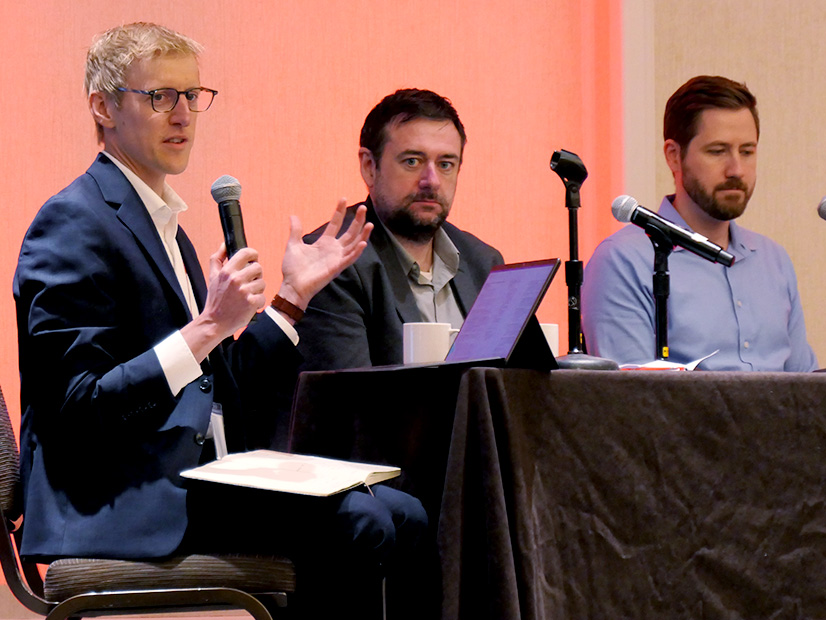
“We know we can’t necessarily build fast enough to meet that demand,” he said and offered demand flexibility and grid-enhancing solutions as ways to maximize the grid and get a breather on adding new generation.
Sparkfund CEO Pier LaFarge said the industry is navigating a moment not seen since the Industrial Revolution, where the data center explosion is coinciding with geopolitical tensions.
Xcel Energy Vice President of Supply Chain Murray Sanderford seconded the echoes of the Industrial Revolution.
“In my career, I’ve never seen something so daunting from a supply chain standpoint,” Sanderford said. He said he and his peers estimate that just 60 to 70% of planned generation won’t get built due to lack of labor and lack of equipment.
MISO’s Aubrey Johnson reminded attendees that about 30 GW of MISO’s 53 GW in generation projects that have signed generator interconnection agreements but have yet to come online are more than two years behind their commercial operation deadlines.
Johnson also noted the industry is grappling with a growing shortage of technicians specializing in inverter-based relay systems, another obstacle to meeting demand and reliability targets simultaneously.