New York authorized its first tranche of projects under a 2024 order that sought to address urgent existing and anticipated electric infrastructure needs as the state pushes to decarbonize transportation and buildings.
New York has authorized its first tranche of projects under a 2024 order that sought to address urgent existing and anticipated electric infrastructure needs as the state pushes to decarbonize transportation and buildings.
The 29 projects chosen are intended to expand capacity by 642 MW at an anticipated cost of $636 million, or about $1 million per megawatt. They were winnowed down from 65 proposals rated at 1,290 MW that would have cost $1.88 billion, or $1.5 million per megawatt of new capacity.
The Public Service Commission voted unanimously to approve the work at its June 12 meeting (Case 24-E-0364).
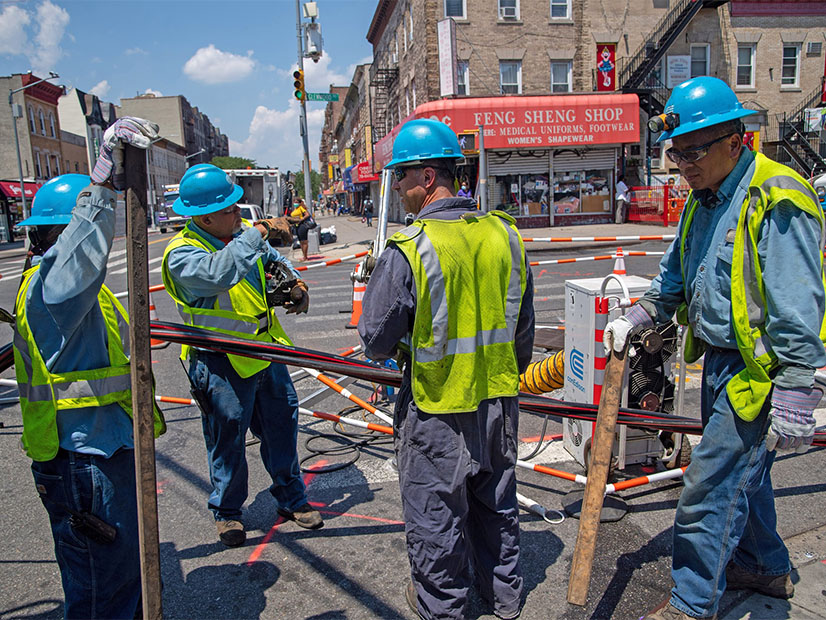
Most of the projects are in upstate New York, but much of the spending and much of the new capacity will come through five Con Edison upgrades in a few square miles of New York City facing immediate constraints.
Con Edison said extensive transportation electrification in an area of the South Bronx requires urgent near-term distribution system, sub-transmission and area station investments.
The area is dotted with fleet depots and service centers that serve an estimated 15,000 commercial vehicles, some of which are expected to electrify and some that already have.
There also is the largest-of-its kind Hunts Point Food Distribution Center, target of multiple electrification initiatives including a freight-focused charging facility and development of dozens of DCFC and L2 plugs.
Con Edison’s five projects would increase capacity by 380 MW at an estimated cost of $440 million.
The PSC in its August 2024 order directed the state’s large investor-owned electric utilities to begin the process and identify urgent needs. (See New York Orders Utilities to Join in Proactive Grid Planning.)
Con Edison, National Grid, NYSEG and RG&E submitted the 65 proposals; Central Hudson and O&R indicated they had nothing “urgent.”
Department of Public Service staff rejected more than half the proposals for not meeting one or more of the evaluation criteria:
-
- The work is needed to meet anticipated load growth from building electrification and/or transportation electrification.
- Construction-related activity could start by July 1, 2026.
- There is a high degree of certainty about location, magnitude and timing of load
- There is demonstrated consideration of risks and benefits of the size and timing of the proposed action, and of delaying that action or not taking it at all.
The 36 proposals that did not meet all four conditions may be able to advance later on a path other than this urgent/proactive process.
“We are approving these projects today because significant grid capacity is needed to support electrification across vehicle duty classes and buildings,” PSC Chair Rory M. Christian said in a news release. “Grid constraints have already begun to limit electrification in some parts of the state. The urgent grid upgrade projects would expand grid capacity in many areas of the state, relieving urgent constraints on an accelerated basis while a broader, unified planning framework is developed.”
One project each was authorized for NYSEG and RG&E.
NYSEG’s Kent Falls project would add 30 MW of capacity at a cost of $37.1 million to support a large and expanding manufacturing facility.
RG&E’s Station 124 project in Penfield would add 47 MW of capacity at a cost of $33.2 million to address electric vehicle charging needs and growth of existing loads in the Rochester area.
PSC approved 22 National Grid proposals with a combined capacity of 185 MW and estimated cost of $126 million — most of them small, but with a few station rebuilds and other larger projects included.
Among them is an “innovative” bridge-to-wires project that involves 4.4 MW of mobile battery energy storage systems. It would address immediate constraints, support transmission electrification and provide flexibility while a substation solution is developed for the longer term. At $21.6 million, its estimated cost per megawatt is nearly five times the average of the projects authorized June 12.
The most expensive project by capacity on the list would support a load request by a depot serving a school bus fleet that is being electrified to meet a state mandate. At 2.2 MW and $15 million, it would cost $6.8 million per megawatt.