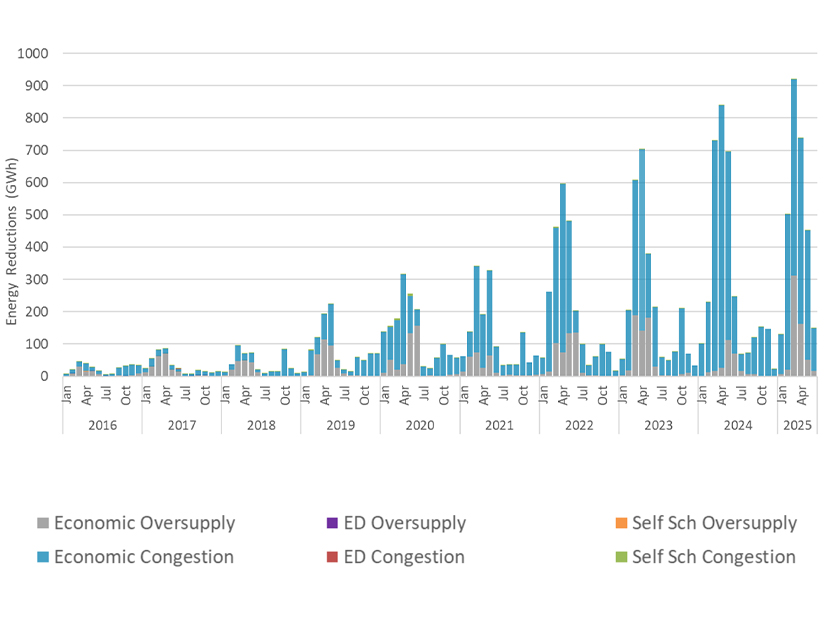
Local line congestion is the primary cause of renewable curtailment in California — and the amount is increasing each year, CAISO said during its second-quarter Market Performance and Planning Forum on June 26.
About 80% of curtailment is due to local line congestion in CAISO’s region, rather than oversupply, which sometimes is thought of as the reason why renewable generation is reduced — or curtailed.
“The extent of congestion is widespread, going from major and regional conditions to more local conditions,” CAISO staff said at the forum.
The two primary types of curtailment for solar and wind resources are “Economic – Local,” which is the market dispatch of generators with economic bids to mitigate local congestion, and “Economic – System,” which is the market dispatch of generators with economic bids to mitigate systemwide oversupply.
On May 14, about 27,000 MW of wind and solar was curtailed for “Economic – Local” reasons and about 4,000 MW for “Economic – System” reasons, CAISO staff said. Overall, about 94% of renewable curtailment is for solar resources, and this practice is not unique to specific locations in CAISO’s region, staff said.
In recent years, solar oversupply has been reduced because more solar farms have been built with battery storage facilities nearby — a development approach that allows batteries to more easily charge during hours when solar production is plentiful, CAISO staff said. In general, battery storage resources are helping to flatten the net load in the region, meaning fewer conventional generation resources, such as gas or hydropower, need to be used to meet demand, staff added.
During the forum, ISO staff noted the region’s load has been fully met with renewable resources during intervals on 40 days so far in 2025. Renewables serve load mostly during midday hours when batteries are charging, solar production is high and demand is low.
At the forum, CAISO also reviewed battery performance on March 4 and 5. On March 5, the battery fleet was significantly less charged than normal: 13,800 MWh compared to 35,000 MWh on March 4, requiring gas generation and imports to increase significantly to make up for the lack of battery storage energy available to meet demand, staff said. Battery storage energy was low on March 4 due to higher energy prices during the middle of the day, which minimized how much solar power the batteries soaked up, staff said.
CAISO staff also noted that, during winter months, California’s morning peak is becoming as high as the evening peak. The ISO is studying how the grid can rely on storage resources to meet morning and evening peaks, staff said.
CAISO said certain solar generation forecasting errors increased in 2025 compared with previous years, in part due to growth in solar capacity.
CAISO staff also reviewed the results of a recent change to how battery resources are managed on the grid. The results specifically looked at how batteries performed now that the ISO is accounting for a battery’s state of charge in the upward flexible ramping product program.
Due to this change, the grid operator observed that fewer flexible ramping up (FRU) awards went to storage resources during morning and evening peak times. However, the average resource usage under FRU procurement did not change significantly, said Kun Zhao, CAISO engineer.
“This effort will be a longer-term monitoring project for us, and we’ll definitely give updates,” Zhao said.