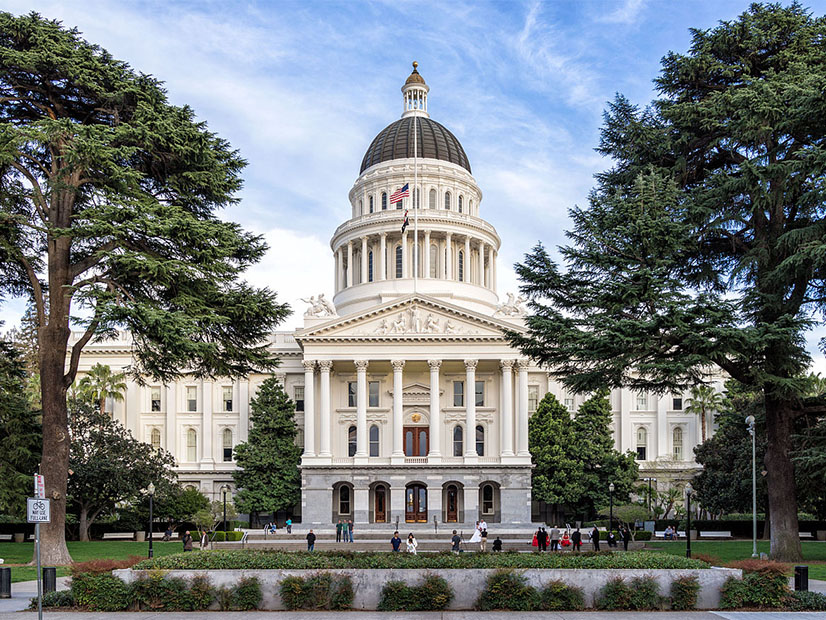
The author behind the bill that would allow CAISO to relinquish market governance to an independent “regional organization” (RO) delayed a hearing scheduled for July 16 after several organizations withdrew support for the proposed legislation.
SB 540, which passed in the California State Senate in June, was set for a first hearing in the State Assembly’s Utilities and Energy Committee but was delayed until after the Legislature’s summer break at the request of the bill’s author, Sen. Josh Becker (D). (See ‘Pathways’ Bill Passes California Senate on 36-0 Vote.)
Meantime, Gov. Gavin Newsom and Assembly Speaker Robert Rivas on July 16 both signaled their support for efforts to expand California’s involvement in regional electricity markets, although spokespersons for each pointed out they were not necessarily backing SB 540.
SB 540 is part of the West-Wide Governance Pathways Initiative, an effort to create an independent RO to govern CAISO’s Western Energy Imbalance Market and the soon-to-be-launched Extended Day-Ahead Market (EDAM). The effort aims to assuage concerns that the ISO — whose Board of Governors are appointed by California’s governor — would act solely in the state’s interest.
“The hearing was delayed with the support of the Senate and Assembly in order to have more time to iron out some details with the bill,” Becker’s press secretary, Charles Lawlor, told RTO Insider. “There is a huge, diverse coalition behind this bill. Conversations are active and ongoing. Our collective work is going to continue over the summer, and our goal is to move the legislation when we’re back in August or September.”
The move comes after 21 organizations, including the Environmental Defense Fund, PacifiCorp, Advanced Energy United, Amazon and Portland General Electric, changed their position to “oppose unless amended” on SB 540.
In a July 11 letter, the coalition said it opposed an amendment creating a new Regional Energy Market Oversight Council responsible for ensuring CAISO’s participation in the regional energy market “serves the interests of the state.” (See Amended ‘Pathways’ Bill Boosts — and Complicates — Calif. Protections.) The new council would be authorized to mandate withdrawal if those interests are compromised.
The coalition requested lawmakers remove the amendment, stating “the language in this section mandates the withdrawal of California entities from the market without exception or discretion, which is unacceptable.”
“Market rules should be established based on facts, evidence and reliable data rather than fear,” it wrote. “Even if withdrawal from the market were to be a prudent action, the mandated 120-day time frame is far too short and exposes California customers to serious reliability concerns, especially during periods of peak demand. Lastly, this language inadvertently asserts new [California Public Utilities Commission] jurisdiction over the state’s publicly owned utilities, which is inappropriate and must be removed.”
The coalition also argued lawmakers should remove revisions to California’s Renewables Portfolio Standard Program and restrictions on a future market. It noted that some entities in Colorado, New Mexico and Idaho are at a crossroads on whether to join EDAM or SPP’s Markets+.
“A smaller market for California means less cost savings, a less reliable grid and more climate-harming emissions,” the coalition wrote.
Leah Rubin Shen, managing director at Advanced Energy United, commended the legislature for delaying the hearing to “ensure a productive path forward that preserves the widely supported core purpose of the bill: to facilitate California’s participation in an expanded Western electricity market that provides robust state policy and consumer protections.”
“The stakes are too high for California to walk away, especially as trading partners across the West weigh their options,” Rubin Shen said. “Our shared vision remains clear: A strong regional electricity market that includes California will benefit the entire West by lowering costs, increasing reliability and delivering clean energy across the region. With continued commitment to passing a workable bill this year, we can achieve this goal.”
Meanwhile, The Utility Reform Network (TURN) has changed its opposition to neutral after the bill was amended to address the organization’s concerns that handing over governance to an RO could lead to increased federal intervention and undermine the state’s clean energy goals. (See California Lawmakers Seek to Trump-proof Pathways Initiative Bill.)
“We need a very enhanced level of protection and guarantees that this entire experiment is voluntary and that the state of California has … full control over whether we would continue to participate over time,” Matthew Freedman, staff attorney at TURN, said in an interview.
“We’re mindful of the [Trump] administration’s threat to force utilities throughout the West to subsidize legacy coal-fired generation that might be at risk of retirement, either under Section 202 of the Federal Power Act, or sent through some other mechanism that they invent,” Freedman added. “We want to make sure that this regional market is not weaponized against California.”
But Katelyn Roedner Sutter, California state director at the Environmental Defense Fund, said in an interview that fears the federal government will get involved are overblown, and that the bill makes clear California’s existing climate or clean electricity policy will not change.
“None of this … is going to impact our renewable portfolio standard. And the same is true for other states. Other states get to uphold their existing policy as well,” Roedner Sutter said.
“Where the real concern seems to come from is our relationship with FERC,” Roedner Sutter noted. “And I think what people who raise that are not understanding is that CAISO [tariff revisions] … already have to go before FERC. That is the case right now; … that relationship does not change in any way with this bill or with California entities being part of a regional electricity market. So, nothing is actually changing about our relationship with FERC.”
In separate statements released July 16, Gov. Newsom and Speaker Rivas both pointed to California’s “opportunity” to improve electric reliability and affordability through increased regional coordination.
“We have the opportunity to expand regional power markets that help drive down energy costs and increase grid reliability — or we can turn our backs on this proven model and opt for higher costs and power outages,” Newsom said. “The answer is clear: California must further enable continued cooperation with Western partners to secure our clean, reliable and affordable energy future. This is our best shot at lowering energy costs. Now the legislature must take action this year and deliver for the people of California.”
“There is an urgent opportunity now — this year — to lower energy costs for California families and businesses, and we can help achieve this by expanding regional collaboration,” Rivas said. “California must continue to lead and step up, or others will. We need to continue to facilitate cooperation with our Western neighbors through a voluntary, regional power market, because that is our best path toward driving-down costs and delivering a sustainable, reliable, affordable energy future for Californians. Let’s get this done now.”
Robert Mullin contributed to this article.