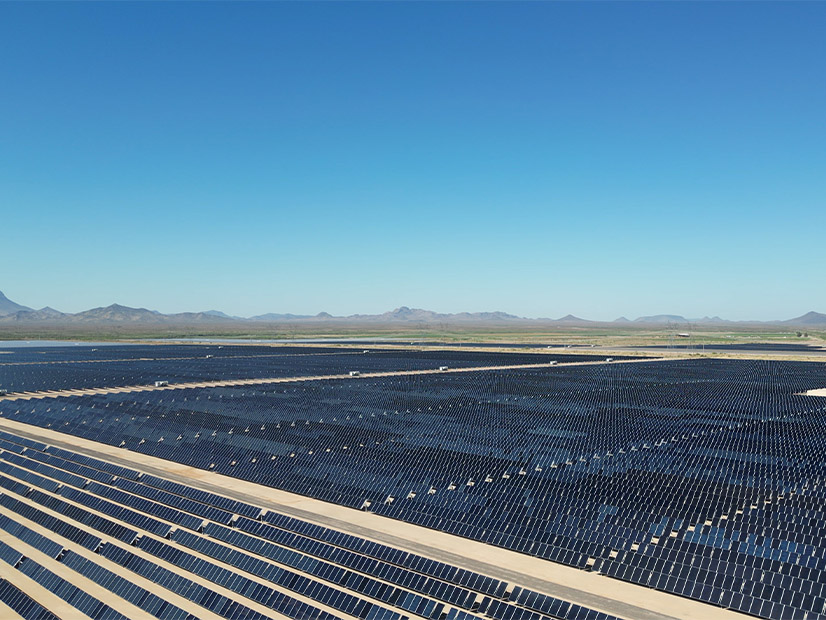
As new solar and wind developments face hurdles due to changes in federal policy, the projects are also encountering growing resistance at the local level, according to speakers at a webinar.
“In most of the United States, it’s very local government — counties or townships — that have the authority to decide whether these large-scale clean energy projects can move forward or not,” said Dahvi Wilson, founder and president of consulting firm Siting Clean. “And increasingly, they are saying no.”
Wilson was one of four panelists at a July 17 webinar on obstacles to energy infrastructure. The event was hosted by Resources for the Future, a nonprofit research institution.
At the heart of the local resistance is the feeling that utility-scale solar and wind projects are transforming rural landscapes, giving them an industrialized feel, Wilson said. But the opposition to projects frequently expands to arguments that “often aren’t legitimate,” Wilson said, such as claims that the projects will have health impacts, hurt property values or are part of the “green new scam.”
Another factor in the growing local resistance is the transmission system’s limited capacity, Wilson said. As a result, clean energy developers are flocking to places where they can get on the grid.
“It leads to a ton of pressure on those places,” she said. “Suddenly, the resistance to this kind of development increases.”
Mapping Restrictions
Panelist Robinson Meyer, founding executive editor of Heatmap News, said that following enactment of the federal budget reconciliation bill, called the One Big Beautiful Bill Act (OBBBA), clean energy adversaries increasingly will focus their efforts at the local level.
“That is where the big fights are coming for slowing down clean energy production,” Meyer said.
Heatmap News surveyed counties across the country and found that 605 counties — accounting for about 17% of the land area of the continental U.S. — restrict solar or wind development in some way. The restrictions might be in the form of an outright ban, development requirements such as setbacks that make it nearly impossible to build, or moratoria that can be slapped on at will.
Wind and solar developers also identified local opposition as a significant barrier to clean energy projects in a January 2024 report by Lawrence Berkeley National Laboratory. (See Reports Detail Causes, Impact of Local Opposition to Renewables.)
Meyer said areas such as the Southwest have had a “relief valve” for building renewable projects on federal land, where county rules don’t apply. But now even that relief valve is under fire from the Trump administration.
Under a new directive from the Department of the Interior, all decisions concerning wind and solar energy facilities must be reviewed by Interior Secretary Doug Burgum, including leases, rights-of-way, construction and operation plans, grants, consultations and biological opinions. Critics called the order a “shadow ban” on clean energy projects. (See Interior Dept. Places Solar, Wind Under Close Review.)
Some states, such as New York and Michigan, are addressing local resistance to solar and wind projects by adopting mechanisms to override the opposition.
So even though the 250-MW Mill Point Solar 1 proposal in Glen, N.Y., has polarized residents, locals are limited in their ability to fight back. (See Rural Town Grapples with N.Y.’s Renewable Energy Vision.)
“State preemptions of these rules can be quite effective,” said Meyer, who noted there are more clean energy projects on the Michigan side of the Michigan-Ohio state line than on the Ohio side.
Tax Credit Clock Ticking
With the enactment of OBBBA, solar and wind developers now face a tight timeline for starting and finishing projects in order to qualify for sunsetting tax credits.
Investment and production tax credits no longer will be available for solar and wind facilities placed in service after Dec. 31, 2027 — unless construction starts by July 6, 2026, in which case the deadline for placing the project in service is extended. The dates are subject to Treasury Department guidance; an update to the guidance is expected by Aug. 18.
The tight tax-credit timeline means opponents need only to delay a project to derail it, Wilson said.
“They don’t even have to kill the project,” she said. “They have to delay them maybe a year, to knock them out of being qualified.”
Webinar panelist Rich Powell, CEO of the Clean Energy Buyers Association, said there could be a rush for developers to “commence construction” of solar or wind projects to meet the tax credit deadline. That might entail starting work on a new transformer or road, or meeting a spending threshold by buying solar panels, turbines or batteries.
“Which is painful from the buyer’s perspective, because that’s going to mean prices go up for all of these things … as people sort of rush to do that,” Powell said.
Panelist Allison Clements, a former FERC commissioner and now a partner at ASG, a consultant to the data center, cloud and real estate development industries, called the administration’s actions “economically irrational.”
“I couldn’t have guessed in my most creative moment some of these things they’re doing to slow things down. [Saying] ‘I really hate this color of electron versus that color of electron,’” Clements said.
But Clements said given the “durable demand” expected over the next five to seven years due in part to computing needs and electrification, she still expects projects to proceed.
“Things will just be increasingly messy but continue to go forward,” she said.