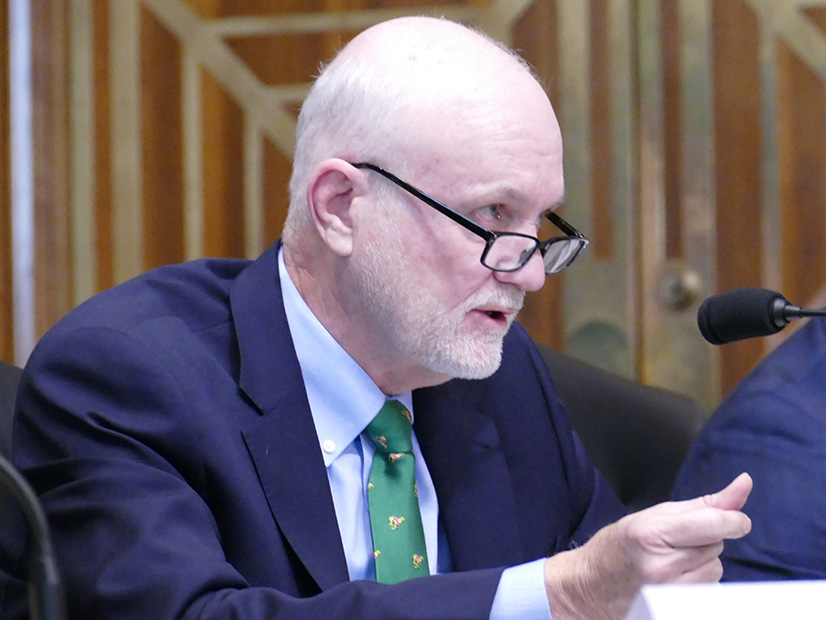
FERC Chair Mark Christie presided over his final open meeting July 24, as he plans to step down in the coming weeks after completing work on several orders.
President Donald Trump nominated Laura Swett of Vinson & Elkins to replace Christie as chair. Christie’s term ended June 30, but he is allowed to stay until the end of the year as long as his replacement has not been confirmed. (See Trump Replacing FERC Chair Christie with Laura Swett.)
Christie started his career in public service in 1994, when newly elected Virginia Gov. George Allen made him a member of his cabinet. He joined the Virginia State Corporation Commission in 2004, where he served 17 years until he was appointed to FERC by Trump during the president’s first term.
“After 31 years, it’s coming to an end,” Christie said. “When I look back at my experience, it’s been a hell of a ride. It really has. I’ve had tremendous opportunities to serve the public, to be in public office, where you get a chance to do good things. And let me just say this, nobody accomplishes anything alone. Whatever you accomplish, others are part of it.”
Christie praised the commissioners he served with during his tenure at FERC and his staff, and thanked Allen and Trump.
He also reminisced about what he learned throughout his career. He recalled that during the first major rate case he presided over as an SCC commissioner, he noticed how packed the room was and mentioned the number of people present to the chair.
“He said that room wasn’t packed with people,” Christie said. “That room was packed with lawyers and lobbyists for every interest group that has money riding on what we do. He said, ‘The people who pay the bills for what we do and what we’re going to do in this rate case, those people are not in that room. So don’t you ever forget the people who are not in that room.’”
The second Trump administration has embraced the “unitary executive” legal theory, which holds that the president can fire members of independent regulatory agencies at will. Asked about it, Christie pointed back to a lesson he learned early at the SCC: that regulators need to worry about the consumers who foot the bill of their decisions.
“There’s really no one but us here to be thinking about them and thinking about how what we do affects them,” Christie said. “And I hope that everybody who ever sits on this commission always remembers those people’s wishes — the millions of people who pay the bills, struggle and worry about whether their lights come on or not.”
The SCC is much different from FERC in that it is an agency with its independence recognized in the Virginia Constitution, whereas the federal commission is statutory — created by the Department of Energy Organization Act of 1977 — and is more subject to changes in its legal foundation, Christie said.
Asked about his biggest accomplishment at FERC, Christie pointed to the regular letters he has been writing ever since Trump’s so-called Department of Government Efficiency sent an email to all federal employees asking them to explain five things they did in the past week.
“When you read those letters, it’s just remarkable what we do around here; it’s just remarkable. I think it’s hard to say what we’re most proud of, but being chair, I’m very proud of what we got done,” he added. “And those letters really detail the important things we got done every week, every day.”
Those familiar with Christie’s dissents on many orders over the years will not be surprised to hear his major regret: that he was not able to cut back on transmission incentives, which he calls “FERC candy.”
More specifically, he pointed to a Notice of Proposed Rulemaking that he voted out with former Chair Rich Glick and former Commissioner Allison Clements that would have limited the adder utilities can charge for joining an RTO to just three years and required their choice to join to be voluntary (not required by their state). It never moved forward from the NOPR stage, even through his own time as chair.
“That is something that I regret, that I couldn’t get three votes for that,” Christie said. “But it just shows … FERC is constantly lobbied, alright? Constantly lobbied. And again, the people paying the bills are not here lobbying or represented. They’re just not.”
All three commissioners praised Christie, and each of them noted that he reached out to them just after they had been nominated to offer his congratulations and advice.
“A lot of FERC chairs have talked about making FERC boring again, and you, I think, really have achieved that,” Commissioner David Rosner said. “We’ve done a lot of complicated orders. We’ve done a lot of important work. … The level of consensus is high, and I call that boring, but also the energy nerd here also finds this all very exciting.”