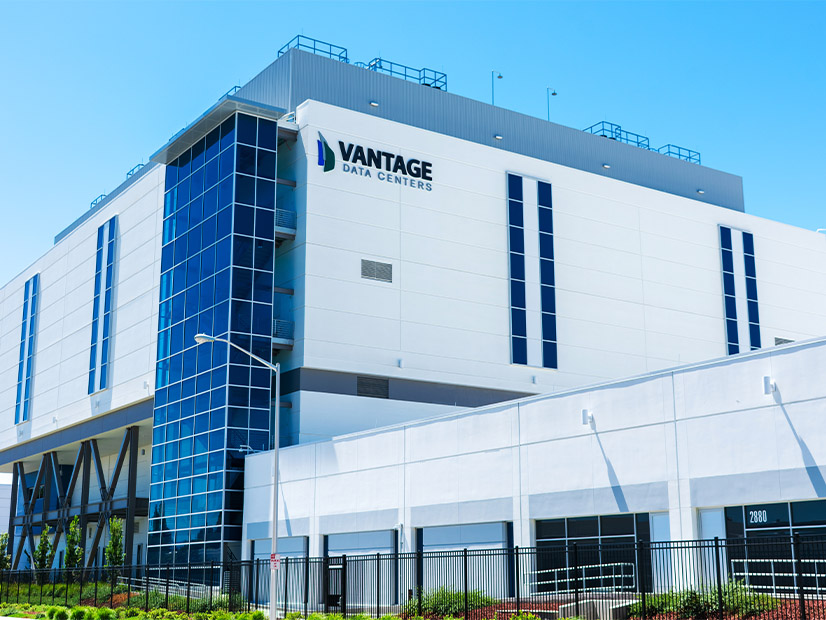
The California Public Utilities Commission (CPUC) on July 24 partially approved a new rule that will make it easier for artificial intelligence data centers and other large customers such as EV charging stations to complete transmission connection projects in Pacific Gas and Electric’s territory.
PG&E in November 2024 applied to the CPUC for approval of the new retail tariff, Electric Rule 30, saying it had received 40 transmission connection applications since 2023. These new applications have increased PG&E’s retail customer transmission interconnection demand by more than 3,000%, utility representatives said.
“Given the unprecedented number of pending transmission-level service connection applications received between 2023 and 2024 that are awaiting negotiations with PG&E for retail service at transmission-level interconnection, it is reasonable to consider an interim implementation of Electric Rule 30,” the CPUC said in its decision, which temporarily approves the rule for transmission customers willing to foot the costs for needed upgrades ahead of a final decision by the agency (24-11-007).
The rule will allow transmission customers who provide advance payments and voluntarily commit to prefunding up to 100% of their needed network upgrades to bypass previously required procedures, speeding up their interconnection times.
In its application to the CPUC, PG&E contended that, without the new tariff, it must engage in lengthy one-on-one negotiations with those customers, often leading to “non-typical/exceptional” case filings that require the time and resources of the utility, the customer, the commission and other stakeholders.
The CPUC historically has required PG&E to complete an advice letter and case filing process for large transmission connection projects.
PG&E said the new rule would eliminate those negotiations, standardize the process and provide faster service for large load customers, while providing rate benefits and lower monthly bills for existing customers.
“This decision allows for interim implementation [of Electric Rule 30] for transmission-level customers who provide advance or actual cost payments and voluntarily prefund up to 100% of specific transmission network upgrades,” CPUC Administrative Law Judge Manisha Lakhanpal said in a June proposed decision recommending the agency approve the rule. “The decision requires new transmission-level customers seeking retail services to be responsible for the initial costs of all transmission facilities, rather than those costs being borne by ratepayers.”
The new rule applies to large transmission customers sized 50-230 kV and the following types of transmission facilities:
-
- Type 1: Transmission Service Facilities
- Type 2: Transmission Interconnection Upgrades
- Type 3: Transmission Interconnection Network Upgrades
- Type 4: Transmission Network Upgrades
Eligible transmission customers must provide advances and cost payments for Type 1-3 facilities and a 100% pre-funded loan for Type 4 facilities, the decision says.
The decision deferred PG&E’s request for refunds on Type 1-3 facilities; repayment of pre-funded loans and interest provisions; and repayment of loans for Type 4 facilities. A decision on these matters will be included in the CPUC’s final decision.
PG&E had said if the CPUC denied its application, pending connection applications regarding service requests would not be directly affected.
Cal Advocates, The Utility Reform Network (TURN) and the Joint Community Choice Aggregation group opposed the decision, saying PG&E’s proposal is “unjustified, premature and rushes the procedure without fully evaluating the impact on ratepayers.”
PG&E shareholders, rather than ratepayers, should be responsible for Electric Rule 30 costs because PG&E has not substantiated prospective benefits, Cal Advocates, a public agency, said about the decision.
TURN said the massive size of the data center load “increases the likelihood of causing or accelerating the need for expensive transmission system upgrades, which would be recovered primarily from other customers under PG&E’s proposal.” About 70% of the transmission-level service connection applications are data center load, the decision says.
The CPUC rebuffed the consumer groups’ concerns but agreed the cost implications of the new Electric Rule 30 are unknown.
Robert Mullin contributed to this article.