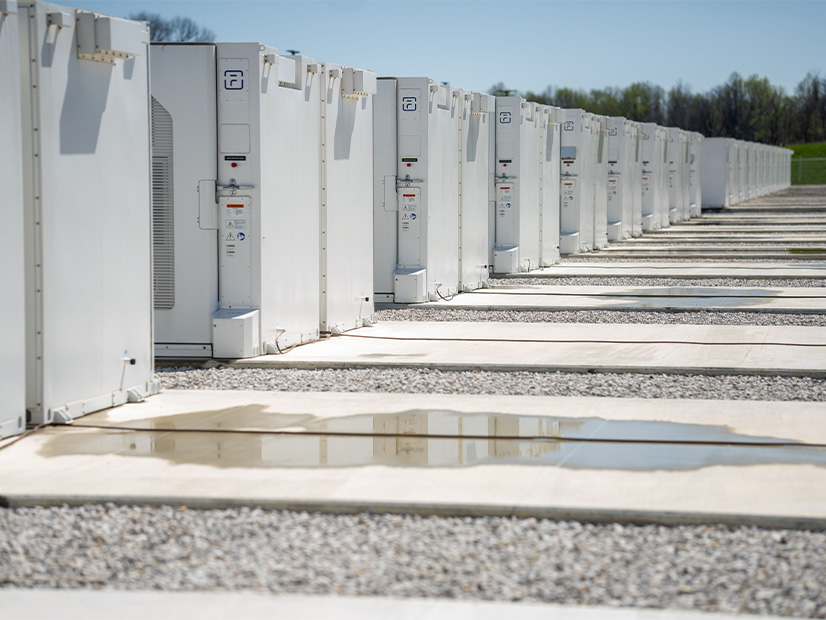
A new report shows the MISO footprint could ring up $27 billion in additional system costs through 2050 if it and members miss the boat on developing new gigawatts of battery storage.
The report, from Austin, Texas-based Aurora Energy Research and commissioned by American Clean Power Association, concluded that without a widespread deployment of battery storage in the Midwest, MISO risks higher costs, less robust reliability and a more drawn-out transition to clean energy.
Aurora said an 11-GW deployment of new battery storage in the Midwest and Central U.S. by 2035 could save consumers several billion dollars in energy costs and fortify reliable operations.
Aurora’s modeling showed that without battery storage, MISO’s peak energy prices would climb $159/MWh higher during the times of highest demand by 2035, leading to an excess of $4.5 billion spent over 10 years. It estimated MISO would rely heavily on gas peaker plants to meet a 130-GW demand by then, adding an additional $493 million in energy prices and raising the average cost of peaker-generated electricity by $1.75/MWh. The report concluded more storage resources could slash evening energy price spikes by more than 60% between now and 2035.
Aurora used a “no battery” scenario for comparison purposes, where it anticipated that only 250 MW worth of battery storage is online in the footprint by 2027, followed by a standstill in battery development thereafter. The research firm assumed natural gas prices would rise to about the $5/MMBtu mark by 2035. It also assumed the extension of production and investment tax credits and introduction of an investment tax credit for battery storage.
Aurora said the more than $4.5 billion that batteries could save in energy costs by 2035 could reach more than $25 billion by 2050. It said its long-term modeling showed $27 billion in savings versus the no battery scenario, with savings originating from lowered wholesale prices on peak and smaller system costs through the flexibility that batteries can provide.
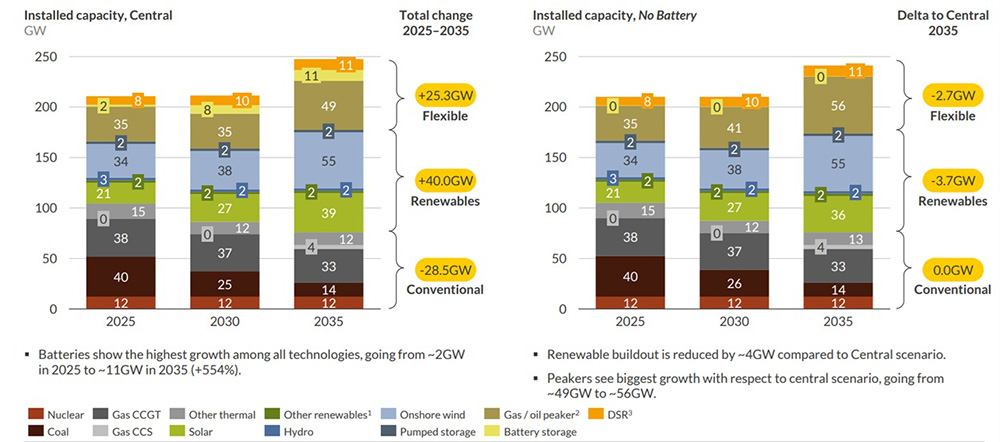
Without more battery assistance soon, the report projected that MISO’s wind and solar generation could be 8 TWh lower by 2035. Aurora anticipated a spike in the RTO’s ancillary service costs, with regulating reserve prices potentially increasing 179%.
MISO has nearly 1 GW of storage online and registered and has about 70 GW of battery capacity in its generator interconnection queue. More than 25 GW of proposed battery storage projects lined up to connect to the system in 2024 alone. Historically, only about 20% of generation proposals ever make it to interconnection agreements in MISO.
The planning scenario that MISO based its nearly $22 billion long-range transmission portfolio on in 2024 assumed 20 GW of new four-hour lithium-ion batteries by 2024.
“There are hundreds of energy storage projects in the MISO project queue, working through their lengthy interconnection and permitting process. These projects represent billions of dollars in economic investment, thousands of jobs and billions of dollars in energy cost savings,” the American Clean Power Association said, urging policymakers to act now to help deploy projects.
“As power demand surges, battery storage is one of the fastest and most effective ways to strengthen reliability and lower electricity bills,” Noah Roberts, American Clean Power’s vice president of energy storage, said in a press release. “Grid batteries deliver massive cost savings for families and businesses, while ensuring that the grid delivers power when it’s needed most. With more than $25 billion in energy savings at stake, this is a generational opportunity for the Midwest to secure a more reliable and affordable energy future.”
At a July 30 MISO stakeholder workshop to discuss reliability, Clean Grid Alliance’s David Sapper said he hoped MISO could “do better in terms of fostering” battery storage.