Dominion Energy reported earnings of $760 million for the second quarter as executives reported continued growth in data center developments in its territory and continued progress on its Coastal Virginia Offshore Wind (CVOW) project.
“We’re continuing to see strong sales in our service areas, driven by continued data center expansion and economic growth,” CFO Steven Ridge told analysts on an Aug. 1 earnings call. “Notably, nine of our top 10 all-time peak days in Virginia have occurred this year, including six in the last six weeks, and our all-time peak in South Carolina was set just a few days ago.”
Dominion will release its standard disclosures on data centers later in 2025, which will show continued growth in its contract backlog. Interest in new data centers is as robust as the utility has ever seen, Ridge said.
The CVOW project is 60% complete, is poised to begin delivering electricity to customers in January 2026 and will be completed later in 2026, CEO Robert Blue said on the call. Construction has continued steadily since the first quarter earnings call, despite tariff uncertainty. (See Coastal Virginia Offshore Wind Sees Costs Increase from Trump Tariffs.)
“It represents the fastest and most economical way to deliver almost 3 GW of electricity to Virginia’s grid to support America’s AI and cyber pre-eminence in the largest data center market in the world, support U.S. shipbuilding including Huntington Ingalls (the largest naval ship building company in the United States and one of our largest customers), and support some of the country’s largest and most important military and defense installations,” Blue said.
The project has widespread support among political and economic interests in Virginia and has been fully permitted and approved by federal and state agencies, he added.
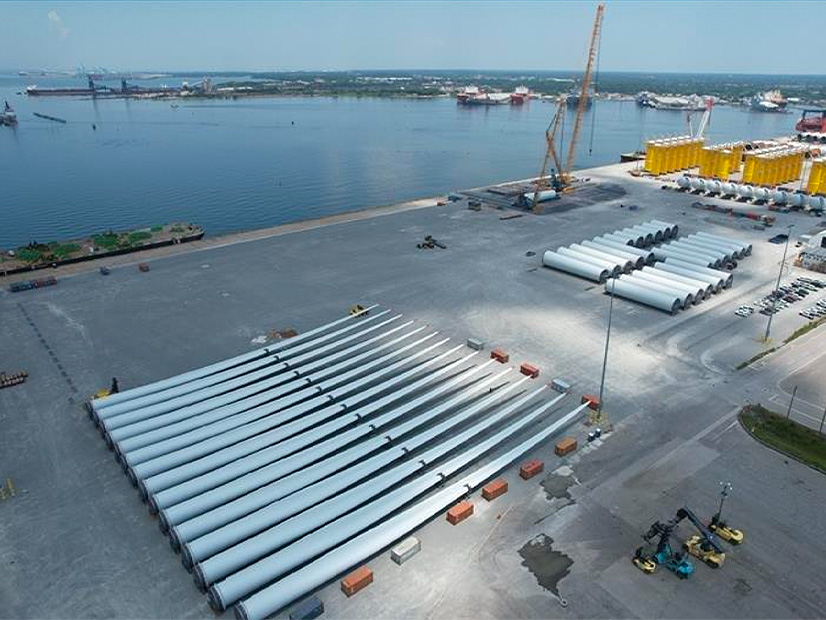
As of the call, Dominion had installed 134 out of 176 monopiles and in July set a record for installing 26 in a month. There are just 42 left and three months of the installation season remaining. Most of the monopiles already have been delivered to the staging area for the project in Portsmouth, Va., with two more barge loads of deliveries needed.
“Commissioning of the first offshore substation, which was installed on March 10, is now complete,” Blue said. “The remaining two offshore substations are 99% and 70% complete, respectively, and on track to be delivered this fall, with installation to be completed by Q1 2026, as planned.”
Siemens Gamesa is producing turbines for the project with sections for 58 full towers completed and 12 already delivered to Portsmouth. Unlike the monopiles, turbines can be installed at any point during the year, Blue said.
The Jones Act-compliant vessel, Charybdis, is nearing completion, with a few final tests required before it can start sea trials that will last a couple of weeks. Once those trials are over, it will take 10 days to get to Virginia from Brownsville, Texas.
“We will install our first turbine in September, which is in line with our original schedule,” Blue said. “We had expected the vessel to complete sea trials last month, which would have enabled us to begin turbine installation ahead of schedule. However, the electric cable terminations that connect much of the ship’s internal communication technology simply took longer to complete than expected. That work has now been complete for several days.”
The vessel is being delivered a little behind schedule, but its completion in the coming weeks will be a major milestone for CVOW, Blue said.
Tariffs are impacting CVOW, which is being built with imported material from the E.U. and Mexico.
“We estimate that the total impact of tariffs as they exist today, through project completion at the end of 2026, would be $506 million,” Blue said. “This is slightly lower relative to our disclosure last quarter, despite a doubling of the steel tariff due to both working with vendors to identify cost mitigation strategies as well as completing our analysis of the final trade regulations and appendices.”
That number could grow as the Trump administration reportedly is considering 5% higher tariffs for both the EU and Mexico, which would raise project costs by an additional $134 million, though Blue cautioned that was just an estimate and tariffs might not go up at all.