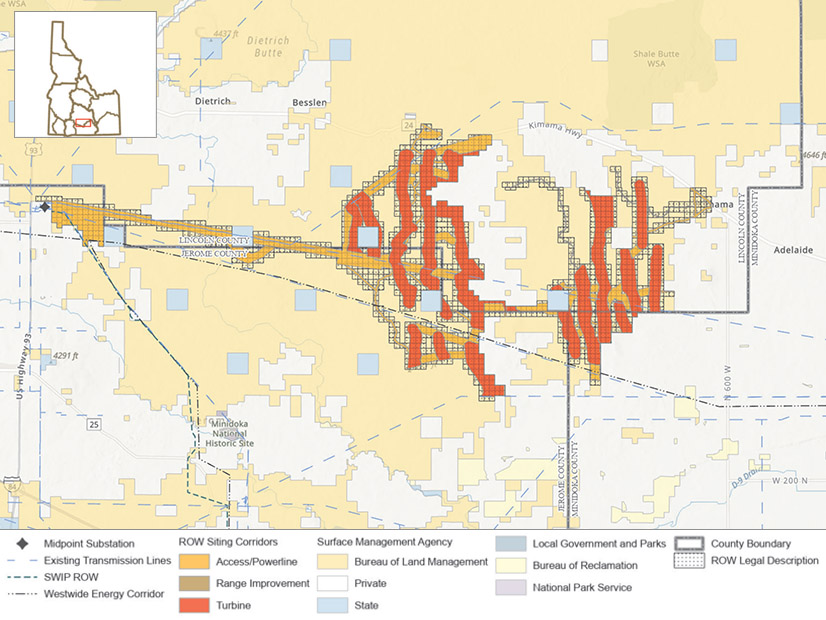
The Department of the Interior is moving to cancel the Lava Ridge Wind Project, a gigawatt-scale wind farm proposed on thousands of acres of federal land in Idaho.
The proposal had long been the target of criticism within the state. President Donald Trump ordered all development halted in a Day One memorandum Jan. 20 so Interior could review the record of decision issued six weeks earlier.
On Aug. 6, Interior announced the review had uncovered crucial legal deficiencies in the “reckless” and “thoughtless” approval issued under lame-duck President Joe Biden.
“This decisive action defends the American taxpayer, safeguards our land and averts what would have been one of the largest, most irresponsible wind projects in the nation,” Interior Secretary Doug Burgum said.
Lava Ridge developer Magic Valley Wind and its corporate parent, LS Power, did not respond to requests for comment for this report.
Interior’s decision is the latest in a series of directives and policy actions by Trump and his cabinet agencies to thwart renewable energy development, one of Biden’s signature initiatives. (See Feds Pile on More Barriers to Wind and Solar and Trump Administration Takes Another Swing at Wind Power.)
Trump instead is seeking to maximize fossil fuel use. A reminder of this came later Aug. 6, when Interior announced it had advanced the first expedited coal lease under provisions of the One Big Beautiful Bill Act. A day earlier, Interior announced it had approved the second-largest coal mine expansion since Trump returned to office — a move intended to enable extraction of 33 million tons of coal at a Montana mine.
Lava Ridge was proposed in 2021 with up to 400 wind turbines disturbing 9,114 acres. During the Bureau of Land Management review process, it was reduced to 231 turbines and 992 acres disturbed, with the overall footprint reduced to 38,535 acres. BLM issued a favorable record of decision Dec. 5, 2024.
Nameplate capacity was to be at least 1,000 MW, which would nearly double the roughly 1,100 MW of wind power installed statewide in 2024. Idaho’s largest existing wind farm in 2024 was rated at only 160 MW, according to the U.S. Energy Information Administration.
Residents and elected leaders of the solidly Republican state mounted a vocal campaign against the plan on the grounds that it would be ugly; would be too close to the Minidoka National Historic Site, where civilian Americans of Japanese descent were held during World War II; and would send its electricity to California.
Idaho’s congressional delegation and governor, Republicans all, had fought the Lava Ridge proposal all the way through to BLM approval and then continued after. On Aug. 6, they took a victory lap.
“I made a promise to Idahoans that I would not rest until the Lava Ridge Wind Energy Project was terminated,” U.S. Sen. Jim Risch said. “Today, President Trump and I delivered on that promise.”
On X, Gov. Brad Little praised Trump and Burgum: “On behalf of all Idahoans — thank you for your leadership.”
BLM said in December it had worked to reduce the impacts of the original proposal on wildlife, cultural resources, local aviation, ranchers who use public land and adjacent private landowners.
Minidoka, where more than 13,000 Japanese Americans were interned, had become a bit of a rallying point for opponents, as alternate iterations of the Lava Ridge plan would have put turbines much closer than the nine miles in the final version.
Turbines already spin southeast and southwest of the concentration camp site — most of Idaho’s existing wind energy generation is in the Snake River Valley.
California Impact?
It is unclear what impact the cancellation of Lava Ridge will have on California’s ambitious plans to reduce its electricity emissions, which include extensively tapping output from wind resources in the inland West. As part of that effort, the California Public Utilities Commission’s (CPUC) integrated resource planning portfolio calls for the state to procure more than 1,000 MW of wind generation from Idaho.
Unclear also is the effect on another LS Power project, the Southwest Intertie Project-North (SWIP-North), a 285-mile, 500-kV transmission line being developed in northern Nevada by the company’s Great Basin Transmission subsidiary.
Last year, the CAISO Board of Governors finalized approval of a proposal to include SWIP-North as a CAISO participating transmission owner (PTO) after ISO planners determined the project would be the only line completed in time to help deliver Idaho wind to California’s load-serving entities by 2027.
While development of SWIP-North has not been tied to any single generation project, most of Lava Ridge’s output was expected to be exported on the southbound segment of the line. In response to past stakeholder concerns about the line’s dependence on Lava Ridge, CAISO pointed out that “CPUC portfolios for out-of-state wind resources in Idaho are based upon generic wind resources and not specific to any one specific facility such as Lava Ridge.”
Sources have told RTO Insider that the CAISO PTO designation for SWIP-North likely influenced Idaho Power’s leaning in favor of joining the CAISO Extended Day-Ahead Market (EDAM) rather than SPP’s Markets+. But even with the Lava Ridge cancellation, Idaho Power’s interest in SWIP-N would appear to be secure, given that the utility plans to use the line to import power from the Southwest and not for exports.
“The SWIP-North project is the final segment of the larger SWIP project, which began decades ago. The urgency of completing the project has grown as growing energy demand across the Western United States strains the grid,” Idaho Power said on its website.