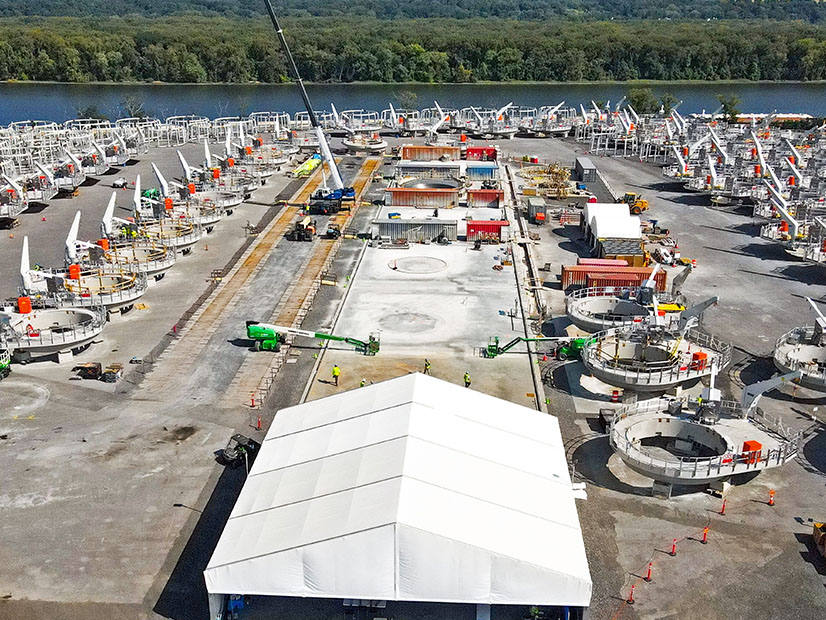
Ørsted is moving to raise as much as $9.33 billion on its own to finish building the Sunrise Wind project off the New York coast.
The company said Aug. 11 the money will be sought from existing shareholders and that it must take this step because it has been unable to reach a financing deal and secure an equity partner under acceptable terms in the hostile environment President Donald Trump has created for U.S. offshore wind development.
Ørsted CEO Rasmus Errboe said negotiations with multiple potential partners were progressing well — until April 16, when the Trump administration slapped a stop-work order on Empire Wind 1, an Equinor project off the New York coast, and did not allow construction to resume for more than a month.
This “extraordinary and unprecedented development” significantly increased the perceived risk in the U.S. offshore wind sector, and those potential partners raised their requirements to a level untenable for Ørsted — so Ørsted must go it alone and fund the entire cost of Sunrise Wind on its balance sheet.
With the “vast majority” of the expenditures already committed, there is far more value in moving ahead with the project than in abandoning it, Errboe said. Ørsted still expects Sunrise to produce a lifecycle internal rate of return in the mid-single digits.
So it is seeking $6.22 billion to cover financing and capital costs, plus about $3.11 billion to strengthen the company’s capital structure and give it needed financial flexibility.
The plan is to offer a rights issue — a discounted sale of additional shares to existing shareholders — in October, if authorized at an extraordinary general meeting in September. The Danish state, which owns a 50.1% share majority of the company, has given its full support, Errboe said, and the rights issue would be fully underwritten by Morgan Stanley.
Ørsted’s stock tanked on the news, shedding nearly 30% of its value.
Aside from the U.S. regulatory environment, and aside from the resulting financial squeeze, the largest western offshore wind developer presented a positive state of affairs with its first-half financial results.
The two projects Ørsted still is actively developing in U.S. waters are on schedule.
Revolution Wind, a 704-MW project that will send power to Connecticut and Rhode Island, is roughly 80% complete, with all turbine foundations and nearly 70% of the turbines installed. Commercial operation is targeted for the second half of 2026.
Sunrise, a 924-MW project, is targeted to begin feeding the New York grid starting in the second half of 2027. Onshore construction is nearly complete, and more than a dozen turbine foundations have been installed.
Sunrise is in a much better position than New Jersey’s Ocean Wind or Maryland’s Skipjack Wind, which Ørsted canceled and shelved, respectively. But Sunrise has had a tortuous path nonetheless.
It dates to July 2013, when the federal government auctioned off rights to develop wind power on OCS-A 0487, a patch of the Outer Continental Shelf south of Fall River, Mass., and east of Montauk, N.Y.
Ørsted and then-partner Eversource won an offtake contract from New York in the summer of 2019 for what was then called Sunrise Wind 1, but rising costs in 2022 and 2023 made the terms untenable.
In 2024, New York renegotiated a much more expensive contract for Sunrise Wind — $146/MWh — and Ørsted bought out Eversource’s ownership stake in the project for $152 million.
Later in 2024, Donald Trump was elected to a second term as president, and hours after his inauguration in January 2025, he began to fulfill a campaign-trail promise to thwart offshore wind development. Multiple policy changes announced since then have created new setbacks and hurdles for the already-struggling industry.
Equinor recently recorded a nearly $1 billion impairment it attributed to President Trump, but so far, no other stop-work orders have been issued for the five offshore wind farms under construction and one in full operation in U.S. waters. The Trump administration’s moves have served mainly to block other wind farm plans or concepts from advancing.
But during Ørsted’s Aug. 11 conference call, an analyst asked if the administration might not shut down Revolution or Sunrise the way it halted work on Empire. He asked: “Are you 100% comfortable the U.S. administration cannot block either of those projects?”
“We have no indication of a similar decision or stop-work order against our northeast U.S. program, and I’m not going to speculate about potential regulatory changes that are outside our control,” Errboe said.
Ørsted has followed all state and federal procedures with both projects, he added, “and we remain 100% committed to the continued construction of our program.”