Clean energy advocates are urging California lawmakers to restore funding to a fast-growing distributed energy program that can serve as a peaker plant alternative and showed its ability to support the grid during a test run.
Funding for the Demand Side Grid Support (DSGS) program is expected to run out this year and an estimated $75 million is needed to keep it going in 2026, representatives of more than 30 clean energy groups and companies said in a letter to state lawmakers.
The letter also calls for $50 million for the Distributed Electricity Backup Assets (DEBA) program, which incentivizes the construction of cleaner and more efficient distributed energy assets to be on-call for emergencies. DSGS and DEBA are California Energy Commission programs.
“At a time when affordability and reliability are under such strain, cutting these programs would take away proven cost-saving solutions just as they are most needed,” the letter stated.
The Brattle Group recently completed an analysis of DSGS, focusing on the program’s “Option 3,” in which battery owners agree to make their stored energy available to the grid during energy emergency alerts or when day-ahead prices go over $200/MWh. Participants sign up through DSGS providers, which include companies such as solar-and-storage providers Sunrun and Tesla Energy.
Participants are compensated based on the power they share with the grid.
“It’s not a subsidy. It’s not a giveaway or anything like that,” Edson Perez, a senior principal at Advanced Energy United, told RTO Insider. Perez is one of the authors of the letter to lawmakers.
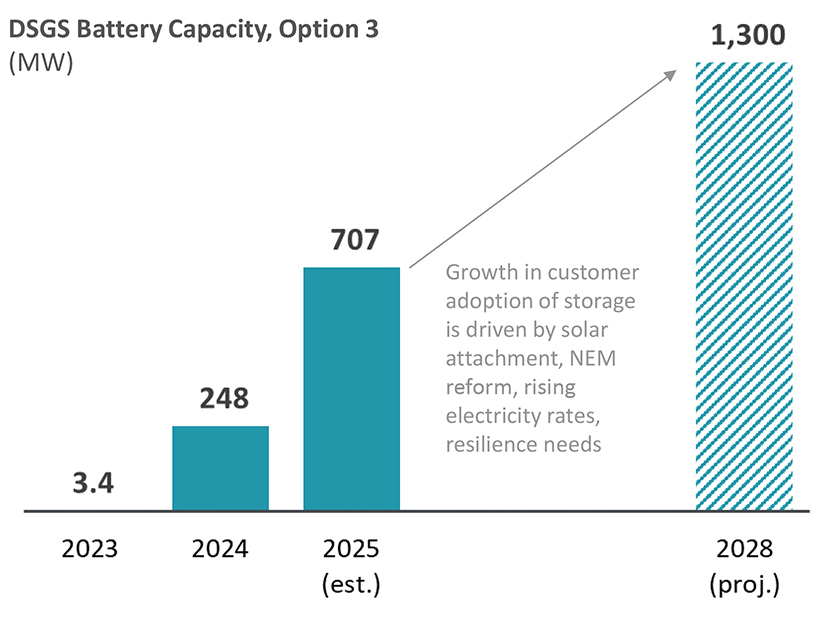
The Brattle study, which was prepared for Sunrun and Tesla Energy, estimates that DSGS Option 3 will reach 700 MW of nameplate battery capacity in 2025 and grow further to 1,300 MW by 2028.
Besides boosting the grid, DSGS can save money. Brattle projected program net cost savings of $28 million to $206 million from 2025 to 2028. The lower figure assumes the program provides capacity value and some energy cost savings. Program costs are mainly the payments to participating battery owners.
The higher savings scenario assumes California is paying more than $200/kW-year for emergency resources and that tariffs and supply chain issues are increasing capacity costs. In that case, DSGS would be “a significantly lower-cost alternative,” Brattle said.
The Brattle study also assessed a virtual power plant (VPP) test event July 29 involving about 100,000 residential batteries. The batteries were primarily enrolled in the DSGS program, and the two main aggregators in the test were Sunrun and Tesla Energy.
The batteries provided an average of 535 MW of support to the CAISO grid during the 7-to-9 p.m. test period. (See Home Batteries Provide 535 MW to CAISO Grid on VPP Test Day.)
“Aggregating home generation and storage produces a reliable, flexible energy resource that dispatches at the same scale as multiple peak generation plants to help meet soaring electricity demand,” Sunrun CEO Mary Powell said in a statement.
Although the governor’s proposed budget in January included money for the DSGS program, that funding disappeared in later budget revisions. Perez said those who signed the letter to key legislators would leave it up to the lawmakers to decide how to fund DSGS.
And at least one state senator has indicated his support for doing so.
Sen. Josh Becker (D), chair of the Senate Energy, Utilities and Communications Committee, discussed the DSGS program during an Aug. 19 oversight hearing on grid reliability.
“That’s a program that I think has had a great success,” Becker said. “We had a great virtual power plant success recently. We need to make sure those are funded.”