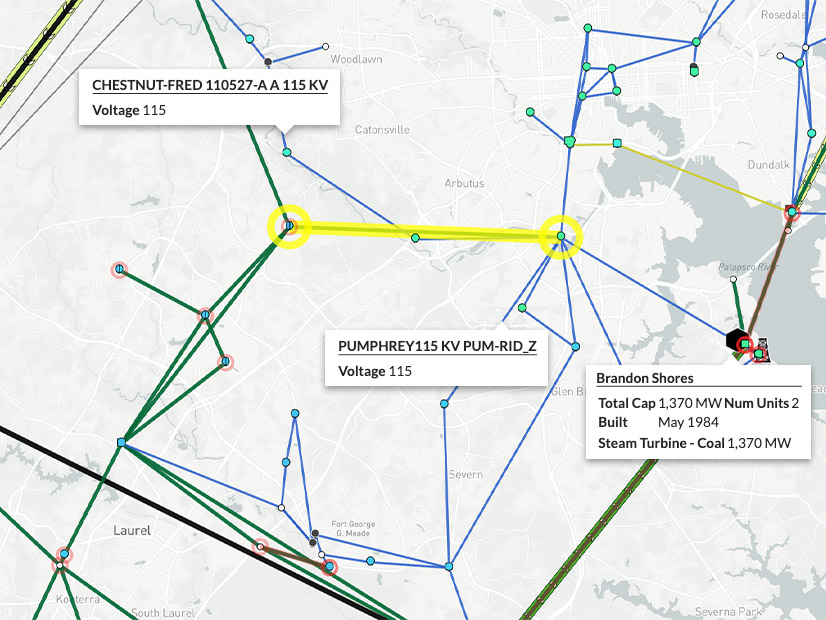
VALLEY FORGE, Pa. — An Aug. 11 load-shedding event in Baltimore was caused by equipment failure at the Brandon Shores substation, causing all breakers to open and cutting the city off from a major transmission feeder. (See PJM Initiates Load Shed in Baltimore Region After Substation Disconnect.)
Isolated from the 230-kV network passing through Brandon Shores, increasing strain was placed on the 115-kV lines running into the city until PJM issued a load-shed directive at 3:52 p.m. The load-shed directive was preceded by a voltage reduction action initiated at 2:15 p.m.
About 20 MW of load was shed for 28 minutes to mitigate an identified N-5 cascading outage risk that could have taken 1,200 MW offline, PJM Director of Operations Planning Dave Souder said at the Aug. 20 Markets and Reliability Committee meeting. He said PJM worked closely with Baltimore Gas and Electric (BGE) to identify regions where load shedding would be most valuable.
“We knew early on that we were going to have to go into emergency procedures,” Souder said.
Exelon Director of RTO Relations and Strategy Alex Stern said PJM worked extremely closely with BGE to limit the impact.
Six transmission lines intersect with the Brandon Shores substation, and two generators are tied into it: the 1,289-MW Brandon Shores and 843-MW H.A. Wagner, both owned by Talen Energy. The generators are running on reliability-must-run (RMR) agreements to maintain transmission security while network upgrades are constructed to facilitate their deactivation. (See FERC Approves $180M Annually for RMR Deals with Brandon Shores and Wagner Plants.)
Stakeholders questioned why the emergency procedures page and PJM Now mobile app incorrectly showed that the load-shed directive initiated a performance assessment interval (PAI), which would place capacity resources at risk of penalties if they failed to underperform.
PJM Senior Vice President of Operations Mike Bryson said staff took a broad stance on sending notifications that a PAI had been initiated to allay stakeholder concerns that capacity resources could be penalized without owners realizing an event had begun. Based on feedback since the Baltimore load shed, PJM is open to reconsidering how it sends those notifications and can add a discussion to the Sept. 11 Operating Committee agenda.
Souder added that the localized nature of the incident and its basis in a transmission emergency, rather than generation, precluded it from being a PAI. Responding to questions of whether a PAI would have been declared if load shedding were initiated across the BGE zone, he said they are declared for reserve zones, not transmission owner (TO) zones or subzones.
Bruce Campbell, of Campbell Energy Advisors, said the distinction between reserve and TO zones during emergency operations may not be widely known across stakeholders and may warrant further education. He added that there is only one reserve zone, which covers the full RTO, and one reserve subzone, Mid-Atlantic Dominion.
Several questions were raised about whether the two Talen generators were on outage during the event or if their availability contributed to the emergency. Souder said PJM does not publicly post information about generation outages and reiterated that the substation itself was unavailable. All available generation in the area was dispatched, but Brandon Shores was disconnected from the grid by the substation outage, and Wagner’s start-up time prevented it from coming online until the next day.