A state with plenty of brownfields and lots of ambition for clean energy is having trouble bringing the two together.
New York’s Build-Ready program was launched in October 2020 to develop a roster of turn-key plans that would place renewable generation on sites such as landfills, abandoned industrial sites and dormant electric-generating facilities.
More than four years of effort by state personnel at a cost of $15.5 million identified 480 potential sites for such projects through June 30. But for assorted reasons, all 480 were found to be unworkable.
The one success so far was the auction of a 12-MW solar project on a tailings pile at a defunct iron mine, and even that had to be scaled back from 20 MW to avoid the need for expensive grid upgrades. (See NY Sells First Build-Ready Site for Renewables.)
Requests for proposals are out for three more solar projects totaling 15 MW — two on a former municipal landfill and one adjacent to the infamous Love Canal toxic waste cleanup site.
The New York State Energy Research and Development Authority offered the details about Build-Ready in an annual progress report submitted to the Public Service Commission on Aug. 28.
NYSERDA told NetZero Insider that Build-Ready is an inherently challenging prospect — preparing what may be a blighted location for a clean energy system that private developers would not build on their own due to cost and risk.
“The fact that the Build-Ready program screened 480 sites shows the due diligence needed to find the right site for a successful project,” a spokesperson said.
NYSERDA said, however, that its upcoming five-year report will provide a more complete overview of the program and offer recommendations for moving it forward. That report is due Oct. 1.
Build-Ready began as part of the Accelerated Renewable Energy Growth and Community Benefit Act of April 2020.
In October 2020, it became one of the many initiatives launched from the wide-ranging proceeding the PSC initiated in 2015 to implement a large-scale renewable program and a clean energy standard (Case 15-E-0302).
Build-Ready calls for NYSERDA to look for potentially suitable sites; assess their suitability; secure rights to the site; evaluate environmental needs and interconnection options for a renewable generation project; design a project; seek necessary permits; and then offer the package to the private sector in a competitive sale, bundled with a long-term contract for renewable energy certificates.
Each of these steps can take months or years on their own — the final package is about as close to “build-ready” as one could hope for.
But the process has reached completion exactly once so far, at the defunct iron mine in a remote wilderness area; $56.3 million of the $71.8 million allocated to Build-Ready remains unspent.
The 480 rejections break down to:
-
- 166 for insufficient buildable land area;
- 91 for lack of landowner cooperation;
- 64 because interconnection options were not viable;
- 51 due to agriculture activity, which since 2024 has been ranked as a higher priority than Build-Ready;
- 46 because of commercial development potential, also a higher priority;
- 40 to avoid competition with a potential private-sector renewable developer; and
- 22 due to wetlands or other significant environmental constraints on site.
NYSERDA’s report goes into detail on several of the sites that reached advanced stages of review — four landfills, an airport and a huge post-industrial scar sprawling from the city of Utica into a neighboring town.
One by one, they all got crossed off the list.
The Utica site stands out as a lost chance to repurpose a site with a tortured history.
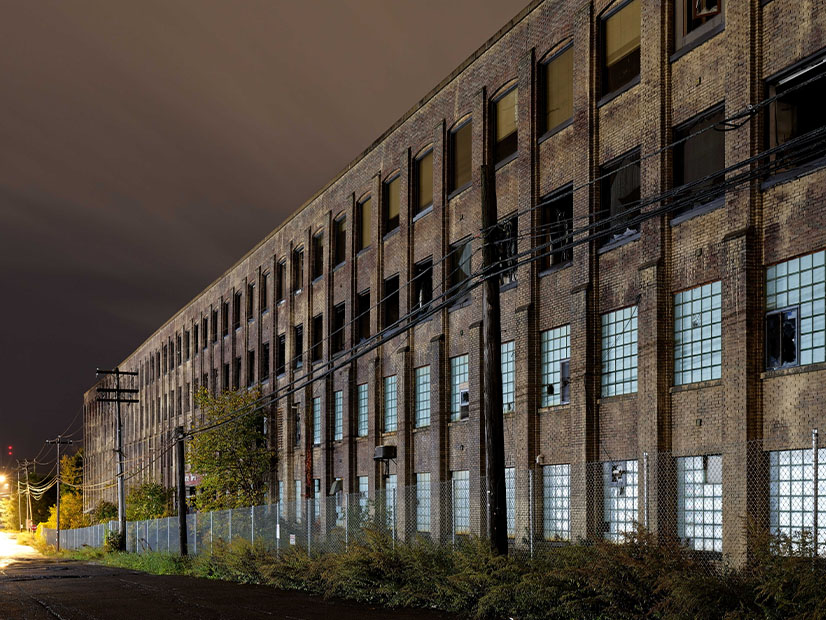
Thousands once worked there, cranking out guns and later computer parts in one of the massive brick-and-concrete industrial complexes that once dotted upstate New York. The factory died, was reborn as a retail outlet complex, lost its luster, was converted to a mixed-use office and commercial facility, died again, was partly demolished and partly left to rot, was gutted in a massive fire, stood as a skeleton for two years, then finally was demolished in 2022 by the EPA, which removed nearly 30,000 tons of debris, asbestos and drums of hazardous substances.
Build-Ready would have placed batteries on the concrete foundations left on site, and there would be few residents in the surrounding industrial zone to be worried about them.
But during its assessment, NYSERDA determined that the amount of site preparation and electrical upgrades that would be needed for a 20-MW standalone BESS — including a three-breaker ring bus — would be so expensive as to make the project unviable.
There is no mention in the report of another factor that may make future projects unviable: President Donald Trump and his Republican allies in Congress.