Arizona utility Salt River Project (SRP) and Google are partnering to study the real-world performance of non-lithium-ion, long-duration energy storage (LDES) technologies, the parties announced Sept. 8.
Google will fund some of the costs for LDES pilot projects developed for SRP’s grid, according to a release. Google will crunch numbers on the pilot projects’ performance and help with the research and testing plans.
The goal is to help the emerging storage technologies scale more rapidly.
“We believe that long-duration energy storage will play an essential role in meeting SRP’s sustainability goals and ensuring grid reliability,” Chico Hunter, SRP manager of innovation and development, said in a statement. “This first-of-its kind research collaboration with Google will bring additional insight into the viability of these new technologies that could move them to maturity more quickly.”
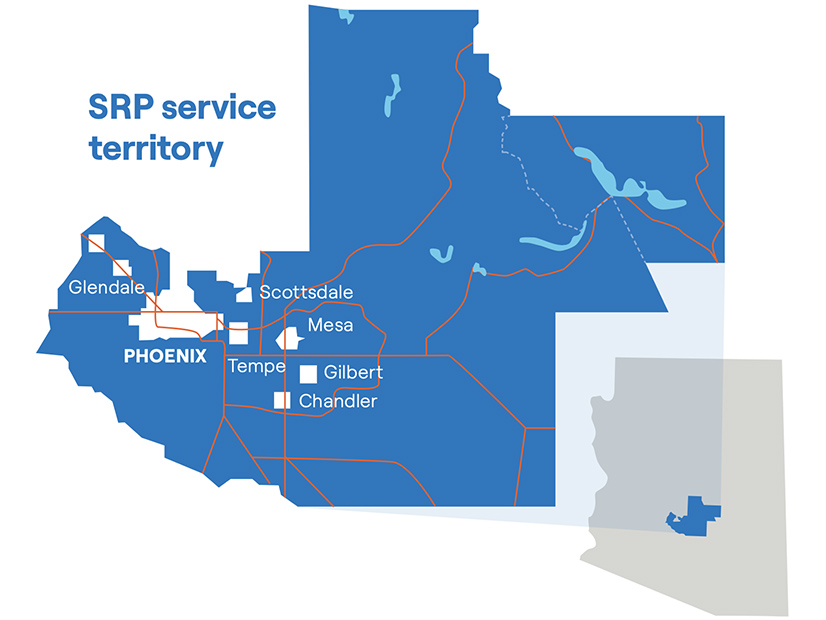
SRP serves about 1.1 million customers in the greater Phoenix area. The utility now has about 1,300 MW of energy storage, including 1,100 MW of battery storage at eight facilities. Another 200 MW is pumped hydro storage.
The SRP-Google collaboration may include multiple LDES projects. SRP noted that it issued requests for proposals in 2022 and 2024 for LDES demonstration projects.
“Long-duration energy storage is a key technology in the portfolio of advanced energy solutions that we want to bring to market faster — to unlock stronger, cleaner, more resilient grids,” Lucia Tian, Google’s head of advanced energy technologies, said in a statement.
Although the type of LDES technology to be deployed in the project isn’t yet known, Google announced in July a partnership with Energy Dome, which makes a carbon-dioxide-based energy storage system.
The system uses renewable energy when it’s abundant to compress CO₂ gas into a liquid. When the grid needs more power, the liquid CO₂ expands back into a hot gas under pressure, which spins a turbine. The energy generation lasts for eight to 24 hours.
Google said it will support commercial deployments of Energy Dome’s technology globally as well as invest in the company.
SRP has committed to reaching net-zero carbon emissions by 2050. Google wants to run its global data centers and offices on carbon-free energy and achieve net-zero emissions across its operations and value chain.
Google and SRP have partnered on clean energy resources to power Google’s future data center in Mesa, Ariz. The resources include the Sonoran Solar Energy Center, a 260-MW solar facility with 1 GWh of battery storage; Storey Energy Center, an 88-MW solar and battery storage system; and Babbitt Ranch Energy Center, a 161-MW wind farm.
Meanwhile, SRP wants to at least double the number of generating resources on its power system in the next decade to maintain reliability and resilience.
On two consecutive days in August, SRP set new records for system peak load: 8,429 MW on Aug. 6, followed by 8,542 MW on Aug. 7. High temperatures hit 116 and 118 degrees Fahrenheit on those days; peak energy demand was between 3 and 4 p.m.
SRP’s previous record peak of 8,361 MW was set on July 9.