PORTLAND, Ore. — When former SPP COO Carl Monroe hands out his business card these days, it reads, “Carl Monroe, Principal, Munro Advisors.”
“Munro?” Is that a misspelling?
“It’s the traditional way of spelling Monroe. They were Irish,” Monroe says of his ancestors. “‘Munro’ means they’re from the River Roe in Northern Ireland.”
The Munros were also “tenacious fighters” during the 1400s and into the 1600s, centuries punctuated by the Hundred Years’ War, King Henry VIII’s reign, the English Civil War and the beginning of the Jacobite Risings.
“They fought so ferociously that the Scots hired them as mercenaries to fight all the Scottish clans,” Monroe says. “Eventually, they got enough esteem that they are one of the clans that are considered [part of] Scotland, or Scotch-Irish.”
The Munros were so highly respected that the Scots gifted them land for their own castle, Monroe says.
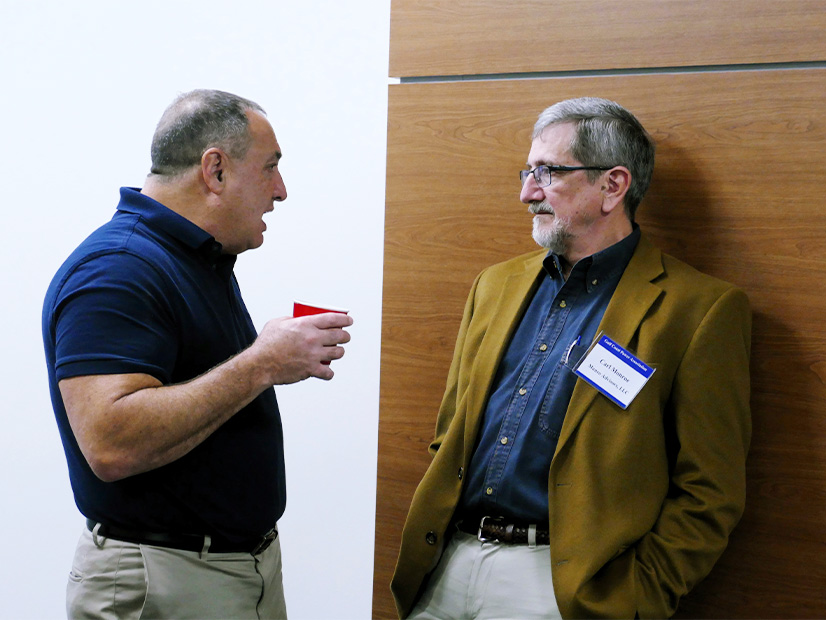
When the story is related to an SPP stakeholder, who had just greeted Monroe on the sidelines of an industry conference, he says, “Had I known that he was so lethal, I would have given him a wider berth.”
Of course, unlike his ancestors, Monroe is anything but “lethal.”
A veteran of more than 45 years in the industry that first included stints with Ameren and Entergy, Monroe spent 15 of his final 22 years with SPP as its COO. That made him responsible for grid operations across the RTO’s 14-state balancing authority area, a footprint that grew from eight states during his tenure with the addition of Nebraska’s public power entities and the Integrated System in the Dakotas.
Independent transmission developer Grid United, for whom Monroe now serves as one of three members of its Advisory Board, credits him for being “instrumental” in expanding SPP’s footprint by 20% and adding $1.5 billion of transactions in the real-time energy market.
“Carl has helped to shepherd us through tremendous change and growth. We just wouldn’t be where we are today without his leadership,” SPP CEO Nick Brown said when Monroe announced his retirement in 2019. (See SPP COO Monroe to Retire in Early 2020.)
The footprint is expanding once again. The RTO’s expansion into the Western Interconnection will be live in April 2026. In 2027, SPP Markets+, a day-ahead service offering that includes real-time commitment and dispatch, will begin operations. It will replace the grid operator’s Western Energy Imbalance Service market, which it has administered on a contract basis since 2021.
SPP has also been serving as a reliability coordinator for primarily future Markets+ participants since 2019, and it was chosen by CAISO and five utilities nearly 10 years ago to administer the Western Interconnection Unscheduled Flow Mitigation Plan, which manages the use of certain controllable devices to mitigate congestion along transmission lines. The RTO was also selected as the program operator for the Western Power Pool’s six-year-old Western Resource Adequacy Program (WRAP).
Much of that is credited toward the “instrumental” Monroe and his outreach for more than a decade to Western Interconnection entities. He led SPP’s effort to add the Mountain West Transmission Group, a Front Range initiative that fell apart after Xcel Energy subsidiary Public Service Company of Colorado pulled out and led to a broader Western Market Exploratory Group that studied the benefits of a regional market. Years later, PSCo is one of seven entities joining Markets+ after Colorado regulators ordered the state’s utilities to join regional markets.
Jack Moore, an SPP IT engineer involved in the Markets+ development effort, spoke recently during a stakeholder meeting here. He prefaced his comments by remembering his first visit to Portland in 2010, when he accompanied Monroe to talk with the Bonneville Power Administration about “an energy market in the West.”
“So, 15 years later, here we are,” Moore said.
“That was one of the things Carl was always doing, just seeing whether there was a way that SPP could meet potential stakeholder needs,” said Jim Gonzalez, SPP’s director of seams and Western services. “As we hear opportunities for help, facilitating and collaborating, that’s one of the things SPP has always really been open to. If we have neighbors and there seem to be needs, can we help meet those needs?”
“That’s a lot of it,” Monroe says by way of agreement. He described a “paradigm shift” that has taken place with wholesale markets and the West’s growing understanding of their benefits.
“That’s why you’re seeing a lot of the development of markets out there. I think you’re starting to see that paradigm shift about having a real real-time [market] and a wholesale market that actually provides more benefits to them than trying to hold onto control of those things,” he says.
“It really gives them a way to mitigate some of the risks. … That’s why you see a whole lot of interest, but there’s some underpinnings that at least we stumbled through in the East,” Monroe adds, listing tariffs, balancing authorities, resource adequacy and “those types of things” that grid operators do. “It just means that a group of utilities can decide how to do those things together in a way that provides a benefit to the whole that is greater than the benefit each of them can provide individually.”
As an example, he points to the WRAP and utilities that got together “with SPP’s help” to understand how they could work together in a resource adequacy program.
“I was an adviser for some of that too,” he says. “Together, they could rely on each other’s resource adequacy more and ensuring that each party was upholding their portion that they had to rely on.”
“In nearly 15 years as a director at SPP, I’ve met no one with greater knowledge of markets and operations or with such ability to collaboratively address complex issues,” SPP Board of Directors Chair Larry Altenbaumer said of Monroe when he announced his retirement.
His decision just happened to coincide with the COVID-19 pandemic, making him something of a forgotten figure. He was asked what he intended to do with his spare time and whether he would go into consulting.
“I didn’t know the difference between retirement or COVID. Everybody just went home to work,” he says. “I spent some time with SPP near the end working with the West trying to help them out, first of all, just to understand what it means to work together and what benefits you get out of it, [and] beyond that, what SPP could do for them. Of course, you’re seeing some of that play out today.”
SPP gave him a contract to “do one little thing,” but when he was finished with the project, he was free to work with others. With his somewhat eponymous consulting firm, Monroe helps clients with bulk power system operations, reliability standards, wholesale energy markets, strategic planning, FERC tariffs and other issues.
“I don’t want to do things that are not interesting to me, but this industry is really interesting,” he says. “The transition that it’s going through … it’s just been fascinating to watch the industry and what the industry needs to do, but at the same time, how it’s needed within the country and what reliability means to the country itself as critical infrastructure. …
“There are things I know that I can help people with,” Monroe adds. “There were a few people that called and wanted some help and just understand SPP and our wholesale markets and stuff like that. So that’s been a lot of fun.”
Besides his work with Grid United and its HVDC projects, Monroe also has consulted with solar and hybrid storage in both interconnections.
“Some are looking at markets, and some are looking at coordinating their activities together with others for optimized operations,” he says. “But the most interesting thing, [which] gets me my 49th state to do work in, is an RTO for Alaska.”
Monroe graduated from Auburn University with a degree in electrical engineering. While at SPP, he decorated his office with a black-and-white photo from his time on The Plains. The image shows Elvis Presley’s 1974 performance on campus at the Memorial Coliseum. Monroe would direct visitors to the AV booth in the background, from where he was responsible for lighting The King.
He joined SPP from Entergy, originally being hired to manage the RTO’s growing IT department. He was elected as an officer and promoted to executive vice president and COO in 2004, where he oversaw operations, the power system’s long-term forecasting and planning, and interregional coordination.
“I believe his personal efforts, contributions and leadership were critical to the tremendous development and success of the Southwest Power Pool,” said longtime member Mike Wise, with Golden Spread Electric Cooperative.
“I’ll do what I can to help people,” Monroe says. “If I can’t help you, I’ll tell you I can’t help you. That’s fine. I’m enjoying what I do, whether I do anything or not.”
Nothing to do? Given Monroe’s history, that’s a little hard to believe.