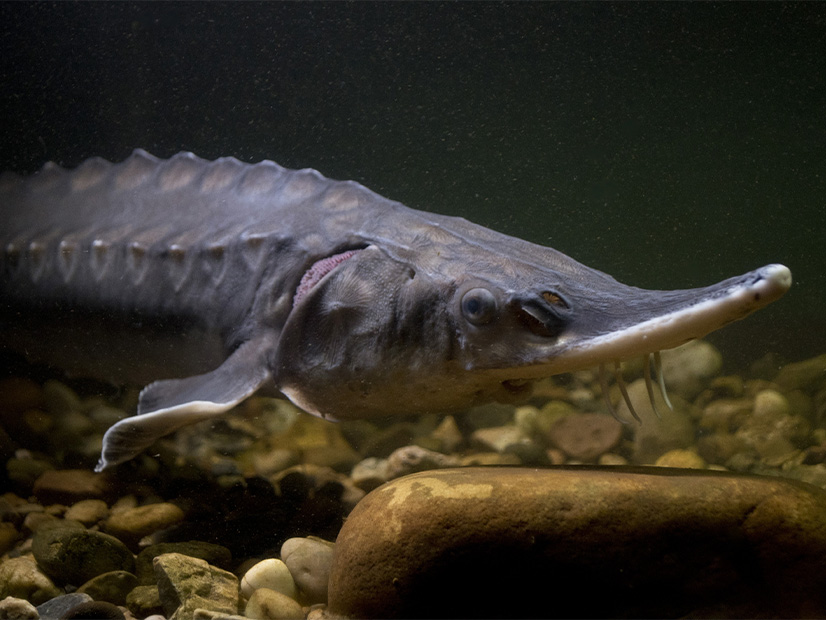
The balance between benefit and harm that some regulators try to maintain has been reset again, this time to the potential detriment of an ancient fish slurping through the seabed off the New York coast.
The state’s Public Service Commission previously had barred developers of the Empire Wind 1 project from laying their export cable in October and November to limit potential harm to the Atlantic sturgeon and shortnose sturgeon.
But a 23-day federal stop-work order this spring put the offshore wind project behind schedule, and Empire petitioned July 3 to modify the time-of-year restriction and be allowed to work from Oct. 1 to Nov. 15 (21-T-0366).
The PSC granted the request Sept. 18, finding that alternative approaches would present serious risks to the project or the endangered sturgeons or both, and risk delaying completion of an emissions-free 810-MW power facility the state is counting on to help meet its decarbonization goals.
The possibility of harming the local ocean ecosystem in the name of protecting the planet is a rallying cry of offshore wind opponents, particularly the prospect of harm to whales.
The ancient armor-plated sturgeon probably is not what comes to mind when most people think of the ocean. But its bottom-feeding habits and its migratory patterns may place it in the path of submarine cable installation crews in early autumn in the New York Bight.
The choice here comes down to more fully protecting the fish vs. cleaner air for New Yorkers and a fractional reduction in the carbon emissions blamed for global climate change.
The choice can be an uncomfortable question for those trying to save the planet, who likely would prefer to do all of the above. None of the three environmental advocacy organizations asked to comment for this story about striking a balance between harms and benefits offered any response.
Developer Equinor gave NetZero Insider a list of steps it is taking to avoid impacting sturgeons with the cable installation and to mitigate what impacts do occur, but it offered no opinion on the harm-benefit balance.
A PSC spokesperson explained in detail how the commission and its staff arm, the Department of Public Service, make these decisions and strike a balance:
“Staff evaluates any modification applying the same thinking used generally throughout our transmission siting proceedings. Staff assess how these modifications will impact the environment and the public, balancing the need to complete projects in a timely and efficient manner that is consistent with approved construction practices, among other considerations, while also seeking to minimize impacts to the greatest extent practicable. This balancing must also consider whether the facility, or in this instance the requested amendment, will serve the public interest, convenience and necessity. Staff also consults with other agencies, such as [the Department of Environmental Conservation and Department of State], as appropriate to inform its review.”
In this case, the DEC and DOS advised that continuing the cable installation work through October and November might adversely affect the protected sturgeon species but that pausing the work then resuming it in the winter or in 2026 would impact the sturgeon more significantly.
The PSC approved the change unanimously as part of the Sept. 18 meeting’s consent agenda, the list of dozens of measures approved with a single vote without discussion.
Ancient and Modern
The PSC record on the Empire Wind export line — two 230-kV HVAC transmission lines running to the Brooklyn waterfront — is a reminder of how complex the state’s regulatory regime can be.
Empire Wind’s initial application in June 2021 for permission to build and operate the line was followed by 469 filings before the PSC finally approved the request in December 2023. As of September 2025, the record totals 743 filings, some pertaining to details as obscure as site fencing, dust control and unexpected recovery of human remains. Sturgeon protection constitutes only a tiny portion of the record.
The sturgeons in question are part of a family estimated to have existed in similar form for more than 100 million years. With their bony armor plates, they are a living fossil of sorts, a throwback to the dinosaur era.
Until the last 200 years or so, the waters of what is now New York were a good place for them to live. The 150-mile Hudson River estuary offered plenty of space to spawn and long expanses of riverbed muck hiding the small creatures they sniff out, slurp up and swallow whole.
Thanks to overfishing and other conflicts with human activity, the shortnose and the New York Bight distinct population segment of the Atlantic sturgeon both are classified as endangered. But they still swim in the Hudson and the Bight, and they sometimes get caught by fishers pursuing other species or get smacked by passing vessels.
The jetting and/or plowing of 15.2 nautical miles of trenches in the seabed is another potentially disruptive or injurious activity for them to cope with.
To reduce the chance of harm, Empire Offshore Wind LLC said in the Sept. 25 revision of its sturgeon plan that it would:
-
- Monitor for acoustically tagged Atlantic and shortnose sturgeon before each start of construction, and suspend or delay construction if a specimen is within 200 meters of the work area.
- Station a dedicated visual observer on a monitoring vessel, watching for sturgeon or other protected species.
- Report sturgeon detections to researchers and regulators.
- Document and report details of injured or dead sturgeon.
- Use a cushioned hammer, bubble curtain and silt curtain during pile driving.
Beyond all this, Empire Wind will increase its contribution of mitigation funds to the Hudson River Foundation to assist with its research activities, which Empire expects will provide a net benefit to the two sturgeon species to offset whatever negative impacts the offshore wind project creates.
Empire said in another PSC filing that it would use as little of the Oct. 1-Nov. 15 window as possible but that it could not predict a completion date.
An Equinor spokesperson told NetZero Insider that the $7 billion Empire Wind 1 project is more than 50% complete.