In a report filed with FERC on Sept. 23, NERC said the ERO’s Find, Fix, Track and Report (FFT) and Compliance Exception (CE) programs “are meeting the commission’s expectations” and streamlining the handling of lower-risk noncompliance cases by the ERO Enterprise (RC11-6).
NERC and its regional entities proposed the FFT program in 2011 as an alternative to Notices of Penalty (NOPs) and spreadsheet Notices of Penalty (SNOPs) for processing minimal- and moderate-risk reliability standard violations. Similarly, the CE program, approved by FERC in 2015, allows the processing of minimal-risk violations without penalty; compliance exceptions are also not included in entities’ compliance history for penalty purposes. (See New NERC Enforcement Methods Allow Self-Logging Minor Risk Issues.)
Under both processes, the registered entity must mitigate the noncompliance and make the facts and circumstances of the incident available for review by NERC and appropriate governmental authorities. Instances of noncompliance are tracked and analyzed to identify emerging risks and trends, and entities can object to the use of the process.
A condition of FERC’s 2012 approval of the FFT program is that NERC submit annual reports on the program’s progress over the previous year. CE program reports were added to this requirement in 2015.
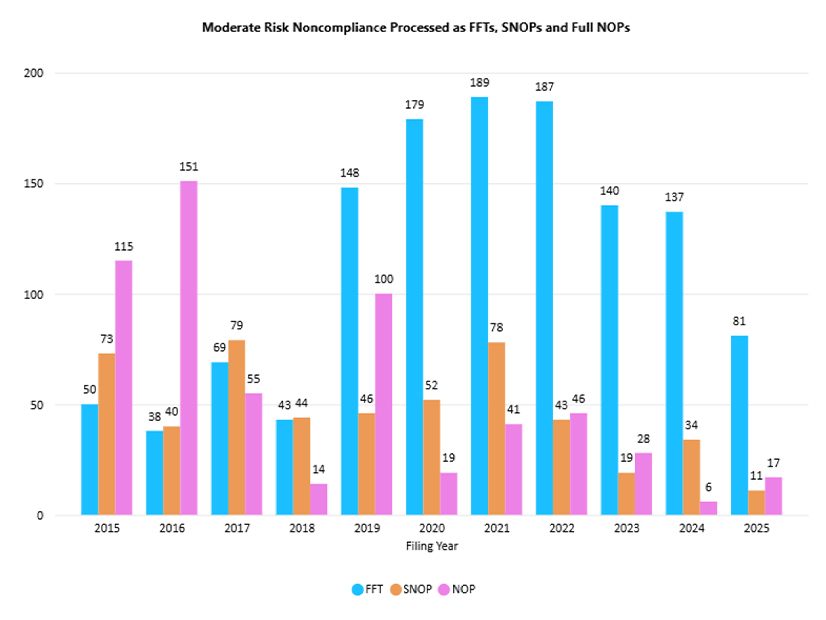
In this year’s report, NERC staff wrote that both programs have become the preferred means for handling moderate- or minimal-risk violations since their introduction, with 137 of 177 moderate instances handled via FTT in 2024 and 1,371 of 1,483 minimal instances processed as CEs.
Most minimal-risk violations have been processed as CEs each year since the program began in 2015. Most moderate-risk violations were filed as SNOPs or NOPs until 2019, but in that year, FFTs accounted for the majority of cases and more than half in every year since then.
“The availability of dispositions not involving settlements or penalties encourages registered entities to conduct their own assessment of their compliance programs … and to report noncompliance found during that assessment knowing that they will not face a settlement or penalty for lower-risk noncompliance,” the report’s authors wrote, adding that “the regional entities’ effective use of FFTs and CEs shows increased consistency in processing and understanding of the risk associated with individual noncompliance across the ERO Enterprise.”
NERC’s report also discussed the results of a joint review by staff from FERC and the ERO of FFTs and CEs submitted to the commission between October 2023 and September 2024. The review began in October 2024 and ended in August 2025; ERO and commission staff reviewed 32 FFTs and 33 CEs, aiming to determine whether REs were properly implementing the programs.
FERC staff agreed with REs’ risk determinations for all sample FFTs and CEs, saying that the assessments “clearly identified the factors affecting the risk prior to mitigation,” and that none of the cases “contained any material misrepresentations by the registered entities.” They concluded that the joint review shows “significant alignment across the ERO Enterprise” regarding the processing of individual noncompliance cases.