New reports give a picture of a U.S. energy storage sector accelerating even faster in 2025 despite policy changes but facing a potential slowdown because of those same policy changes.
American Clean Power Association and Wood Mackenzie reported 5.6 GW of new capacity was installed in the second quarter, a quarterly record.
Troutman Pepper Locke examined the heightened risk facing U.S. storage developers amid the regulatory and tariff uncertainty created by the Trump administration and Congress.
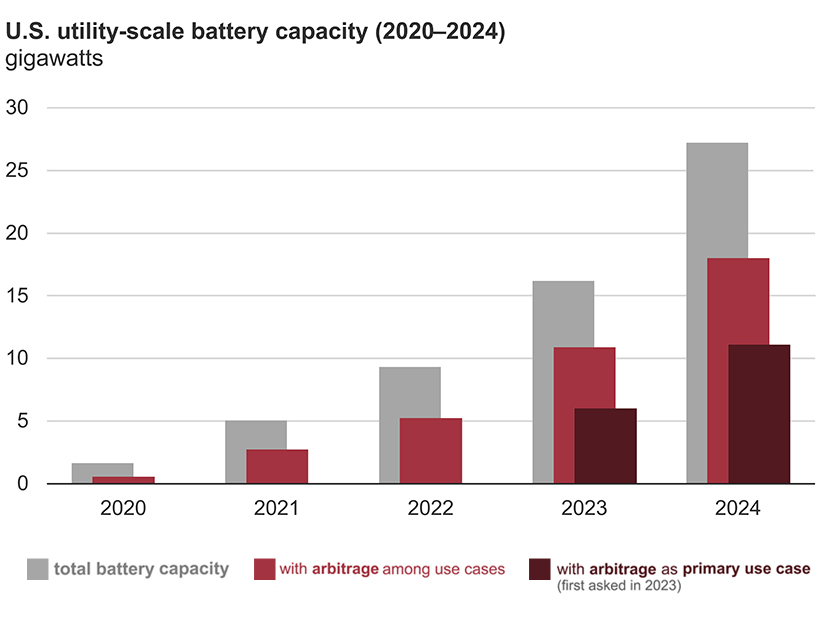
U.S. Energy Information Administration reported that this rapidly expanding class of grid assets increasingly is being used for arbitrage, rather than for grid-stabilizing functions.
ACP and Wood Mackenzie
In their latest “US Energy Storage Monitor” report, released Sept. 26, ACP and Wood Mackenzie said 4.9 GW of utility-scale storage was added in the second quarter of 2025, 63% more than in the same quarter of 2024.
Residential installations totaled 608 MW, up 132% year-over-year, and community/commercial/industrial installations totaled 38 MW, up 11%.
Texas, California and Arizona each added more than 1 GW of utility-scale storage. California, Arizona and Illinois accounted for most of the residential growth. More than 70% of the commercial and industrial installations were in California and New York; community storage deployments remained limited due to cost and policy constraints.
The report predicts U.S. storage capacity will reach 87.8 GW by 2029.
But headwinds facing the sector could reduce utility-scale storage installations 10% in 2027, the report indicates.
And over the next five years, those headwinds could reduce the buildout by 16.5 GW, said Allison Weis, global head of storage at Wood Mackenzie.
“After 2025, utility-scale storage projects must comply with new, stringent battery sourcing requirements to receive the ITC,” Weis said. “While domestic cell supply is ramping up, supply chain shortages are possible, although developers are continuing to consider supply from China to fill in any gaps. A rush to start construction under the more certain near-term regulatory framework uplifts the near-term forecast. Projects that have not met certain milestones by the end of 2025 are at risk of exposure to changing regulations. There is additional downside risk if further permitting delays threaten solar and storage projects.”
Troutman Pepper Locke
Troutman Pepper Locke drilled down on these headwinds in “Brave New World: What’s Next for US Energy Storage After OBBBA and Amid Continued Tariff Risk?”
In its announcement of the report Sept. 23, the law firm said the sector was “bruised but buoyant amid regulatory and tariff uncertainty” and detailed how developers, investors and lenders have prepared for these risk factors.
The report also explains why they remain confident about the storage sector’s growth trajectory in the wake of the One Big Beautiful Bill Act (OBBBA), which dealt so much pain to other parts of the clean energy industry.
“Energy storage’s versatility of use cases has untethered it from the fate of wind and solar to a meaningful degree,” said co-author Vaughn Morrison, a partner in the firm.
Andrew Waranch, CEO of storage developer Spearmint Energy, explained the economics: “So much of the power market and power price is set by expensive and old generators that only need to operate during ramp times in the morning and evening. In contrast, batteries can solve that quickly and cheaply with extremely high reliability.”
The national origin of the batteries will be an important factor moving forward, said John Leonti, a partner in the law firm.
He said: “Although the impact of the OBBBA on energy storage is less severe than some feared, the ambition to onshore battery component manufacturing and the attendant Foreign Entities of Concern (FEOC) provisions issue significant supply challenges for the industry moving forward.”
Headwinds and tailwinds for U.S. battery energy storage systems will mix as demand for their services rises while heavier loads are placed on an aging grid, to a degree that far outstrips U.S. production capacity, the report states.
The majority of battery components come from China, where tariffs and FEOC restrictions will boost material costs.
Energy Information Administration
In an analysis released Sept. 22, the EIA tracks U.S. utility-scale battery storage capacity in the 2020s.
The 230 plants operational in 2020 had a nameplate capacity of 2.09 GW. The 786 plants operational in 2024 had a nameplate capacity of 27.82 GW.
EIA in its surveys has been asking operators since 2020 if arbitrage was among the use cases for their batteries, but it was only in 2023 that EIA started asking if arbitrage was the primary use case.
It found that arbitrage was among the use cases for 66% of all utility-scale battery capacity in 2024 and the primary use case for 41%.
The most common other primary uses, in descending order, were frequency regulation, excess wind/solar generation, system peak shaving, load management and co-located renewable firming.
The EIA data shows other shifts:
-
- Lithium-ion batteries accounted for 86% of the projects in 2020 and 96% in 2024.
- Non-CHP IPPs operated 54% of facilities and 75% of capacity in 2020; that jumped to 72% of facilities and 86% of capacity by 2024.
- Electric utilities operated 35% of facilities and 23% of capacity in 2020; that dropped to 23% of facilities and 10% of capacity by 2024.
- Only 22% of facilities and 17% of capacity was operated in support of transmission and distribution assets in 2024.
- As of 2024, there were 558 facilities with a combined nameplate capacity of 74.64 GW classified as “proposed”; here again, non-CHP IPPs are behind the great majority of the proposals, the great majority of which would entail lithium-ion batteries. Arbitrage would be the primary or secondary use for 402 projects with a combined capacity of 56.3 GW.
EIA breaks U.S. utility-scale battery capacity into three geographic categories: CAISO, ERCOT and everywhere else. 2024 ended with nearly 12 GW of capacity online in CAISO, approximately 8 GW in ERCOT and roughly 7.5 GW in the rest of the country.
ERCOT showed the heaviest activity, with roughly 7 GW sometimes used and 4 GW primarily used for arbitrage.
Arbitrage was somewhat less frequent in CAISO and much less frequent in the rest of the country, where only about 2 GW was primarily used to facilitate buying electricity when cheap and selling it while expensive.