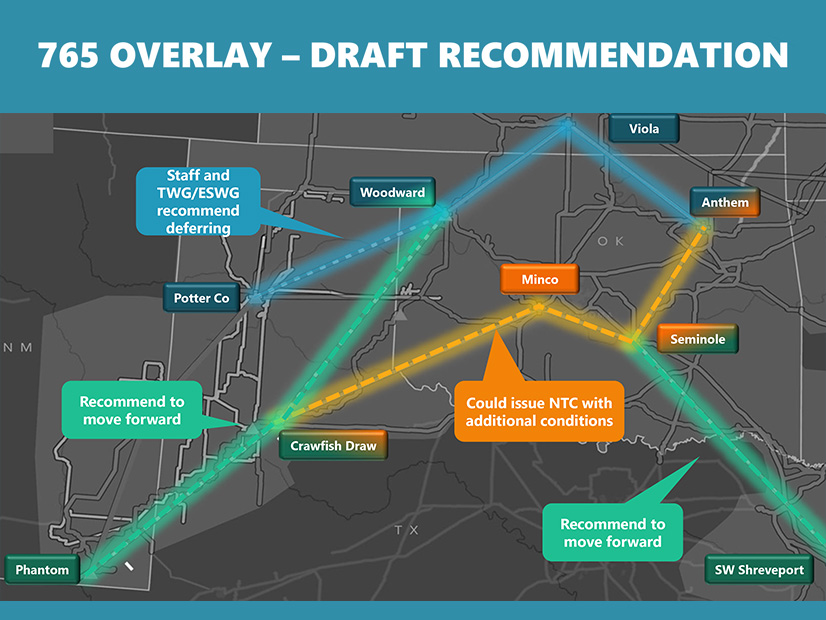
SPP staff have reiterated their position to defer part of the RTO’s planned 765-kV transmission overlay, setting aside about $7 billion in regional projects from its 2025 transmission assessment.
Instead, they plan to seek approval of up to 50 projects with an estimated cost of $11.16 billion, a 45.9% increase over the record 2024 $7.65 billion assessment. That does not include more than $1 billion for 22 stakeholder-submitted zonal planning criteria (ZPC) projects that also were studied in the 2025 Integrated Transmission Plan for system impact.
“This particular ITP has been a big lift,” SPP’s Casey Cathey, vice president of engineering, told state regulators during an Oct. 10 education session for the Regional State Committee. “It’s probably the most comprehensive study that SPP and its members have ever done, and it reflects where the system is and where our region is growing. Load is growing faster than we’ve ever seen, and our grid is feeling the strain.
“So, the question is, how do we stay ahead of it responsibly and cost effectively?” he asked. “This is a challenging situation for everyone.”
Cathey said deferring $7 billion of transmission projects “that we do believe is necessary” will allow staff to refine termination points for the upper part of a proposed 765-kV overlay in the southern portion of the footprint. He said staff are trying to better understand the full buildout that will be needed to meet the load growth they see ahead in 2026.
“It’s indicating load growth from all of Kansas state all the way up through North Dakota that will necessitate additional EHV [extra-high-voltage] and possibly ultra-high-voltage facilities in the 2026 time frame,” Cathey said.
The southern 765-kV overlay builds on the RTO’s first EHV project, Southwest Public Service’s 345-mile Potter-Crossroads-Phantom transmission line that was part of the 2024 ITP. (See SPP Stakeholders Endorse Record $7.65B Tx Plan.)
Staff said subsequent analysis using 2025 data demonstrated that a single 765-kV facility would not provide adequate energy delivery or voltage support for a region where load has increased from 4,700 MW to 11,500 MW between the 2023 and 2025 ITP forecast cycles. They said the SPS region’s isolation from the broader SPP grid makes it critical to use 765-kV solutions to establish “highly efficient” bulk power delivery.
The portfolio includes four 765-kV projects totaling $7.55 billion in costs, comprising the first phase of SPP’s 765-kV backbone. It connects SPS’ grid with the broader SPP network through Oklahoma and back down to Shreveport in northwestern Louisiana.
The Markets and Operations Policy Committee heard much the same presentation during a September education session. (See SPP Considers Deferring 765-kV NTCs to 2026.)
Staff’s presentation to the RSC included two 765-kV segments that they propose to defer while they refine termination points. By deferring a construction permit for the Potter-Woodward segment, a 471-mile facility in western Oklahoma predicted to cost $1.35 billion, SPP preserves the flexibility to evaluate whether more strategic or cost-effective alternatives could be achieved, they said.
SPP says the 2026 ITP will evaluate the need for a complete regional 765-kV network, including areas to the north in the footprint where spot loads were submitted for study for the first time. The Consolidated Planning Process transition assessment that follows also will consider additional EHV lines.
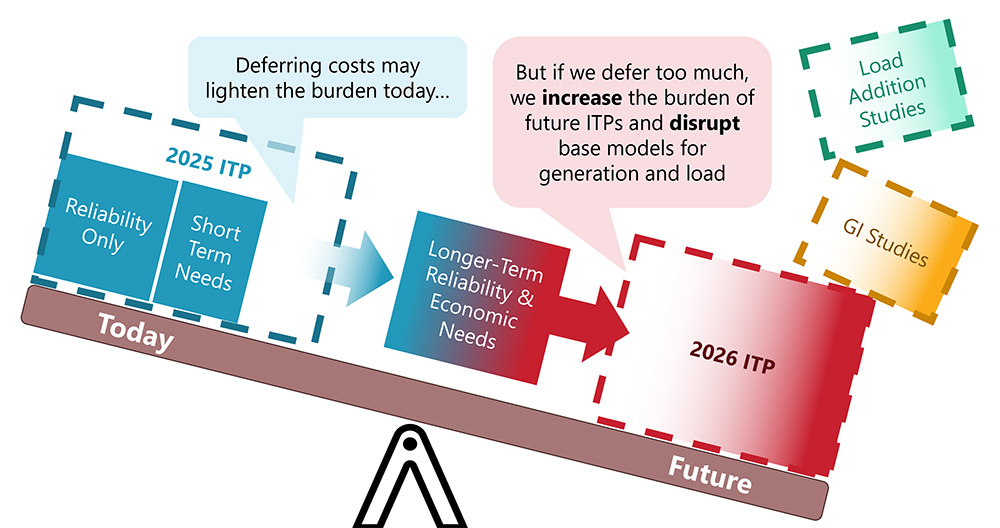
Staff cautioned the RSC that deferring costs may lighten the burden for the 2025 ITP but have unintended consequences for future assessments.
“What we don’t want to do is defer too much where we increase the burden of future ITPs and actually disrupt models,” said Kirk Hall, manager of transmission planning. “If there’s not enough transmission in the model because we’ve deferred too much, then it makes it really difficult to perform studies. It makes it difficult to explain what is going on in the models because in some cases, they may not even solve appropriately.”
Oklahoma Corporation Commission Chair Kim David said new legislation in her state requires the commission to consider an “extensive list” of criteria before approving construction permits for any transmission lines.
“I can just see the writing on the wall with some of this: that there could be a lot of delays; there could be some certificates [of convenience and necessity] not granted,” she said. “When I’m looking at that, I’m just seeing costs rising and costs rising and costs rising. I have some real concerns about it actually coming to fruition.”
“It’s going to be challenging,” Minnesota Public Utilities Commissioner John Tuma agreed, calling 765-kV projects “different animals.”
MISO’s second long-range transmission plan portfolio includes several 765-kV projects that the Minnesota PUC is grappling with. (See MISO Affirms Commitment to $21.8B Long-range Tx Plan in Final Workshops.)
“I hope estimates are being reworked for 765,” Tuma said. “They’re going to be a challenge for us to site.”
It took SPP several meetings with the RSC, Board of Directors and stakeholders to get SPS’ 765-kV project formally approved. The project had a cost estimate of $1.69 billion when it was approved in 2024, but SPS filed a revised estimate of $3.62 billion in June. (See SPP Board Approves 765-kV Project’s Increased Cost.)
The 2025 portfolio, excluding the ZPC projects, has a benefit-to cost ratio between 6:1 and 10:1, preserves reliability and mitigates rising energy costs because of increasing demand, SPP said.
During a joint meeting Oct. 1 between the Transmission and Economic Studies working groups, the TWG endorsed the assessment 10-9, with four abstentions, and the ESWG voted 6-4 in favor, with three abstentions.
The 2025 ITP now goes before MOPC during its Oct. 14-15 meeting in Little Rock, Ark.