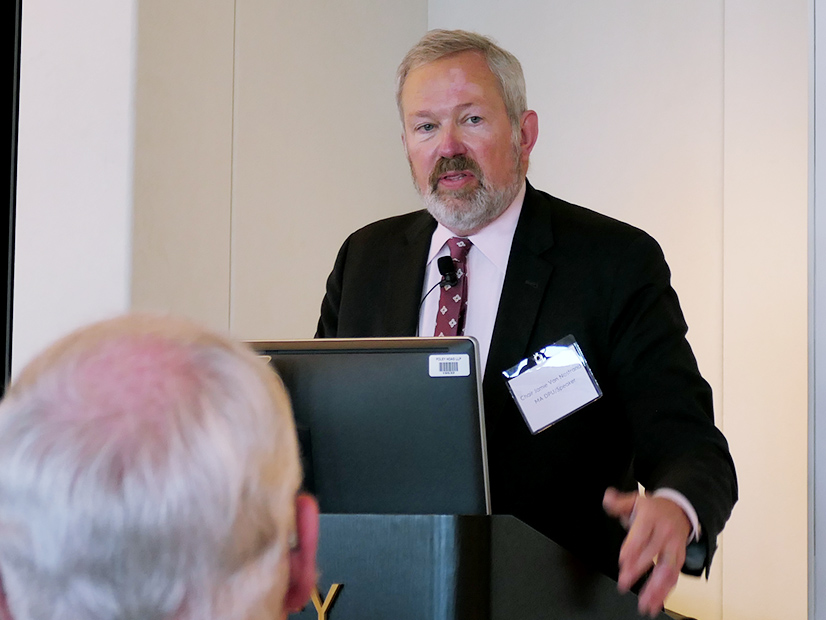
Jamie Van Nostrand’s tenure as chair of the Massachusetts Department of Public Utilities has been defined, in large part, by the department’s effort to align gas utility regulation with the state’s decarbonization laws and targets.
Prior to his appointment in 2023, the DPU faced significant criticism from public advocacy groups over a gas decarbonization planning process largely dominated by the long-term vision put forward by the state’s investor-owned gas utilities.
Following the election of Gov. Maura Healey (D) in 2022, Energy and Environmental Affairs Secretary Rebecca Tepper appointed Van Nostrand and fellow Commissioner Staci Rubin, tasking them with building “a 21st-century DPU” centered around “a commitment to transparency, equity and innovation.”
At the time, Van Nostrand was a professor focused on energy issues at the West Virginia University College of Law. Earlier in his career, he represented utilities in regulatory proceedings in the Pacific Northwest, and nonprofits and public interest groups in proceedings in New York and Virginia.
After 12 years at WVU, “I had the opportunity to come to Massachusetts, and couldn’t say no to Secretary Tepper,” Van Nostrand said in a recent interview with RTO Insider. “It was a dream job.”
Two and a half years after taking the helm at the DPU, Van Nostrand will leave the department Oct. 17 after leading it through a series of major changes in its approach to natural gas regulation.
In December 2023, the DPU published Order 20-80-B, which concluded the department’s contentious multiyear investigation into the decarbonization of the state’s gas network. While utilities had pushed for a framework centered around partial electrification and alternative fuels like hydrogen and renewable natural gas (RNG), the DPU largely sided with climate and consumer advocacy groups in its assessment that gas system decarbonization must focus on electrification.
The order marked a significant step toward an eventual transition away from natural gas, setting the stage for the challenging technical and political questions the DPU has been working on over the past two years. (See Massachusetts Moves to Limit New Gas Infrastructure.)
It required gas utilities to consider non-gas alternatives before investing in new gas infrastructure; directed the utilities to submit climate compliance plans every five years; mandated integrated planning with electric utilities; banned the companies from promoting natural gas expansion; and prevented them from including in the rate base the costs of procuring hydrogen or RNG.
With the order and the proceedings that followed, “I think we pretty much staked out the position as the No. 1 state in the country on the gas transition,” Van Nostrand said.
The Obligation to Serve
Following the order, the DPU has taken more steps to amend its line-extension policies, which would limit the utilities’ ability to spread the costs of connecting new gas customers across their rate base; minimize spending on pipe replacement projects and update the utilities’ “obligation to serve” gas customers.
The obligation to serve, the companies have argued, would prevent them from decommissioning entire sections of pipe if any customers refuse to give up their gas service. In 2024, the legislature amended the statutory basis for this obligation, authorizing the DPU to “order actions that may vary the uniformity of the availability of natural gas service” to enable emissions reductions and compliance with the state’s climate laws.
In early October, stakeholders submitted comments to the DPU on how it should interpret the legal definition. The gas companies argued that the DPU cannot require them to disconnect existing customers, while climate advocates, the Massachusetts Attorney General’s Office and Sen. Mike Barrett, the top senator responsible for drafting the 2024 legislative changes, argued that the DPU does have this authority (D.P.U. 25-40 through 25-45).
The obligation to serve “is a tough nut to crack,” Van Nostrand said.
“How do you shrink the system if you identify a decommissioning possibility and not all the customers want to electrify?” he said. “That would completely thwart the ability to decommission the pipe, so your throughput is going to go down, but your fixed costs aren’t going to go down.”
He said addressing the obligation to serve is part of a broader need to carefully manage the transition to prevent customers who cannot afford to electrify from being saddled with an increasing share of the gas system’s fixed costs.
“An unmanaged transition results in much, much higher rates for customers who can least afford to pay them,” Van Nostrand said. “I think we’re leading the nation on it, but I’ve learned a lot from regulators in the other states who are struggling with the same issues.”
The Coal Trap
While teaching at WVU, Van Nostrand wrote “The Coal Trap,” a book about how the close alignment of the coal industry and top West Virginia politicians prevented the state from taking advantage of clean energy opportunities between 2009 and 2019, hurting the state’s economy and environment.
He said he sees some parallels between the Massachusetts gas industry’s resistance to electrification and the West Virginia coal industry’s pushback against emissions regulations under the Obama administration.
For the coal industry, “there was a resistance to giving it up,” Van Nostrand said. “The coal industry tended to want to just put their head in the sand and say, ‘Oh, everything would be fine if Obama’s job-killing EPA would just leave us alone.’”
In Massachusetts, Van Nostrand said, he has faced some frustration in his effort to bring the utilities to the table to work through challenging aspects of the gas transition.
“I’ve encouraged the LDCs [local distribution companies] to work with us to try to figure out how we can incentivize the LDCs so they will be on board with electrification and not necessarily hide behind the obligation to serve and customer choice,” he said.
“At the end of the day, we have to maintain the financial viability of the utilities, and we’ve got to make sure that, as long as there’s gas going through the pipes, it’s going to be safe,” he added.
He praised a recent filing by Eversource Energy (D.P.U. 25-86) proposing a new regulatory framework to develop networked geothermal heating in new construction projects. Networked geothermal offers significant efficiency benefits over standalone heat pumps, and Eversource already is operating a networked geothermal pilot project. (See Networked Geothermal Breaks Ground in Framingham.)
“I think good utilities get out in front of it, they see the direction things are going, and they plan accordingly,” Van Nostrand said. “There are great workforce transition benefits with network geothermal, because you’ve got the pipes running down the middle of the street and laterals going out to houses, just like what a gas company does. And I think Eversource gets that.”
New Leadership at the DPU
On Oct. 20, Van Nostrand will be replaced as DPU chair by Jeremy McDiarmid, former general counsel for Advanced Energy United, while Liz Anderson, former chief of the energy and ratepayer advocacy division at the Massachusetts Attorney General’s Office, will take over for DPU Commissioner Cecile Fraser.
Representatives of multiple public interest groups active in the state expressed optimism that the new DPU will carry on Van Nostrand’s work to implement a managed transition away from gas.
But challenging questions remain for the incoming commissioners about the role of the state’s gas network and the need for new investments in the system.
While the DPU has directed the gas utilities to reduce their reliance on supply from the Everett LNG import terminal, some industry experts have expressed skepticism about whether the state will be able to eliminate its need for the facility when existing utility supply contracts expire in 2030. (See Gas Industry Sees Political Opportunity in New England and Massachusetts DPU Approves Everett LNG Contracts.)
The uncertain future of Everett, coupled with the utilities’ continued addition of gas customers, leaves regulators in a difficult position as they work to affordably meet existing needs for gas while attempting to avoid larger-than-necessary investments in long-term gas infrastructure.
Eversource recently filed a supply agreement to support a limited expansion of the Algonquin pipeline in the state. While the utility claims this proposal would reduce costs for its own customers, it is unclear whether the proposal would shift costs to customers of other utilities that rely on Everett if the facility remains open beyond 2030.
As regulators in Massachusetts continue to grapple with the existential questions of the gas transition, Van Nostrand plans to live full time in Philadelphia, where his wife teaches. He said he hopes to continue working on issues related to the clean energy transition but is looking forward to taking on a slightly less stressful gig.
“It’s probably more likely to be on the gas side, because that’s where the challenge is the greatest,” he said.