Storage developers in Ontario are pushing back on IESO’s 100-MW/minute ramp limit for batteries, saying it will reduce their revenues.
IESO said the limit is needed to allow it to meet NERC standards requiring balancing authorities to keep system frequency at 60 Hz.
“IESO has experienced negative impacts to system frequency resulting from the fast-moving capabilities of BESS [battery energy storage systems],” the grid operator said in a presentation Oct. 16 on its Storage and Co-located Hybrid Integration Project, which will introduce a single bidirectional resource model for BESS.
The initiative, part of the ISO’s Enabling Resources Program (ERP), initially will focus on electricity storage and hybrid generation-storage resources. It will replace the current two-resource model — which separates the withdrawal portion of the resource as load and the injection portion as a generator — with a single continuous offer curve. The current model creates operational challenges and reduces market efficiency, according to the ISO.
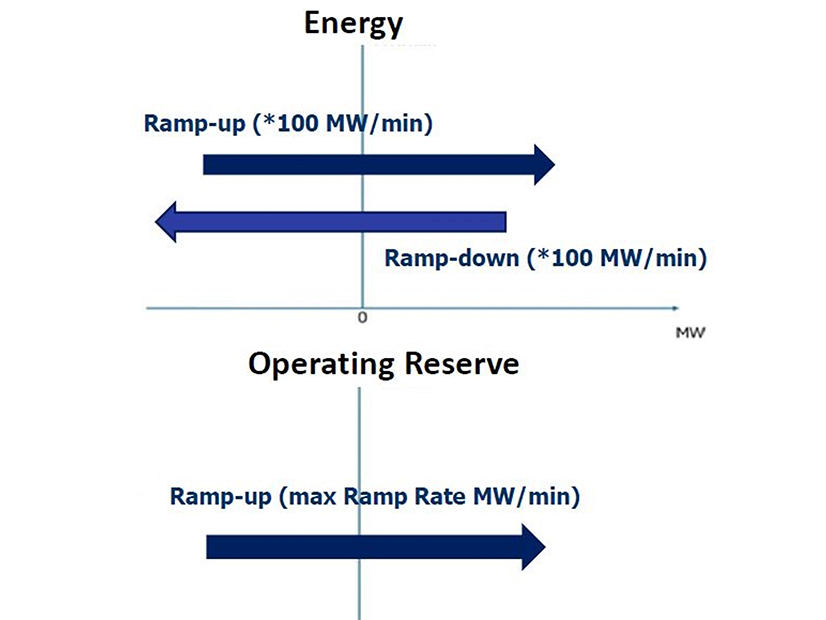
IESO plans to continue using its current 100-MW/minute up and down limit per facility under the new model.
3,000 MW of Storage Expected by 2028
The ISO noted that it expects 25 BESS facilities to join the grid in the near term, with about 3,000 MW of contracted storage expected in service by 2028.
IESO relies on regulation services to compensate fast output changes from batteries, said Ihor Lopuch, a project adviser. “In some cases, ISO control room operators have had to take additional out-of-market control actions, such as constraining some resources or sending one-time dispatches to help rebalance the system,” he said.
Storage operators first raised objections to the static ramp rates following an engagement session July 24. (See IESO Seeks Feedback on Revised Storage Model.)
In the most recent session, Travis Lusney, director of power systems for Power Advisory, representing the Energy Storage Resources Consortium, led the opposition. The consortium’s 12 members include Capital Power, EDP Renewables, Brookfield Renewables and Northland Power.

Lusney asked the ISO to determine the impact of increasing the ramp limit from 100 MW and whether there is an optimal limit that could maintain area control error while offsetting higher costs of regulation capacity. “Can it be 150, 200 [MW]?” he asked.
Lusney also asked for data on how often IESO will dispatch storage resources for operating reserves (OR) versus energy.
“The answer that I’ve gotten consistently is OR resources are … scheduled on the sideline to be there, but their dispatch instructions are only energy, and that there is no OR dispatch instruction,” Lusney said. “Part of that may have had to do with the previous market design, and that might be changed, but it’s not clear that there’s any historical information to understand how often an energy storage resource may receive an energy dispatch and be limited in that 100-MW/minute step up versus an OR dispatch that would allow them to ramp to their full capability.”
Lusney said battery operators face lost revenue because the limits negate the competitive advantage of their ramp speeds. “In a market design that encourages more price fidelity … this is quite restrictive on the competitive advantage of storage,” he said.
‘In Alignment’
IESO officials said the 100-MW limit is “in alignment” with other ISOs, including CAISO and SPP.
Tyler Chuddy, project superviser, said the ISO has limited analysis of batteries’ ramp impacts because it expects numerous BESS facilities to come online at the same time. “One hundred megawatts per minute means like a 500-MW shift in your production over one interval, which is pretty substantial,” Chuddy said.

He asked Lusney to provide details on how the ramp restrictions would result in lost revenue for battery operators. Lusney agreed to provide some examples from the consortium.
The current phase of the project, which may run as long as through 2028, will seek to establish the single resource model and set rules on state-of-charge management. Phase 2 will consider ways to allow batteries to also offer frequency regulation, which the ISO uses to correct supply-demand imbalances.
Lusney urged the ISO to consider batteries as a potential solution to the ramping challenges.
“If it’s a regulation capacity challenge driven by the fast response of the energy storage, can energy storage provide some of that regulation capacity in its dispatch instruction?” he asked. “[I recognize that] it’s not part of the current engagement process, but it seems like they are interconnected.”
Next Steps
IESO is seeking written feedback to its proposed rules by Oct. 30 deadline at Engagement@ieso.ca. The next engagement session for the project is expected in the first quarter of 2026.