Puget Sound Energy announced a partnership with Norwegian tech company Heimdall Power to install monitoring devices on 100 miles of transmission lines, stating the technology will help optimize the capacity of existing equipment.
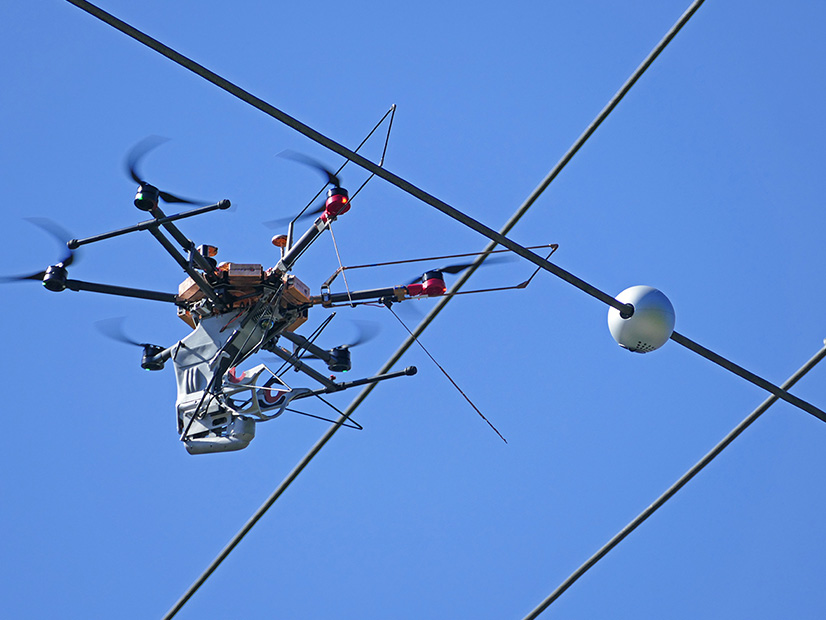
PSE and Heimdall Power have installed 75 monitoring devices called “Neurons” on the utility’s transmission lines in western Washington under a dynamic line rating (DLR) pilot project that will run through summer 2026. The sensors can help increase grid capacity and power delivery for PSE’s 1.2 million customers by collecting real-time data on electrical current, line temperature, sag, wind speed and weather conditions, according to an Oct. 22 news release.
“This is an exciting first step for PSE to understand and capture the value of dynamic line ratings,” Alex Brotherston, principal engineer on PSE’s grid modernization team, told RTO Insider in an email. “With load growth, rising costs, aging infrastructure and long project timelines, it is critical that we leverage this kind of technology to increase the safety and efficiency of our grid.”
The pilot project “will allow us to observe the real-time conditions around our system and, when conditions are right, transfer more power through existing lines,” Brotherston said. “This in turn can ease congestion and give our operators more flexibility to respond to market or system constraints.”
Citing numbers from the U.S. Department of Energy, Brotherston said DLR can increase transmission capacity by 10% to 30%. PSE conducted a preliminary study using historical weather data, which showed that the utility’s pilot lines could see a capacity increase of up to 50% under the right conditions, Brotherston added.
Heimdall installed the DLR devices using both autonomous drones and traditional installation methods, according to the news release.
The partners said this is the largest deployment of DLR sensors in the U.S. and they will provide a continuous data stream, allowing PSE to increase transmission capacity “based on actual operating conditions rather than conservative estimates.”
Brotherston said the sensors can provide insights on line conditions during extreme weather scenarios, which can assist PSE in understanding how much power each line can safely handle.
“This allows us to proactively adjust load ahead of adverse conditions or avoid overloading lines during emergency rerouting,” Brotherston added.
PSE also hopes the devices can assist in incorporating more renewable energy on the grid.
“When we are armed with more knowledge about the capacity of our lines, we can more strategically route power around our system, which gives us the necessary flexibility to site new renewable energy sources, or more efficiently utilize the renewables already on the system,” Brotherston said. “In the future, this could look like a wind farm being able to generate at full power instead of being constrained by the capacity of the transmission system, or fewer infrastructure upgrades required to site a new solar facility.”
PSE declined to disclose the financial details for the pilot project, saying sharing costs could affect future contracts “as we move toward full-scale implementation or work with vendors on similar future projects.”
PSE said the pilot project is part of the utility’s efforts to modernize the grid and enhance resilience on its network. The utility will test the technology through summer 2026, then analyze the data to determine how to implement dynamic line ratings using the devices.