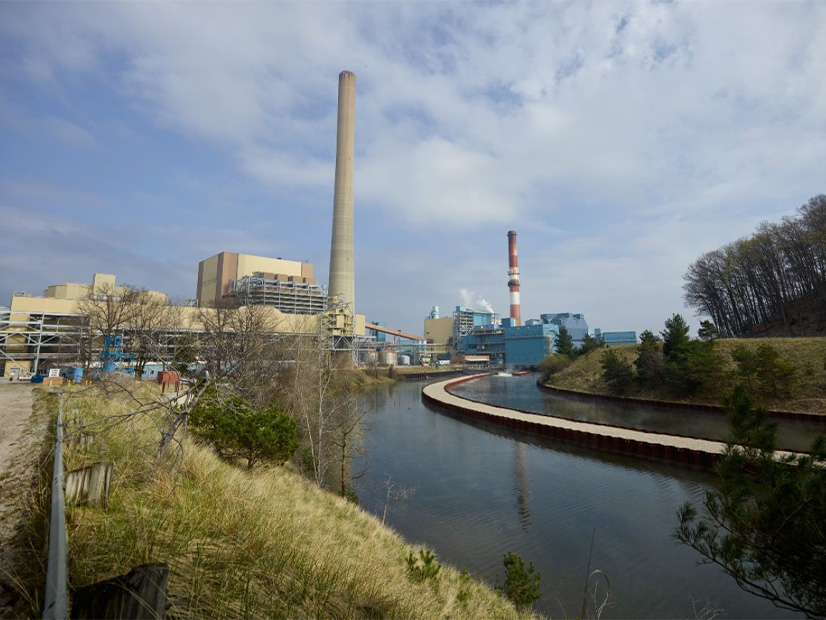
The J.H. Campbell coal plant in Michigan has racked up $80 million in net costs since late May to stay online, per emergency orders from the U.S. Department of Energy.
Plant owner Consumers Energy reported in an Oct. 30 filing to the U.S. Securities and Exchange Commission that from May 23 through Sept. 30, the costs of keeping the 1,420-MW plant online were about $164 million, with the utility offsetting $84 million with revenue from selling the plant’s output in the MISO markets.
J.H. Campell now costs more than $615,000 per day to operate since DOE issued its first emergency order to prevent the plant’s retirement as scheduled May 31. The plant now is operating under a second emergency order that expires Nov. 19. (See DOE Orders Mich. Coal Plant to Remain Available Another 90 Days.)
Consumers Energy divided the costs of running the plant into the two timespans of the emergency orders. From May 20 to Aug. 20, costs swelled to $120 million, with $67 million in revenues, leaving $53 million to be paid. From Aug. 21 through Sept. 30, costs reached $44 million, with power sales covering $17 million, leaving $27 million unpaid.
Consumers Energy will detail the remaining costs associated with the second DOE order in its next quarterly filing, due to the SEC in late January 2026.
Earthjustice senior attorney Michael Lenoff said DOE’s orders that the Campbell plant remain accessible are “extremely expensive.”
Earthjustice, the Sierra Club, Michigan Attorney General Dana Nessel and others are suing DOE, arguing separately that ratepayers are unfairly expected to pay for the plant’s expenses. (See Opponents Take DOE to Court over J.H. Campbell Retirement Delay.)
“Forcing this unnecessary coal plant to keep operating is bilking consumers for the benefit of the coal industry. Earthjustice is in court now to stop the administration from harming consumers, trampling markets and unlawfully usurping the authority of states and regulators to make decisions in the public interest,” Lenoff said in a statement.
Numbers from EPA’s Clean Air Markets Program Data show that J.H. Campbell’s three units were not consistently generating from July to September, when Unit 1 did not produce power on 25 of the 92 days; Unit 2 was dormant 74 of 92 days; and Unit 3 did not produce power 29 of 92 days.
Several organizations continue to argue that DOE’s pair of orders remain unnecessary.
In a September rehearing request challenging the second DOE order, Earthjustice and several other public interest groups argued that even on June 23, MISO’s tightest reserve margin day of the summer, the RTO had 3.3 GW of offers above what it needed to meet its 119-GW peak demand, with an additional 7 GW of emergency headroom from resources on standby. The groups argued that the “primary actors in the electric industry already protect resource adequacy without intrusion” from DOE (202-25-7).
The cost of operating the plant is set to be paid by ratepayers across MISO Midwest. (See FERC Rules Costs of Mich. Coal Plant Extension Can be Split Among 11 States.)
Minnesota Public Utilities Commissioner Joseph Sullivan said DOE is infringing on state jurisdiction by ordering the plant to be kept online in rolling, 90-day increments. Sullivan told the MISO Board of Directors Sept. 18 that Consumers Energy, the state of Michigan, MISO and the Independent Market Monitor all agree that J.H. Campbell was “properly planned for retirement and not needed for reliability.”
DOE claims it’s directing not states but MISO and FERC to keep the plant open. Sullivan said DOE relied on MISO’s previous warnings that resource adequacy was in peril despite the 2025/26 capacity auction clearing sufficient resources.
“We need to be careful with our narrative,” Sullivan said. He warned MISO against assuming retiring generation won’t be replaced or presuming that new load would be brought onto the system without the resources to support it.
The Michigan Public Service Commission in late August accepted annual capacity demonstrations from Michigan’s electric utilities, indicating that each has enough capacity to meet customer needs four years into the future (U-21775).