MISO members debated how their system could change under the weight of large load additions and scheduled a future discussion in front of the RTO’s board of directors.
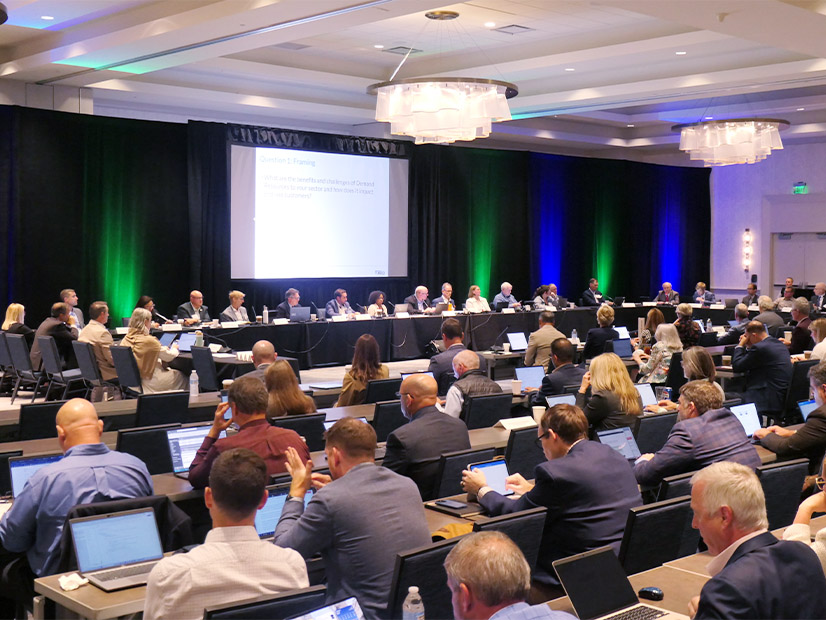
MISO Advisory Committee members considered the co-location of large loads at generating facilities at their Oct. 28 teleconference and planned a discussion slot on large loads at the Dec. 10 meeting to be held in front of the MISO Board of Directors.
Union of Concerned Scientists’ Sam Gomberg said there’s a “timing mismatch” between the rapid development of data centers and the slower-moving processes to “responsibly” get generation and transmission online. On top of that, Gomberg said vacillating federal policy is worsening uncertainty in planning for rising demand.
“People know they should be running, but they’re not exactly sure which direction to be running in,” Gomberg said.
Clean Grid Alliance Executive Director Beth Soholt said in MISO, load forecasts, generation planning, interconnection queues and transmission planning “aren’t totally synced up.” Soholt added there’s an “opaqueness” regarding how much large load customers are required to pay, with each state outlining its own cost responsibilities.
Illinois Commerce Commissioner Michael Carrigan joked that no one can get through a day without debating “AI, data centers, shifting load or increasing load from manufacturing.” He said he’s particularly concerned about an undersized grid expansion.
“We’re going to grow into practically anything you build,” Carrigan said.
But Kavita Maini, representing MISO industrial customers, asked what would happen to all newly built generation if AI processing became more efficient and didn’t need as much generation as anticipated.
“In my head, that’s one of the biggest challenges,” Maini said.
Maini said large loads should cover the costs they incur. Gomberg agreed he was concerned consumers could end up financing grid upgrades through increased power bills.
“The minute we start talking about subsidies and discounts, the whole system becomes inefficient,” Maini said.
Wisconsin Public Service Commissioner Marcus Hawkins said the timing of when cost recovery begins on large loads is vital because existing customers typically are the only ones paying leading up to energizing the large load facility.
Gomberg said it’s probably worth it for MISO to expand participation rules for energy storage and hybrid resources to get online quickly and reliably handle new load. He said storage can absorb or transmit power in a “matter of milliseconds” to keep load and energy balanced.
Gomberg and Soholt said it’s probably time to dust off NextEra Energy’s 2024 proposal that MISO create a dedicated study and registration process for new generation contingent on large loads. (See “NextEra Makes 2nd Overture for Bundled Studies,” MISO Previews Future Projects to Improve System Planning.)
Soholt called for more consolidated planning across MISO in general that ties together load estimates, annual and long-term transmission planning, and the interconnection queue and associated fast lane.
“We still have very siloed planning,” Soholt said.
Gomberg said he is “very curious” what happens when concentrated large loads cause congestion issues on the MISO system. Xcel Energy’s Susan Rossi, representing MISO Transmission Owners, said she likewise has questions around the potential for added reliability costs and uplift payments that could be induced by large loads.
John Wolfram, also representing MISO TOs, said he wondered what ensues when a co-located power plant goes offline but the large load it was built to serve tries to keep humming. Wolfram said that kind of “post-contingency thinking” could be helpful.
NextEra’s Erin Murphy said members’ conversations are especially germane since the Department of Energy recently directed FERC to initiate a rulemaking to speed up the interconnection of large load additions, including data centers and manufacturing facilities. Also, FERC in 2024 initiated proceedings to explore the upshots of co-locating large loads near generating facilities (AD24-11).