More than 400 stakeholders attended a set of workshops where CAISO staff described new processes for scheduling intertie resources and resource adequacy imports in the ISO’s Extended Day-Ahead Market, which will begin operation in May 2026.
ISO staff used the Nov. 5 and 6 workshops to review a white paper on the subjects.
“I haven’t seen [this many participants] on a CAISO call since you were dealing with the 2020 blackouts,” said Dan Williams, principal adviser at The Energy Authority.
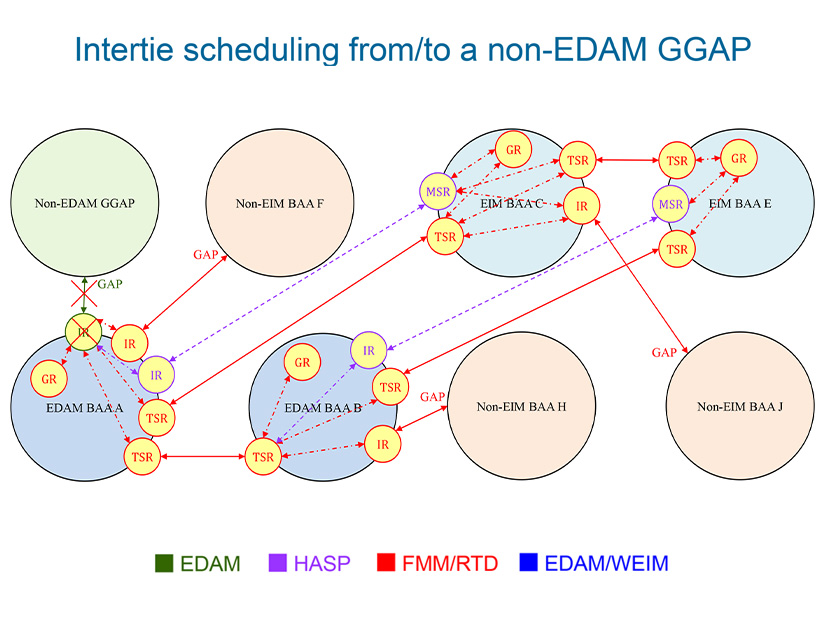
One of the new EDAM processes involves intertie resource bidding and scheduling. Intertie resources in CAISO are currently modeled at specific scheduling points, but under EDAM, those resources will be modeled at a generation aggregation point (GAP).
A GAP is the collection of supply resources in a balancing authority area or group of BAAs.
EDAM will have three types of GAPs: default, custom and generic. A GAP can be resource specific or not, and its location will be in a Western Energy Imbalance Market (EIM) or non-WEIM BAA where the energy is produced or consumed, CAISO staff wrote in the white paper.
The GAP approach will significantly improve power flow and market accuracy, improve alignment with actual power flows by reducing phantom congestion and reduce operator conformance of transmission limits in real time, staff wrote.
CAISO Executive Principal George Angelidis described five intertie resource types: system resources, intertie transaction resources, intertie generating resources, transfer system resources and mirror system resources.
Some participants said they were unclear about these terms.
“I am already a little lost between the difference between a system resource and an intertie generating resource,” said Carrie Bentley, CEO of Gridwell Consulting. “The words seem almost exactly the same. I’m wondering if it would be helpful to ground us all in what all these different terms are for and maybe … dumb it down for us.”
“Both the system resource and intertie generating resource are registered in the master file,” Angelidis said. “The system resources in implementation are non-resource specific intertie resources.”
Williams added: “We are seven months out from this [process] being a live part of CAISO’s market, and as far as I am aware today, there are sort of two sources of power that trade in the forward market: a CAISO source and a non-CAISO source.”
“Western markets are not set up to be trading with any amount of liquidity on a resource-specific basis in the pre-day-ahead market space,” Williams said.
The paper introduced indirect intertie scheduling in EDAM. CAISO currently offers direct scheduling at interties but will now include indirect scheduling in EDAM to allow non-EDAM BAA resources to wheel power through a WEIM BAA that requires explicit wheel-through schedules, the paper says. Indirect scheduling is more complicated than direct scheduling and requires coordinating schedules of multiple resources, the paper says.
EDAM’s implementation overall has been “going smoothly,” although the schedule remains “very tight and very aggressive,” CAISO staff said in October. (See ‘Aggressive’ EDAM Schedule ‘Going Smoothly’ for PacifiCorp, PGE.)
RA Import Changes
The paper also described generic RA import requirements.
CAISO tried to simplify monthly RA showings in EDAM. Monthly generic RA showings will not be resource specific, and scheduling coordinators who have generic RA import obligations will show these obligations in the ISO’s customer interface for resource adequacy (CIRA) system.
The paper also described requirements for imports of flexible RA. Monthly flexible RA will be resource specific, and CIRA will confirm that a scheduling coordinator has obtained the maximum import capacity at the intertie. If the source of the flexible RA obligation is in a non-WEIM BAA, the custom GAP must be the location of a physical resource in that non-WEIM BAA, the paper says.