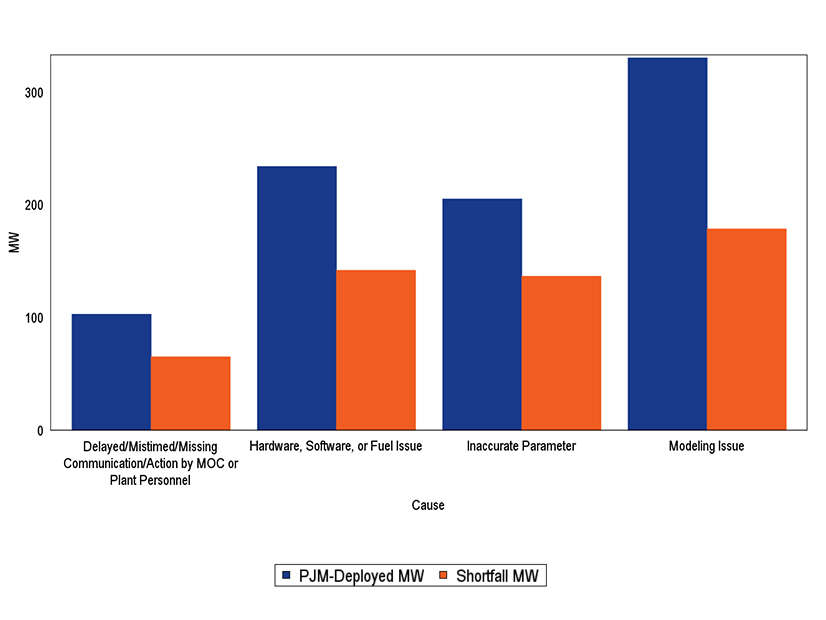
The PJM Independent Market Monitor found that modeling issues were the largest cause of synchronized reserve underperformance during a July 22 spin event, in which about 80% of assigned reserves responded.
The Monitor has been reaching out to resource owners whose units underperform during reserve deployments, focusing on events longer than 10 minutes. It also has inquired with the owners of overperforming resources, but the small sample size limited the amount that could be shared.
The effort has become more important since PJM instituted a 30% adder on the synchronized and primary reserve requirement in May 2023 to counteract a low response rate.
The 10-minute-32-second event had 2,764 MW of generation and 548 MW of demand response assigned, with a 78.8% response rate. (See “July Operating Metrics,” July Heat Wave Update, PJM OC Briefs: Aug. 7, 2025.)

Joel Romero Luna, a market analyst with the Monitor, said PJM’s modeling of the amount of time needed to bring equipment into service or change output is accounting for a rising share of reserve underperformance. That constituted the largest cause July 22, at 178.8 MW of the 523 MW for which a cause was attributed.
Issues with software and hardware, such as mechanical failures or errors in programs that dispatch units, were the second-highest rationale for underperformance, followed by outdated or inaccurate resource parameters.
Luna told the Operating Committee on Nov. 3 that communication between PJM and resource operators has improved significantly. However, operators sometimes still do not know what is required of them during a spin event.
Personnel error and communications issues accounted for 12% of the shortfall for which a cause could be attributed. PJM has reworked how reserve deployments are sent to resource operators to convey instructions through unit basepoints. (See “Stakeholders Endorse Reserve Rework, Reject Procurement Flexibility,” PJM MRC Briefs: July 24, 2024.)
October Operating Metrics
PJM’s load forecast accuracy improved for a fourth consecutive month, PJM’s Marcus Smith said while presenting the monthly operating metrics. The average hourly forecast error was 1.02%, while the rate for peak hours was 1.30%.
Three days exceeded the RTO’s 3% peak-hour error benchmark due to unpredicted weather conditions. The peak Oct. 4 was 3.05% under forecast due to high temperatures in the east causing increased load. Oct. 7 was over forecast by 3.12% due to storms across the footprint pushing temperatures down, and Oct. 8 was over forecast by 3.59% due to lower temperatures and variations in cloud coverage.
There was one shared reserve event and one geomagnetic disturbance warning, and there were 24 post-contingency local load relief warnings. Two shortage cases were approved Oct. 3 due to low generation during the afternoon ramp; another was issued Oct. 17 at 10:20 a.m. due to a unit tripping offline.
A spin event was declared Oct. 15 at 4:52 p.m.; it lasted 5 minutes and 21 seconds. There was 2,804 MW of generation assigned, of which 57% responded.
Another event Oct. 17 was initiated at 8:13 p.m. and lasted 11 minutes and 7 seconds. There was 1,743 MW of generation assigned, of which 74% responded, and 644 MW of demand response assigned, of which 92% responded.
The Oct. 17 deployment is the second in PJM’s three-event rolling average used to determine whether it will reduce a 30% adder on the synchronized and primary reserve requirement. Paired with an event Sept. 25 with 77% performance, the average is 78%. Performance across three consecutive events must be above 75% for the adder to be reduced by 10%, and a larger reduction is possible if performance is higher. (See PJM OC Briefs: March 6, 2025.)
A third October spin event was declared Oct. 28, but the data had not been processed before the Operating Committee meeting.
Manual 14D Revisions Endorsed
Stakeholders endorsed by acclamation a slate of revisions to Manual 14D: Generation Operational Requirements drafted through the document’s periodic review.
The changes require that generation owners notify PJM of start-up issues that may affect their units during a cold weather advisory and added sections detailing cold weather operating limit data requests and the cold weather advisory drill. They also detail how data about resources is used in PJM’s Gen Model to produce load flow, short circuit and dynamics modeling for planning staff.