VALLEY FORGE, Pa. — PJM presented its shortlist of projects for inclusion in the first window of its 2025 Regional Transmission Expansion Plan (RTEP), which includes need for increased west-to-east transfer capability to supply rising data center load in Northern Virginia and the PPL region.
The projects were sorted into four regions: the PPL region of the MAAC zone, the overall MAAC zone, a southern cluster focused on resolving transmission violations and a western cluster centered around Columbus, Ohio. PJM expects to present its recommendations to the Transmission Expansion Advisory Committee during its Dec. 2 meeting.
The need in PPL is being driven by load growth increasing by about 5 GW between the 2024 and 2025 load forecasts, which is driven predominantly by data centers. The removal of 7.5 GW expected from offshore wind projects in New Jersey also caused five 500-kV lines to overload, increasing the need for more transmission into the Mid-Atlantic.
PJM added scenarios removing the offshore wind generation to reflect the New Jersey Board of Public Utilities canceling solicitations for development and postponing construction of transmission and other infrastructure. (See N.J. Puts on Hold Remaining Pieces of $1.07B OSW Transmission Project.)
PJM has shortlisted a single portfolio from PPL, which would make several upgrades to transmission around the Susquehanna nuclear generator for $565 million. The package includes building a new Kelayres 500-kV substation, extending the Susquehanna-Sunbury 500-kV line to cut into Kelayres and rebuilding the Juniata-Sunbury 500-kV line.
PJM Director of Transmission Planning Sami Abdulsalam said this is the first time a transmission owner has submitted a complete competitive RTEP portfolio with a fixed cost cap. He said there is strong confidence the utility’s forecast will increase again next year, creating the need for upgrades of this magnitude.
Increased transfer capability into the larger MAAC region is being prompted by data center growth in PPL, with three portfolios shortlisted and a fourth under consideration. A joint FirstEnergy and MAIT project would build two 500-kV lines between the Keystone and Susquehanna substations for $1.16 billion; a NextEra and Exelon package would build a 765-kV line from Kammer to Juniata, with two new 765/500-kV substations along the corridor for $1.74 billion; and a proposal from NextEra, Exelon and MAIT would build the Kammer-Juniata 765-kV line, plus a 500-kV line from Keystone to Susquehanna, for $2.82 billion.
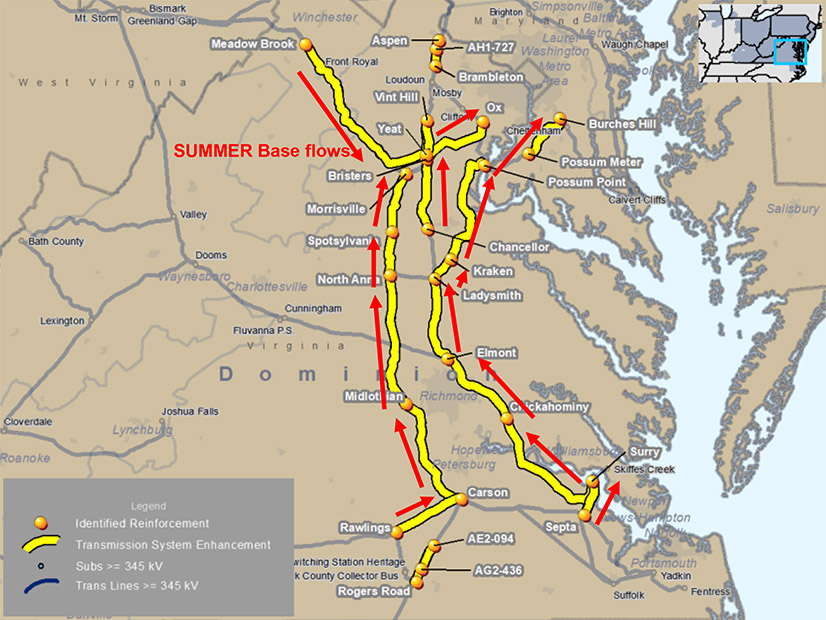
New generation in southern Dominion paired with load growth in Northern Virginia is expected to cause multiple overloads on 500-kV lines between the two regions in 2032. Three packages were shortlisted: a high-voltage DC line from the Heritage substation to Mosby paired with a 500-kV line between Elmont and Kraken sponsored by Dominion for $4.82 billion; a pair of 765-kV lines from Heritage to Vontay and between Joshua Falls and Morrisville, passing through Cunningham brought by Transource for $1.97 billion; and two 500-kV lines between Heritage and Morrisville and from Finneywood to Cunningham and ending at Morrisville proposed by Dominion for $1.99 billion.
Several residents voiced support for the HVDC line, noting it would be underground and mostly follow existing transmission corridors. Many of the comments also called for more underground HVDC options. PJM staff responded that they’re limited to the solutions presented by project sponsors.
Abdulsalam said there are several benefits to underground HVDC beyond aesthetics, including easier expansion capability and reduced injection of short circuit. But he cautioned that it’s not a given the transfer capability is greater than overhead 765 kV.
The western cluster aims to address load growth in Ohio near Columbus and Melissa, as well as regional power flows shifting toward the eastern and southern regions of PJM. Transource submitted a $2.78 billion project including several upgrades to the 765-kV and 500-kV networks around Columbus, including a 765-kV line from Greentown mostly using greenfield right-of-way; a $2.92 billion project from NextEra and Exelon to construct a greenfield 765-kV ring from Gwynneville and looping around Columbus; and $1.49 billion to build a 765-kV line from Belmont in West Virginia to Vassell and upgrade several lines to the southwest of Columbus.
Supplemental Projects
FirstEnergy presented a $50 million project in the APS zone to replace 93 wood H-frames with steel structures and reconductor 12.72 miles along the Carroll-Mount Airy 230-kV line. The utility said the wood poles show signs of accelerated decay and woodpecker damage. The project is in the conceptual phase with a projected in-service date of June 30, 2029.
The utility also presented a $36.8 million project to serve a new customer requesting 230-kV service near the Doubs substation by constructing a 230-kV substation along the Doubs-Sage 230-kV line. The facility would feature 10 breakers and have a breaker-and-a-half (BAAH) configuration. The scope also includes reconductoring 2.9 miles of the Doubs-Sage line. The project is in the conceptual phase with a projected in-service date of Feb. 18, 2032.
FirstEnergy presented a $30 million project in the Penelec zone to rebuild 6.7 miles of the Johnstown-Seward 230-kV line to resolve deteriorating wood structures and insulator bells. The project is in the conceptual phase with an in-service date of June 15, 2027.
AEP presented a need to make repairs along 74 miles of its Hanna-Tanners Creek 345-kV line, which has experienced damage to structure legs, insulator assemblies and conductor strands. Brackets holding suspension insulator strings also are wearing out on 87% of the structures inspected, creating increased risk that a conductor could fall from the towers. There have been five momentary and two permanent outages on the line in the past five years.
PECO presented a $176.6 million project to serve a new customer seeking to bring 600 MW of load near Fairless Hills, Pa., by 2028. The project’s first phase would install two temporary 230-kV lines tapping into the double-circuit Ford Mill-Emilie line, followed by the construction of a 230-kV BAAH substation, named Sinter, with 11 breakers and two customer feeds. The line segment between Sinter and Emilie would be rebuilt, and terminal equipment at Emilie would be upgraded.
Two new service requests were presented for 750 MW near Limerick, Pa., by 2032 and another for 500 MW of load in Philadelphia expected to come online by 2029.
Planning Committee Examines Spare Equipment Philosophy
PJM has expanded its guidance on spare equipment for transmission owners, increasing the document from a single page to eight in an effort to consider equipment likely to fail during extreme weather.
The Planning Committee requested that the Transmission & Substation Subcommittee re-evaluate the document, including the possibility of a “targeted return to service” when determining the adequate supply of spare parts, as well as the logistics to deliver that equipment. (See “PJM Seeks Stakeholder Attention on Spare Equipment Requests,” PJM PC/TEAC Briefs: Dec. 3, 2024.)
The new language lists several major types of equipment that may be difficult to procure or transport after a failure, such as transformers, reactors, circuit breakers, tower components and conductors, and it gives high-level guidance on spare equipment storage and typical replacement timelines.
“Spare equipment is critical to the continued integrity of the bulk electric system (BES),” the document reads.” Failure to maintain adequate spare equipment can lead to unnecessary higher operating costs and unnecessarily long outage times, consequently compromising transmission and overall system reliability.
“Interconnected transmission owners (ITOs) need to be able to support any local interconnection agreements. The purpose of this philosophy is to ensure that thought is given to maintaining adequate spare equipment for the BES. Any new facility connecting to the bulk electric system should observe this philosophy.”