At a two-day workshop held by the California Energy Commission, offshore wind experts and fishermen identified challenges associated with building offshore wind turbines in Humboldt Bay and other parts of the coastline while not displacing the fishing industry.
Recent federal policy changes have left the future of the renewable energy resource in limbo, but California officials continue to push ahead with offshore wind design and development plans. (See CEC Approves 5 Offshore Wind Projects at California Ports.)
At the CEC’s Nov. 13 workshop, engineers, fishermen, developers and port officials, among others, talked about the path towards a future in which offshore wind turbines send electrons to the Golden State’s grid.
“It really takes a lot of our California ports working together to be able to realize this vision,” said Matt Trowbridge, a vice president with infrastructure design company Moffatt & Nichol.
No existing port terminals along the West Coast can support the equipment that’s needed to build offshore wind facilities, he said.
“How much of these manufacturing sites that are building the components needed for offshore wind are going to be in the U.S. and in California, and how many are going to come from other places?” Trowbridge asked. “What’s the right amount of in-state fabrication that will allow this industry to move?”
The fishing industry wants certainty that it will continue to be a viable career for people when offshore wind farms operate in the state.
“Fishing is one of the oldest industries in the United States,” said Ken Bates, vice president of the Humboldt Fishermen’s Marketing Association. “For old fishermen like me and the younger guys that are looking at this, nobody understands how they’re going to survive ocean industrialization.”
Humboldt Bay is the second-largest estuary in California and a huge nursery ground for tons of commercial species, he said.
Ports are the starting and stopping point for fishing operations: When fishing boats come back into the port, “there’s a whole other set of things that they require to keep their businesses running and to get the fish processed for the customer,” Bates said.
“And in the last 25 to 30 years, the priority of the fishing industry and its position in the pecking order, has moved down and down and down. Do we place any value on having a fish processing plant in a little port? There’s room for everybody.”
Another challenge with building offshore wind in California is ensuring that wind farm developers have more certainty about the amount of transmission infrastructure that will be available for offshore projects, said Martin Christensen, senior onshore works manager with Vineyard Offshore.
The Humboldt region does not have enough transmission capacity to bring the power from offshore wind projects to load centers, Christensen said.
“Right now, I think Humboldt can only accept, like, 150 MW, and our project’s going to be between 1 and 2 GW,” Christensen said. “The math just doesn’t add up.”
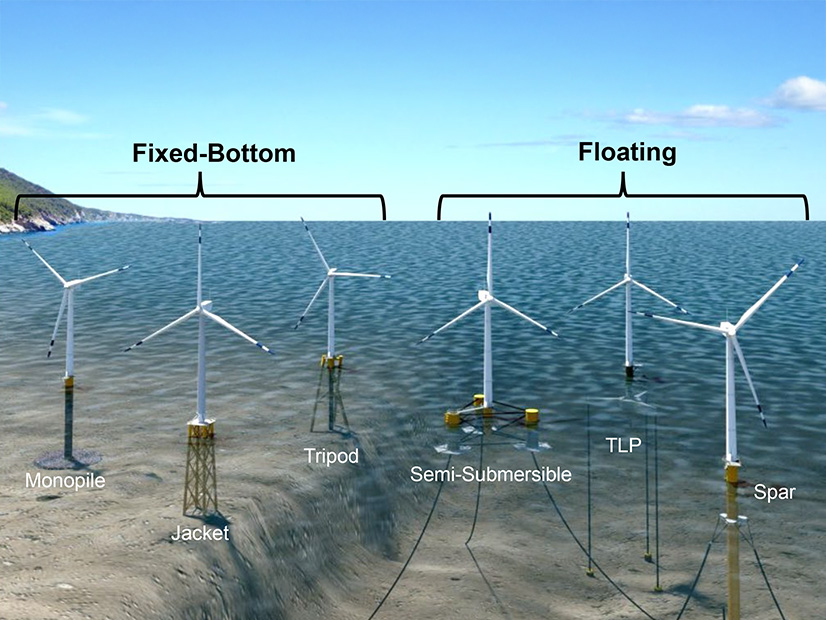
Most existing offshore wind farms are built with fixed-bottom turbines, which anchor using piles or truss jackets, Trowbridge said. But in the Pacific Ocean, the outer continental shelf drops off near California’s coastline, which makes fixed-bottom turbines inadequate. California will need to therefore install floating turbines that connect to the seabed using mooring lines and anchors.
CEC Approves Port Funding
At the CEC’s Nov. 12 business meeting, the commission approved about $9.2 million for research on deepwater HVDC substations and ocean monitoring methods capable of detecting entangled debris.
As part of the funding, Alliance for Sustainable Energy will develop a standardized concept design for a floating HVDC substation. California’s offshore wind farms may be in water that is 1,800 to 4,300 feet deep, making fixed-bottom substations infeasible, the CEC’s resolution says.
HVDC equipment can be affected by the motions of a floating platform, so an HVDC substation’s mooring system must be designed to constrain the motions. This design results in a complex system engineering problem that requires balancing considerations in platform stability, HVDC equipment robustness, mooring stiffness and cable excursions, the resolution says.
Alliance for Sustainable Energy will develop the first open-source floating HVDC substation design, which should reduce the cost of the substations and make them less environmentally harmful.