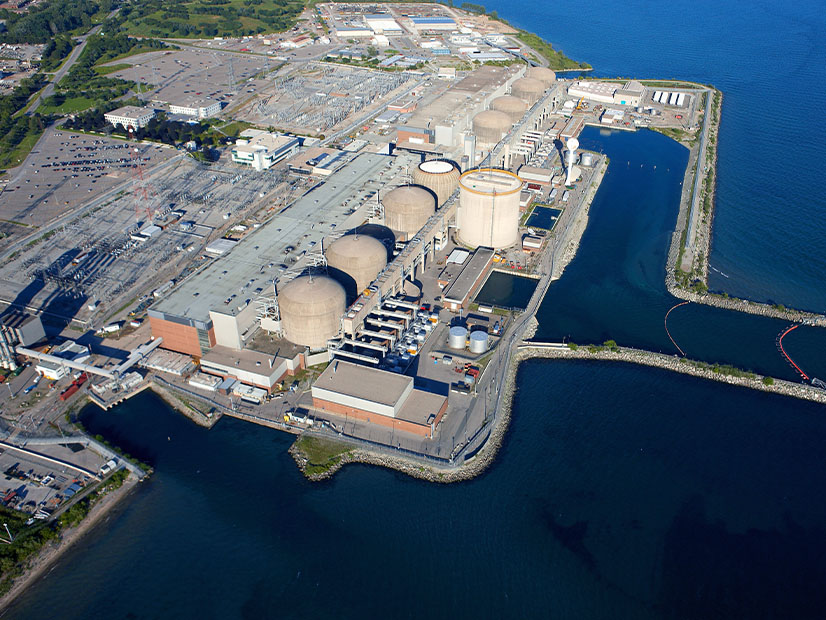
Ontario has approved a $26.8 billion CAD plan to overhaul four aging nuclear reactors that supply approximately 11% of the province’s electricity needs.
Ontario Power Generation said the refurbishment of Units 5 to 8 at the Pickering Nuclear Generating Station will extend their operation by up to 38 years.
The Ontario government announced the approval Nov. 26, saying the project would protect the province’s workforce and long-term energy security while building a more resilient, self-reliant economy in the face of U.S. tariffs.
The OPG facility on the outskirts of Toronto is one of the largest and oldest nuclear power stations in the world. Units 1-4 began operation from 1971 to 1973 and have been removed from service. Units 5-8 began operation from 1983-1986 and are licensed to operate through the end of 2026.
Units 5-8 are rated at 2.1 GW. Minister of Energy and Mines Stephen Lecce said the project would boost their output to as much as 2.2 GW.
The Pickering refurbishment was greenlit as OPG nears completion of a similar project at its Darlington Nuclear Generating Station, 17 miles east of Pickering, that is expected to cost $12.8 billion.
The Pickering project is larger and more complex, including the replacement of all 48 steam generators and the addition of a 1,500-meter deep-water intake structure, neither of which was needed for Darlington.
OPG said more than 7,000 lessons learned through the Darlington overhaul will help shape the Pickering project. The work is expected to begin in early 2027, after final licensing approval by the Canadian Nuclear Safety Commission, and continue through the mid-2030s.
Approval of the Pickering overhaul was not unexpected, but the plan is not universally supported.
Environmental Defence said Ontario’s government had locked the province into a high-cost, high-risk energy strategy that would steer away from wind and solar generation.
There also has been criticism of Canada’s decision to emphasize development of advanced nuclear power. (See Ontario Environmentalists Slam New Nuclear Units.)
Lecce alluded to the opposition in his Nov. 26 announcement: “After the previous government’s attempt to shut down the facility, this refurbishment signals that we are doubling down on Canadian technology, Canadian workers and the Canadian supply chain to protect our economy from global instability.”
Nuclear is the leading form of transmission-connected capacity in the IESO grid as of September: 12.18 GW, or 32% of total nameplate capacity. In 2024, Ontario’s nuclear reactors generated 80 TWh of electricity, or 51% of all power sent to the grid.
The province expects nuclear to remain a central part of its energy portfolio in the future. This was emphasized in “Energy for Generations,” Ontario’s first-ever integrated energy plan, the front cover of which features a sweeping view of the Darlington station. (See Ontario Integrated Energy Plan Boosts Gas, Nukes.)
OPG is building what is expected to be the first small modular reactor in North America beside Darlington at an expected cost of $7.7 billion. (See Ontario Greenlights OPG to Build Small Modular Reactor.) Planned construction of three subsequent SMRs on the same site is expected to bring the total project cost to $20.9 billion.