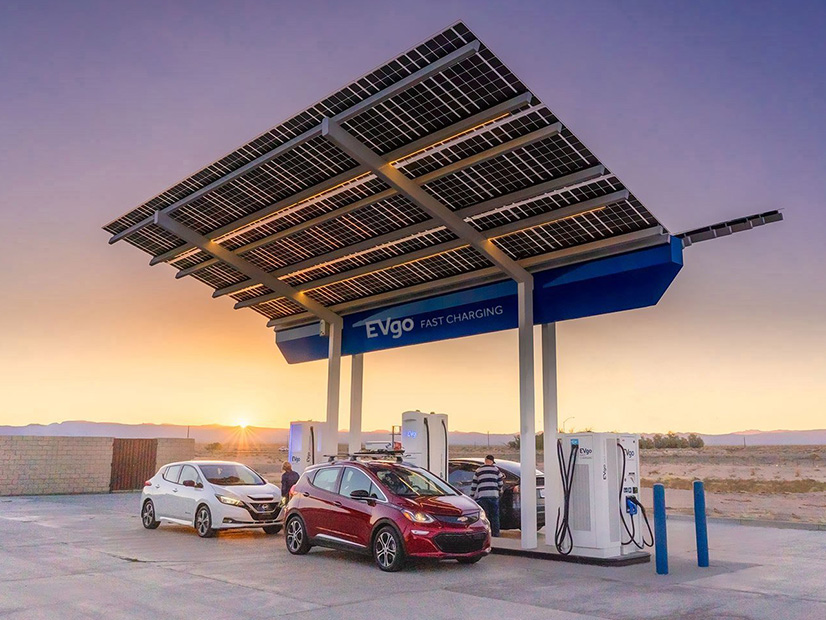
The California Energy Commission granted about $15 million to companies to install more than 100 electric vehicle fast charger stations in the Golden State.
The CEC on Dec. 8 voted to approve about $11.2 million for San Francisco-based Electric Era to install 72 direct current faster chargers (DCFCs) at 16 locations along some of the state’s major highways, including Interstate 80, from Auburn to Grass Valley, and U.S. 101, from San Francisco to Los Angeles.
The source of the grants is the $5 billion Biden-era National Electric Vehicle Infrastructure (NEVI) program, which was funded by the federal Infrastructure Investment and Jobs Act. The Trump administration halted NEVI payments early in 2025 but resumed the program in August after a court ruling. (See DOT Issues Guidance to Resume NEVI Funding.)
Under the terms of the grants, the Federal Highway Administration (FHWA) must authorize funding for the projects before reimbursable expenditures can be incurred, the CEC’s application says. Even where funds already have been obligated or work to be performed will not be reimbursable or will be done with matching funds, FHWA and California Department of Transportation (Caltrans) approval still may be required prior to beginning work, the application says.
Rivian, an EV truck manufacturer, received four grant awards, totaling about $1.7 million, to install DCFCs in Long Beach, Temecula, Tulare and Cabazon. As part of the grant, Rivian must sign a data-sharing agreement with a charging network provider, which will collect and send to the CEC charging data from each charging port, the application says.
The CEC also approved the commission’s 2025/26 investment plan update for the clean transportation program, which included a significant drop in funding for EV light-duty chargers, from $98.5 million in 2025/26 to $34.2 million in 2026/27. EV heavy-duty vehicle charger funding will increase from $15 million in 2025/26 to $44 million in 2026/27.
In total, the transportation investment plan includes about $327 million for fiscals 2025/26 through 2027/28.
“[We are] targeting the expansion of charging in multifamily housing properties,” Commissioner Nancy Skinner said at the agency’s voting meeting. “Because in the analysis we’ve done, multifamily residents have the least access to charging at home. And so, since charging at home is one of the most convenient ways to have an EV, we really want to expand multifamily charging installations so that it is much more convenient for folks.”
POU IRPs Approved
The CEC approved the integrated resource plans (IRPs) for the City of Palo Alto Utilities and Hetch Hetchy Power (HHP).
The approved IRP requires a publicly owned utility (POU) to meet greenhouse gas emission reduction requirements, renewable energy resource procurement amounts, and carbon neutrality and reliability requirements, the CEC’s Palo Alto order notes.
Palo Alto’s IRP shows the utility will increase its investments in geothermal power generation, renew a hydroelectric generation contract with the Western Area Power Administration, and see an increased reliability risk during years with low hydroelectric generation availability.
Most of Palo Alto’s capacity — about 230 MW out of 340 MW — is provided by hydroelectric generation facilities, and about 80 MW from solar power generators.
HHP, which is operated by the San Francisco Public Utilities Commission (SFPUC), has 380 MW of existing resources. The utility anticipates low growth over the coming years, driven mostly by the San Francisco International Airport expansion, public transit electrification and new developments, CEC staff member Bryan Neff said at the meeting.
HHP transmits power across 167 miles of transmission infrastructure that is owned and operated by SFPUC, Neff said.
HHP’s load growth will require additional resources by 2033, so the utility plans to procure 75 MW of battery storage capacity starting in 2027, 100 MW of solar generation starting in 2033 and 50 MW of geothermal starting in 2035, the CEC’s staff review says.
“I think we’re seeing this in all the IRPs from the POUs: There is significant load growth in the upcoming years,” CEC Vice Chair Siva Gunda said at the meeting. “I think that’s consistent with the demand forecast of the CEC.
“When we think about California as a whole, we generally think about CPUC as a significant part of the work, and about 75 to 80% of the load does fall under the CPUC jurisdiction. But there’s almost a quarter, depending on the time of the year, that is planned through the POU work. … There’s also a lot of transmission work that is being taken up by the POUs, and [this is] something that we need to closely track.”
There is significant uncertainty in the load in the West and significant uncertainty in what resources are online, Gunda said. “It’s important for us to track through our dependence on imports and just really be careful of planning that.”