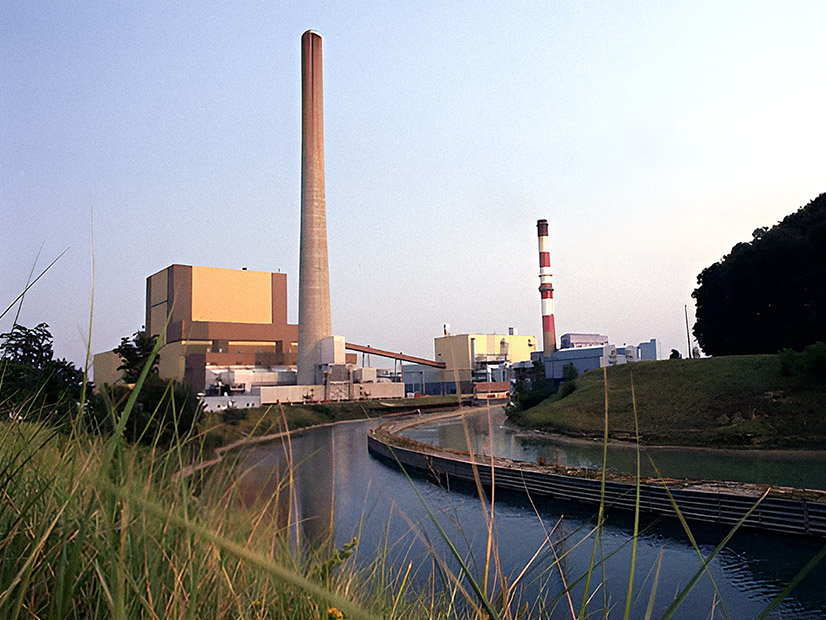
MISO officials clarified that the 1,420-MW J.H. Campbell coal plant — kept online and in retirement limbo by the U.S. Department of Energy’s series of emergency orders — is not eligible for the RTO’s capacity market and is not receiving special treatment for dispatch.
Executive Director of Market and Grid Strategy Zak Joundi and Managing Assistant General Counsel Michael Kessler appeared before the Organization of MISO States during a teleconference Dec. 18 to explain the Michigan plant’s role in RTO operations.
Consumers Energy’s Campbell plant will run through Feb. 17, 2026, after a third emergency order under Federal Power Act Section 202(c) from DOE. (See DOE Issues 3rd Emergency Order to Keep Michigan Coal Plant Open.) Over a four-month span, the coal plant has cost consumers $80 million to stay online. (See J.H. Campbell Tab Rises to $80M on DOE’s Stay Open Orders.)
Joundi said the plant participates only in the energy and ancillary markets. He told state regulators and regulatory staffers that, based on language in the DOE orders, the plant “cannot be deemed a capacity resource and cannot participate in MISO’s capacity auctions.”
Joundi said “it would not be unexpected for” DOE to continue to issue extensions every 90 days to postpone the plant’s retirement, given the first two extensions.
South Dakota Public Utilities Commissioner Chris Nelson asked whether anyone would conduct a prudence review of the plant’s costs.
Kessler said a review would take place once Consumers files for recovery of its costs with FERC under its MISO Midwest load-ratio share allocation. At that point, Kessler said interested parties can inquire about how the plant was “operated and dispatched in the market” and debate the costs Consumers proposes to collect.
“I think all of those issues will come to the forefront once the cost recovery filing is made at FERC,” Kessler said.
To submit a commentary on this topic, email forum@rtoinsider.com.
Joundi said at this point, no costs relating to the plant have been recovered. He said MISO members can expect statements stemming from the plant to be charged under the real-time miscellaneous category.
Bill Booth, a consultant to the Mississippi Public Service Commission, asked whether the plant has a must-offer requirement.
Joundi said per MISO’s understanding, the Campbell plant doesn’t have a must-offer requirement like resources that cleared the capacity auction but has “an obligation” to offer energy because of the orders.
Booth questioned whether MISO is dispatching the plant economically.
“If the conditions allow it, it will be dispatched,” Joundi said. “I can’t talk to you about their bidding strategy.”
Mikhaila Calice, a staff member of the Public Service Commission of Wisconsin, pressed the RTO on how it plans to “preserve the merit order” of dispatch while minimizing costs to MISO Midwest.
“We’re using our market,” Joundi responded. He said MISO is committing and dispatching the plant under its normal process and is not using alternative market rules.
Calice asked if MISO is planning for emergency orders for other plants preparing for retirement.
Kessler said any future generation owners under DOE orders would have to follow Consumers’ steps and start by filing a complaint at FERC to seek a cost recovery mechanism. He said MISO considers itself “well positioned” to handle future emergency orders.
Minnesota Public Utilities Commissioner and outgoing OMS President Joseph Sullivan cautioned MISO again about its tone on resource adequacy issues at a Board of Directors meeting Dec. 11.
Sullivan said the RTO’s gloomier framing around the 2025 OMS-MISO resource adequacy survey was used by DOE to justify the Campbell extension, even though states were more optimistic about the footprint’s standings. (See MISO, OMS Report Stronger Possibility for Spare Capacity in Annual RA Survey.)
“We need to ensure that the states’ narrative and MISO’s narrative do not drift too far apart. Data matters, and so do the stories we tell about that data,” Sullivan told board members and leadership.
Sullivan noted the Campbell plant’s costs are rising while the plant isn’t included in MISO’s planning models.
“This is an affordability issue that we must be mindful of — no unnecessary costs,” Sullivan said in summarizing the situation.