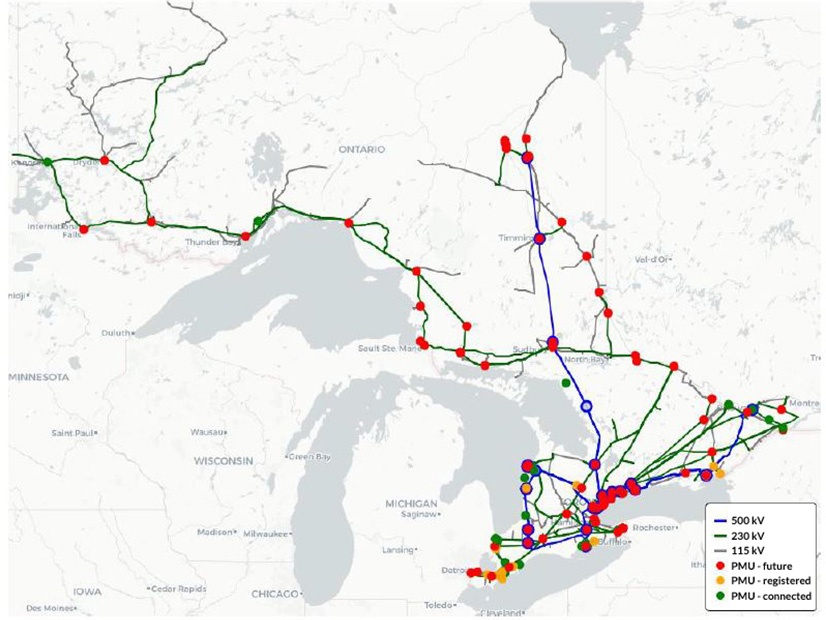
IESO has released proposed market rule and manual revisions to require synchrophasor data from storage resources, part of its effort to expand the use of phasor measurement units (PMUs).
The proposed market rules and manual revisions will require storage units rated at least 20 MVA, including aggregations, to provide their voltage and current phasor measurements and frequency for all three phases. The PMU requirements also apply to generators of 100 MVA and larger.
The requirement also would apply to any size storage or generation facility that can impact a NERC interconnection reliability operating limit. (See IESO to Expand Synchrophasor Data Requirements to Storage.)
The ISO also proposes doubling the reporting rate to 60 samples per second for all resources.
IESO officials briefed stakeholders on the changes at a Dec. 18 engagement session.
PMUs “are becoming more important for monitoring the power system as it’s becoming more dynamic,” said Dame Jankuloski, lead power system engineer with IESO’s performance validation and modeling group. “We are seeing within various jurisdictions the utilization of such data for both offline and real-time applications. It also helps us to promote interconnection-wide monitoring by sharing PMU data … with our neighboring jurisdictions.”

Ontario’s traditional supervisory control and data acquisition (SCADA) uses data from grid-connected facilities every two to 10 seconds, but the data lack precise time stamps needed to evaluate system disturbances, such as the January 2019 event at a steam unit in Florida that caused oscillations across the Eastern Interconnection. (See Oscillation Event Points to Need for Better Diagnostics.)
NERC, which has published PMU guidelines, is expected to elevate them to a reliability standard in the future, Jankuloski said. “The changes that we are proposing here are positioning the ISO to be able to comply with those changes that could come in the future.”
The Novel Applications for Synchronized Power Instrumentation working group — formerly the North American Synchrophasor Initiative — is drafting a research paper to propose future NERC requirements for real-time stability monitoring using synchrophasor data, IESO said.
IESO has 54 PMUs monitoring 24 facilities: four gas-fired generators, 14 wind farms, one solar installation and five substations. It expects to increase that number to 240 PMUs at 111 facilities, including 30 inverter-based resources.
Feedback on the rule and manual changes is due Jan. 22. Technical Panel approval is expected by May, with an effective date targeted for December 2026.
Large loads classified as inverter-based resources are not included in the proposed rule changes but are expected to be subject to such requirements in the future.
IESO applications for such loads should include PMU-capable devices and associated infrastructure in their project design during the System Impact Assessment process.