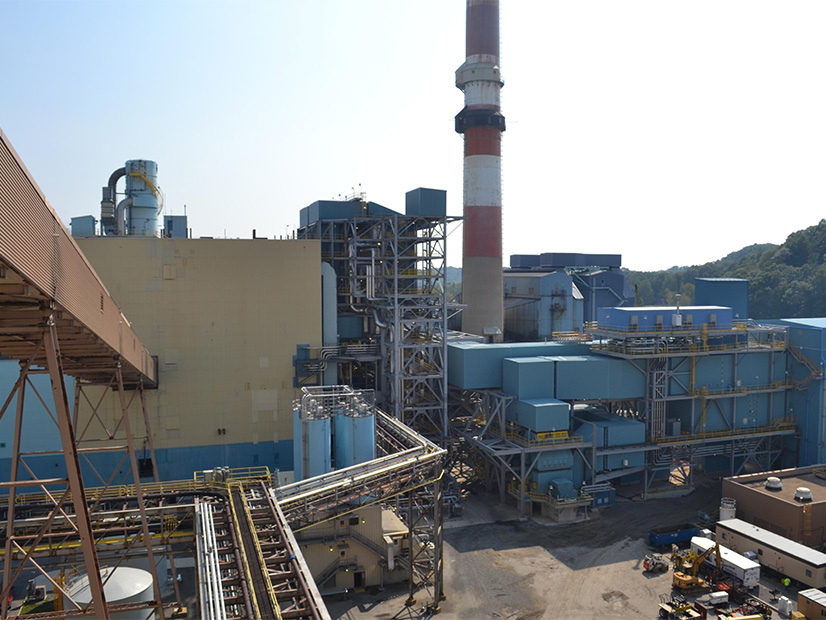
The U.S. Department of Energy is exceeding its authority by using Federal Power Act Section 202(c) to keep the J.H. Campbell coal plant in Michigan running under several consecutive “emergency” orders, opponents argued in recent court filings with the D.C. Circuit Court of Appeals (25-1159).
By defining “emergency” beyond its spatial and temporal limits while continuously extending mandated operation, DOE is taking unprecedented power to control the U.S. generation mix, the attorneys general of Michigan, Illinois and Minnesota argued in a joint brief filed Dec. 19.
The law was meant to give DOE the authority to keep plants online amid war or similar emergency circumstances, like extreme weather.
“Historically, DOE has used that authority narrowly and sparingly,” the attorneys general said. “But here, DOE asserts that a 15-state region of the country is in an energy ‘emergency’ that, if upheld, would empower DOE to order any and all power plants in the region to operate for ‘years.’”
DOE ordered plant owner Consumers Energy and MISO to postpone Campbell’s retirement, originally scheduled for May 31. The states, joined by several environmentalist organizations, challenged the order in July. Since then, the department has issued an additional two orders keeping the plant running. (See related story, MISO: Retirement-delayed Campbell Coal Plant not a Capacity Resource.)
To submit a commentary on this topic, email forum@rtoinsider.com.
Earthjustice, the Environmental Defense Fund, Natural Resources Defense Council, Sierra Club and other organizations filed their own joint brief in the case making similar arguments.
“Section 202(c) places meaningful limits on the department’s discretion, permitting it to compel generation only where an ‘emergency exists’ — that is, to prevent an imminent, unexpected shortage of electricity,” they argued. “The Federal Power Act addresses long-term grid reliability elsewhere, in provisions that withhold federal authority to exercise command-and-control authority over the grid. The department therefore may not use Section 202(c) to address long-term grid reliability concerns.”
Section 202(c) gives DOE important and necessary authority to deal with actual, short-term emergencies on the grid, Earthjustice senior attorney Michael Lenoff said in an interview.
“They’ve expressly said that they are using 202(c) to address long-term issues,” Lenoff said. “And those long-term issues are not part of DOE’s authority. That’s the role of states and grid operators and FERC.”

The industry has processes like reliability-must-run agreements and system support resources that can keep power plants running when shutting them down would lead to reliability violations, he said.
“You enter an RMR deal when there actually is a reliability reason that you need to address,” Lenoff said. “You don’t mischaracterize or misunderstand the evidence that props up a resource that’s not needed and that costs massive amounts of money to produce power.”
MISO had more than enough power to make it through peak demands this summer without the Campbell plant, he added.
While the case is focused on Campbell, DOE also has ordered the Eddystone plant in Pennsylvania online since the summer, and on Dec. 16, the department stopped the Centralia coal plant in Washington state from shutting down. (See related story, DOE Orders Retiring Wash. Coal Plants to Stay Online for Winter.)
Energy Secretary Chris Wright has said he would try to keep coal plants running, and with several other plants around the country to retire at the end of 2025, more orders could be coming, Lenoff said. Tri-State Generation & Transmission’s Craig Unit 1 is up for retirement at the end of the year, and the co-op has told The Colorado Sun it expects a 202(c) order. Lenoff said the Schahfer 17 and 18 coal plants in Indiana also could be the subject of future orders.
“All those are scheduled to retire pursuant to long-developed plans by utilities and state regulators and consumer advocates and a host of other stakeholders to ensure that consumers don’t pay more than what they need to pay to keep the lights on,” he said.
In the case of the Campbell plant, Consumers executed a state-approved plan to retire it and replace the capacity with newer resources that would increase available generation capacity, save ratepayers money and cut pollution, the attorneys general said in their brief.
“The agreement directed the Campbell retirement and the construction, procurement and extended operation of other major generating resources,” they added. “Those resources are now online and producing cleaner, lower-cost power. The net effect was to substantially increase the total generating resources available in the region.”
DOE used its 202(c) authority just 19 times between 1977 and 2024, mostly in response to extreme weather, and in each case at the request of a system operator, utility or both, the attorneys general said. The Campbell order proposes a transformative use of the law, which effectively displaces state law and FPA Sections 205 and 206, which FERC uses to regulate resource adequacy, they argued.
“Indeed, it defies logic that Congress would grant DOE general authority over which power plants may retire across the country — a function with profound implications for rates, state sovereignty and a broad array of stakeholder interests — without any obligation to assess the effect on ratepayers or seek public input,” they said.
The New York University School of Law’s Institute for Policy Integrity filed an amicus brief arguing that DOE exceeded its authority.
“The states, with support from FERC and regional grid operators, are primarily responsible for ensuring regional ‘resource adequacy,’ which is achieved when a region has enough energy supply to meet expected demand under various uncertain future conditions,” it said. “DOE is not the proper entity to independently identify a resource as essential for achieving resource adequacy, nor to impose its divergent determinations about resource adequacy on those who manage the grid.”
Using 202(c) to seize the role of resource adequacy monitor means DOE is usurping the role the FPA assigns to states, the institute argued.