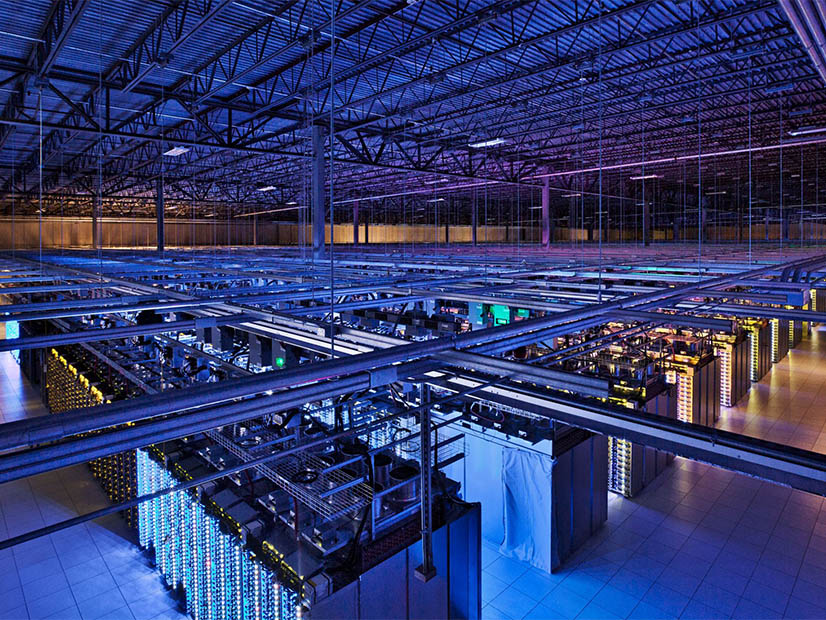
CAISO wants to ensure grid reliability when artificial intelligence data centers “pulsate.”
A pulsating load can occur at AI training data centers after servers in the facility complete large computations. When these computations have finished, “all the load drops significantly, 80 to 90%, within seconds,” CAISO staff member Ebrahim Rahimi said at a Feb. 5 large load information session hosted by CAISO.
“That nature of the AI training comes with a number of potential issues,” Rahimi said. “The main thing is we don’t want a [grid] disturbance to happen and all the large load data centers drop off and stay off. They [could] have a large impact on the system frequency and voltage.”
As observed with AI training data centers, pulsating load levels can trigger critical dynamic system frequencies and force system oscillations, Rahimi said. These effects can cause resonance issues with nearby rotating machines, he said.
The Feb. 5 information session was intended help CAISO determine whether it needs to make certain policy changes for large loads. If policy changes are required, the ISO will begin a new stakeholder initiative.
“Currently, we don’t have a threshold for what constitutes a large load,” Danielle Mills, CAISO infrastructure policy development principal, said during the session. “So that is something that we’ll both take comments on and may develop over the next several months.”
Utilities are responsible for large load interconnections, but CAISO is monitoring developments at the federal level regarding whether RTOs and ISOs can or should be more heavily involved in the process, a Jan. 30 CAISO Large Load Considerations issue paper said.
Cost allocation rules for large loads could be particularly complex, especially rules for co-located load and generation facilities, the paper says. Often, it will be impossible to tell whether load or generation affected networked facilities, the paper says.
“As electric regulators are fond of saying, cost allocation ‘is not a matter for the slide rule,’” the paper says. “Enhancing large load cost allocation rules and responsibilities will thus require significant coordination across tariffs, including the ISO’s.”
Currently, CAISO includes large loads in its annual transmission planning process, and in recent years it approved projects to provide increased capacity in the Bay Area to support data center load growth, the paper says.
CAISO might develop new technical standards that govern large loads — an effort that resembles the NERC project to consider new technical standards for large loads, the paper says.
CAISO is looking for ways to allow large loads to participate in ISO energy and ancillary service markets more efficiently.
At the information session, one stakeholder asked if the focus of the paper is to see whether large loads can be made flexible.
“Flexible loads are a consideration, but we also have a parallel initiative going on right now — the demand and distributed energy market initiative — that is looking probably in more detail at flexible loads,” Mills said.
In July 2025, the California PUC partly approved a new rule to make it easier for AI data centers and other large customers to complete transmission connection projects in Pacific Gas and Electric’s territory. PG&E’s retail customer transmission interconnection demand has increased by more than 3,000% since 2023, utility representatives said. (See CPUC OKs New PG&E Rule to Speed Tx Connections for AI Data Centers, Others.)
Large Loads Forecast
California’s data center load could increase by 1.8 GW by 2030 and by 4.9 GW by 2040, according to the California Energy Commission’s demand forecast.
But large loads include more than data centers: Loads from EV charging stations and electric agricultural and industrial equipment, which also fall into this category, are expected to increase significantly over the coming years, too.
EV charging load is forecast to be about 2.4 GW at the peak hour in 2030 and about 7.8 GW in 2040, the CEC forecasts. These amounts represent about 5% of the system’s load at peak in 2030 and about 13% of the system peak in 2040, the CEC told RTO Insider.
Charging for electrified agricultural equipment such as tractors, specialized mobile equipment and all-terrain vehicles at farms would constitute approximately 16 MW at the peak hour in 2030 and about 51 MW at peak in 2040, the CEC said.
The agency requests updated data from the state’s investor-owned utilities and other utilities three times per year. It uses the data from the first request to develop the draft energy demand forecast, the second to finalize the energy demand forecast, and the third for additional details that inform the dataset it develops for CAISO’s transmission planning process.