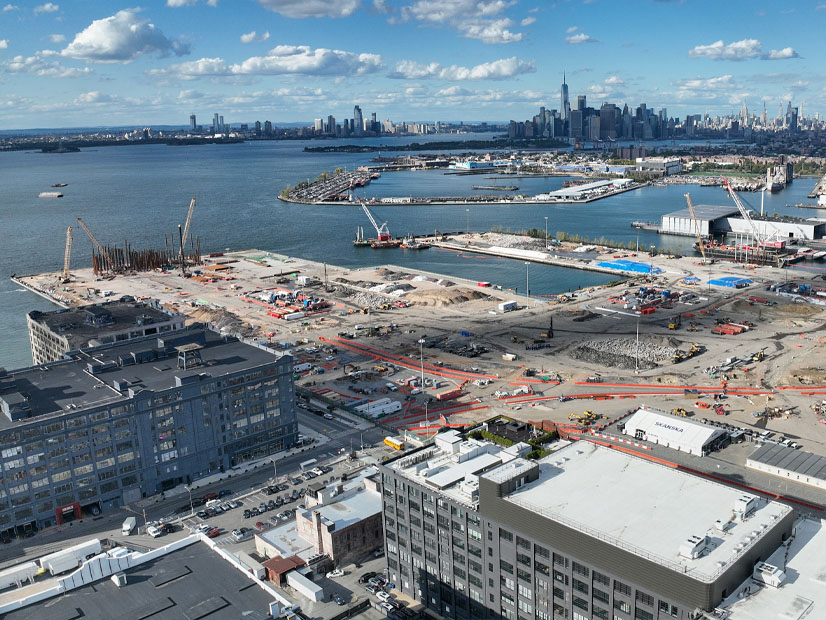
Empire Wind developer Equinor says it’s optimistic it can complete work on the $7.5 billion offshore wind project and start selling electricity to New York on schedule.
But the court fight continues with the Trump administration, CEO Anders Opedal said Feb. 4 during Equinor’s year-end earnings call.
Work on the 810-MW project has been halted twice by the administration and resumed twice by the Norwegian developer, once with the administration’s permission and once with a federal judge’s preliminary injunction against the stop-work order.
In court papers, Equinor estimated the impact of the April 2025 halt at $200 million. Opedal told financial analysts that the company views both stop-work orders as illegal but said the December 2025 halt was much less costly.
He said work is more than 60% complete, with the offshore substation, nearly 186 miles of cable and all monopile foundations installed.
About $3 billion in capital expenditures remain on the $7.5 billion project, Opedal said. Revenue from operations ($155/MWh) and monetized federal investment tax credits (approximately $2.5 billion) should cover outlay of all known upcoming costs, he said, but added: “We, like other companies, remain exposed to uncertainty when it comes to possible future tariffs.”
A financial analyst asked how Equinor feels now about retaining 100% ownership of Empire Wind, formerly a 50-50 venture with bp that was dissolved after the U.S. offshore wind industry ran into spiraling costs in 2023. (See Offshore Wind Reset Complete in New York.)
“This is definitely something to reflect on,” Opedal said. “We normally don’t take 100% in any license.
“We de-risked it somewhat with higher strike prices, with a financing package, and then as you’ve seen, the political risk with the new administration was higher than anticipated.
“This is a trend now we see in several countries,” Opedal said, not just in the United States: Energy investments have become more politicized and polarized.
He will be looking for strong bipartisan support for future projects and considering carefully how to move forward with any project that proves divisive.
“With the political changes we’ve seen … we probably would have thought differently about Empire Wind in the past,” Opedal said.
An analyst asked him to handicap the court fight in the United States.
“This is a little early to say,” Opedal said. However, he noted the other four U.S. offshore wind projects also won injunctions against the Trump administration’s December stop-work order, which is a promising sign. (See With Sunrise Wind Ruling, OSW Industry now 5-0 Against Trump Admin.)
“But I’m an engineer, not a lawyer,” he added.
Equinor — originally and still primarily an oil and gas producer — also reported record fossil fuel production in 2025.
A financial analyst asked Opedal about Equinor’s commitment to the energy transition amid its recent pullbacks.
“We are signaling a consistency around oil and gas,” he said. The market view about offshore wind, hydrogen and particularly carbon dioxide transportation/storage has changed in recent years, he said, and Equinor’s customers have postponed their emissions reduction plans.
“Everyone had a 2030 target,” Opedal said.
Equinor will focus on wrapping up its existing offshore wind projects and place a “high bar” on any future investments in the sector, including through its investment in offshore wind leader Ørsted, he said.
Equinor reported 2025 net income of $5.06 billion or an adjusted $2.47/share on total revenues of $106.5 billion, compared with 2024 net income of $8.8 billion or an adjusted $3.24/share on total revenues of $103.8 billion.