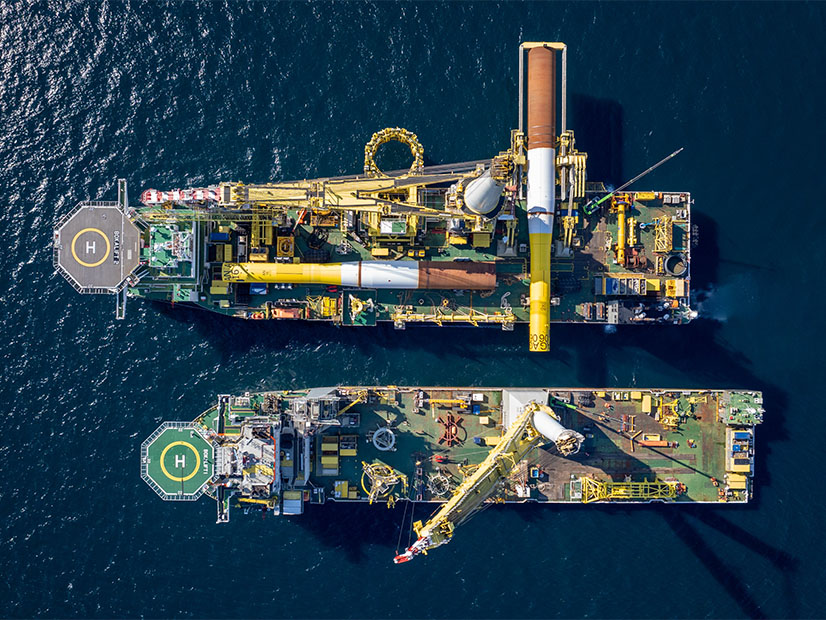
If Ørsted can continue to beat back the Trump administration’s interference, it could start generating electricity with its Revolution Wind project in a matter of weeks.
The 704-MW wind farm off the New England coast is 87% complete, with the export cables, interlink cable and both offshore substations energized, CEO Rasmus Errboe said Feb. 6.
The developer expects the facility to reach commercial operation and full power delivery to Connecticut and Rhode Island in the second half of 2026, barring further setbacks.
Errboe gave the update on Revolution and Ørsted’s other North American project, Sunrise Wind, during a fourth-quarter and full-year earnings presentation to financial analysts.
The Trump administration shut down work on Revolution in August and then shut down work in December on Revolution, Sunrise and the three other wind farms under construction by other developers in U.S. waters on grounds of preserving national security.
Ørsted won injunctions against all three stop work orders, but the shutdowns caused it to lose several weeks of work and take a $90 million impairment. And the injunctions are only temporary protection in the Trump administration’s campaign against offshore wind.
Ørsted began running into problems with its U.S. offshore portfolio in the form of soaring costs and logistical constraints well before Donald Trump was elected to a second term and followed through on his campaign-trail rhetoric against offshore wind.
The Denmark-based offshore wind market leader already has indicated it would undertake no further projects in U.S. waters but an analyst nonetheless asked Errboe during the conference call if he would be “interested in increasing your exposure in the U.S. market at all.”
He replied: “We have no expectations whatsoever to increase our exposure to offshore wind in the U.S.”
Errboe said Ørsted decided shortly after he became CEO in January 2025 to concentrate on wrapping up the two U.S. projects and refocusing its offshore attention on its core European market, plus select Asia/Pacific markets. Value is the priority, not volume.
The company retains its undeveloped wind leases in U.S. waters but has no plans for them, he said.
However, Ørsted still is engaged in onshore U.S. renewables development, which it set up as a separate business unit in October 2025.
“The business is going well, we are moving forward projects, we have right now roughly 500 MW under construction — one wind project, 260 MW, in MISO, and one battery, 250 MW, in ERCOT,” Errboe said.
“And then on top of that, we have 6 to 7 GW of capacity that meet the IRS qualifications through 2029, and we have this development portfolio consisting of mix of solar, wind and storage, slightly weighted more towards solar in the near term. So, moving forward well.”
Errboe said 59 of Revolution’s 65 turbines are installed and work is approximately 87% complete on the project, a joint venture with Skyborn Renewables.
Sunrise Wind, which will send up to 924 MW to New York, is 45% complete with 44 of 84 foundations installed, onshore and near-shore export cables installed, and fabrication completed of most remaining components. First power is expected in the second half of 2026 and commissioning is expected in the second half of 2027.
Ørsted is developing Sunrise alone. After Eversource departed the project, Ørsted sought an equity partner, but the actions of the Trump administration spooked potential investors to the point that the conditions they set for joining the project were untenable, Ørsted has said. (See Ørsted to Raise $9.3B, Self-finance Sunrise Wind.)
It has said Revolution and Sunrise will have a combined cost of approximately $16 billion.
ISO-NE has said Revolution will be important to reducing reliability risks and NYISO has said Sunrise will help address the capacity shortfall identified in downstate zones. (See ISO-NE Warns Halting Revolution Wind Boosts Reliability Risk and NYISO Again Identifies Reliability Need for NYC.)
Ørsted reported 2025 revenue of $11.6 billion, up from $11.2 billion in 2024; EBITDA of $3.6 billion, down from $5.1 billion; and net profit of $501 million, up from $2.5 million.