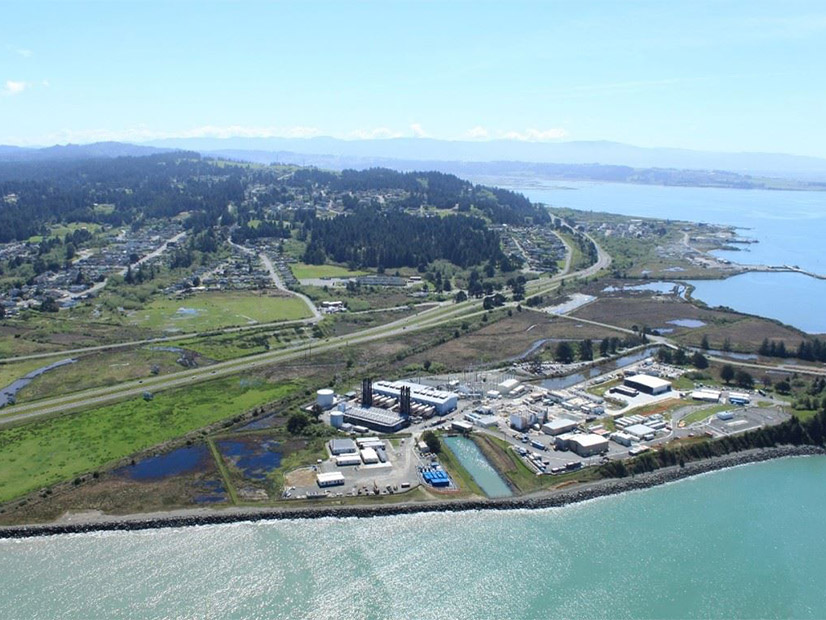
An offshore wind group has urged the California Public Utilities Commission to reject an internal proposal to use a forecast six-year delay to a Humboldt County offshore wind project to inform the state’s grid planning.
Representatives of Offshore Wind California (OWC) said the Humboldt offshore wind project’s online date in the forecast should be revised from 2041 to 2036, according to a Feb. 6 filing with the CPUC.
The forecast is part of a proposed decision on electric integrated resource planning and procurement by CPUC Administrative Law Judge Julie Fitch, which commissioners will vote on during their Feb. 26 meeting. (See CPUC Portfolio Shows Offshore Wind Delayed up to 6 Years.)
The projected six-year delay should be eliminated because offshore wind projects are moving ahead on the East Coast, despite Trump administration actions to attempt to hinder them, OWC said.
“Offshore wind is demonstrating its legal as well as business-case durability, even while under attack by the current administration,” OWC said in the filing. “Planning assumptions that doubt offshore wind’s ability to succeed do not reflect the prevailing legal reality. Nor do they capture the realities of steel in the water, which show eight projects are proceeding towards completion on the U.S. East Coast that will deliver more than 6 GW of clean power by 2027.”
Transmission planning often occurs over decades: The CPUC should not delay making important infrastructure decisions to react to what are likely to be short-term federal policy headwinds, OWC added.
California’s offshore wind projects will not need federal permitting for several years, so the Humboldt project could be online in 2036, the same time as the Morro Bay offshore wind project along the state’s central coast, OWC said.
The California Energy Commission (CEC) in October 2025 dished out $42 million for port upgrades to support the state’s offshore wind projects. (See CEC Approves 5 Offshore Wind Projects at California Ports.)
A month later, the CEC approved $9.2 million for research on deepwater HVDC substations and ocean monitoring methods capable of detecting entangled debris. (See ‘There’s Room for Everybody’: California Ports Prepare for OSW Development.)
The CPUC should eliminate the limited wind sensitivity case in the commission’s Jan. 14 proposed decision on the matter, OCW said. The group said the portfolio is “unreasonably conservative and unnecessary and directly conflicts” with California AB 525, which shows 25 GW of offshore wind generation by 2045, CAISO’s $4.6 billion in transmission investments to support offshore wind and the $475 million approved to upgrade port infrastructure for offshore wind.
The CPUC included the limited wind case portfolio due to recent increased difficulty of permitting wind projects and federal policy changes toward the projects, the commission said in the proposed decision.