SAVANNAH, Ga. — As NERC’s Board of Trustees voted to accept the recommendations of the Modernization of Standards Processes and Procedures Task Force, Chair Suzanne Keenan said the ERO’s leadership is focused on delivering needed change while maintaining industry’s role in standards development.
“We’re moving at speed — executing, adapting and delivering while simultaneously redesigning the machine that carries us forward,” Keenan said at the board’s first meeting of 2026 in Savannah, Ga. “The friction we’re feeling and will feel is data. It tells us what needs reinforcement, refinement and modernization.”
“At the same time, speed without structure is risk,” she continued. “We do need guardrails, not to slow us down, but to keep us aligned and stable as we accelerate. Those guardrails give us confidence to move decisively without veering of course.”
The acceptance of the MSPPTF’s recommendations caps a yearlong process that began with the board’s February 2025 meeting in Miami. (See NERC Leaders Highlight Canada-US Collaboration.) NERC kicked off the initiative after the board twice had to step in to use its special authority under the ERO’s Rules of Procedure to accelerate the normal standards development process to meet deadlines set by FERC.
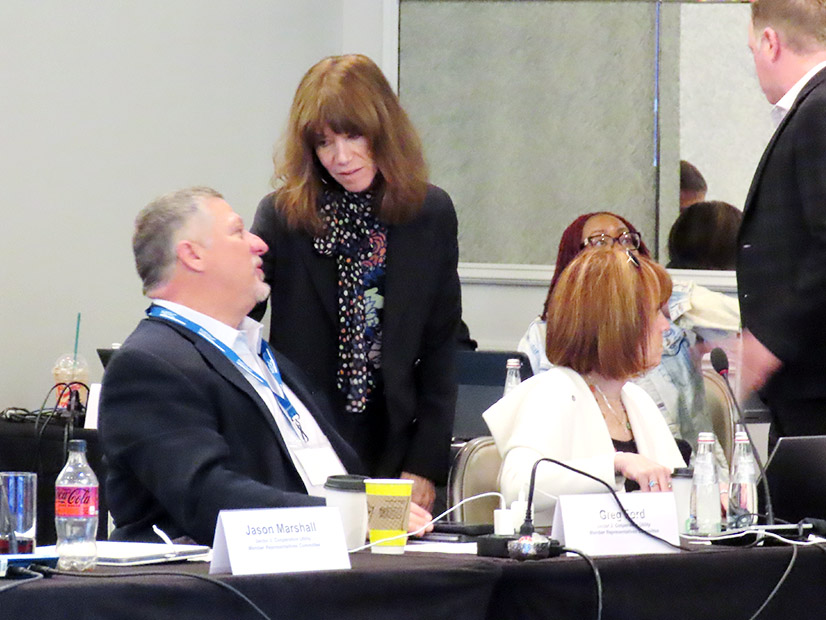
MSPPTF Chair Greg Ford, CEO of Georgia Systems Operations, emphasized that the task force “wanted to make sure that we were accessible to stakeholders” and over the past year gave more than 50 presentations, either standalone or as agenda items at meetings or conferences, that were heard by more than 5,800 participants. NERC also posted the recommendations for a final industry comment period at the end of January. (See NERC Modernization Task Force Leaders Present Final Recommendations.)
The recommendations involve significant changes to the initiation, drafting and balloting stages of standards development, including a new subcommittee of the Reliability Issues Steering Committee to create development plans and a pool of subject matter experts to help NERC staff develop initial standard drafts. Registered ballot body segments would be restructured, and the voting rules would be updated. Also, a “fast track” process would be available for urgent projects.
Howard Gugel, NERC’s senior vice president for regulatory oversight, told trustees the ERO plans to pilot the standards initiation workshop this year and will begin developing the SME pool called for in the MSPPTF recommendations as soon as possible. He said NERC staff is considering using artificial intelligence to help develop the new process “within the bounds of the existing standards process manual.” The MSPPTF will remain in place throughout the implementation as an advisory body.
The final proposal will need FERC’s approval, and revisions to the charters of the ERO’s standing committees, including the RSTC and RISC, also will be necessary, along with the disbanding of the Standards Committee. On page 80 of the meeting agenda, management estimated the final changes to the Rules of Procedure will be submitted to the board in the first quarter of 2027 and, if approved, filed with FERC and Canadian authorities the following quarter. Standing committee revisions should be complete by the end of 2027.
Leaders Tout Accomplishments in 2025
NERC COO Kelly Hanson, presenting the ERO’s 2025 performance assessment, cited the MSPPTF as one example of the organization’s expertise in stakeholder engagement, which she called its “secret sauce.”
That collaboration skill stood the ERO in good stead in 2025, as it accomplished all 10 of its work plan priorities for the year, including:
-
- developing a framework to identify emerging reliability risks from the transforming grid;
- identifying critical cyber and physical security risks to the electric industry;
- meeting all FERC directives and mandates within the required time frames;
- creating a road map for development of NERC’s Critical Infrastructure Protection standards to ensure baseline protection;
- expanding stakeholder engagement to reach a more diverse audience;
- enhancing the ERO’s online portals;
- researching the potential reliability benefits of AI and other new technologies;
- improving financial and human resources processes to improve employee experience and accelerate workflow; and
- boosting operational efficiency by revising corporate frameworks and consolidating facilities.
NERC finished its priorities despite having several “unplanned activities” added to its plate, Hanson said, naming the launch of the MSPPTF, the turmoil of the second Trump administration, the departure of three FERC heads before the confirmation of current Chair Laura Swett and NERC offering to help investigate the mass outage on the Iberian Peninsula in June. (See NERC Offered to Help with Iberia Outage Investigation, Robb Says.)
“We all know what happens in an organization [when] you have unplanned activities,” Hanson said. “It kind of halts everything. It’s very disruptive. All of a sudden, you have to change all of your priorities around you … your people, your processes, your technology, your budgets. … It’s really impressive, because it starts to show how this industry is becoming more agile [and] more flexible.”
Changes at the Top
The board also welcomed new Trustee Ron Talbot after his approval by the organization’s Member Representatives Committee that day. Talbot will fill the vacancy left by the departure of former Trustee Bob Clarke in February 2025; the MRC elected not to replace Clarke at that time, so it could extend the search for a candidate to handle “the current speed of change” in the grid and the technology, security and policy landscape.
Talbot’s 40-year career in the electric industry has taken him across five utilities in all three U.S. interconnections. He has also served on the boards of directors at several companies and nonprofits. Along with Talbot, Keenan and existing Trustees Jim Piro and Kristine Schmidt were elected to serve another three-year term.
The board’s next meeting will take place in Washington, D.C. on June 18. The meeting will be held under a hybrid arrangement in which MRC and trustees will attend in person and all others will participate virtually.