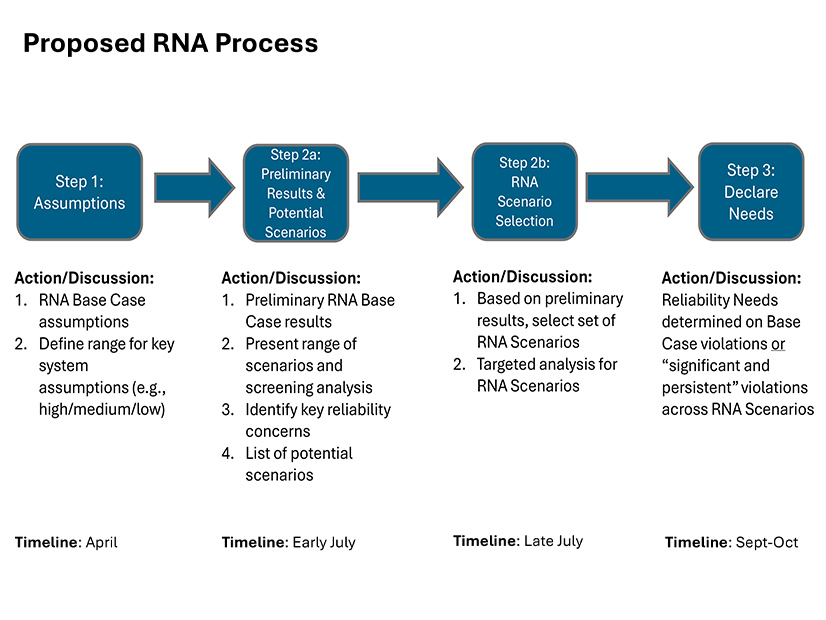
NYISO is proposing to use a set of scenarios rather than relying on a single base case in its Reliability Planning Process to avoid study-by-study fluctuations in determining reliability needs.
ISO officials detailed its proposed revisions for the first time in a marathon meeting of the Transmission Planning Advisory Subcommittee on Feb. 19.
Under the new process, NYISO would compose a base case and several alternative scenarios with stakeholder feedback. It would then determine whether reliability violations occur across the scenarios and base case. If a large magnitude violation persisted across multiple scenarios, NYISO would declare a reliability need.
Yachi Lin, NYISO director of system planning, said this would help avoid being too conservative and overbuilding the system.
Currently, NYISO relies on a single base case, which is updated annually based on what system changes the ISO observes. In recent cycles, this has led to finding and declaring needs only to retract them as the base case updated.
“We have that issue of flip-flopping based on year-over-year volatility of our assumptions,” said Ross Altman, senior manager of reliability planning for NYISO. The new process would weigh the base case against a range of “likely scenarios.”
Altman pointed to the whiplash of reliability findings for New York City. (See NYISO Cancels 2033 Reliability Need for NYC.) He said under the new system, the ISO would not declare a reliability need if a reliability violation did not “significantly persist” across multiple scenarios.
How these findings would interact with other NYISO reliability studies will be discussed at a joint meeting of the TPAS and Installed Capacity Working Group on Feb. 26.
The discussion at the Feb. 19 meeting lingered on whether stakeholders would have voting power over which scenarios would be included in the Reliability Needs Assessment.
“It looks like NYISO is developing all the scenarios without market input. Results are posted for consideration of feedback which NYISO may ignore, which may actually lead to way overbuilding the system,” said Martin Paszek, system and performance planner for Consolidated Edison. “Why not give the market a vote on what scenarios go forward?”
This question seemed to confuse Lin, who said stakeholders would be able to comment on scenarios and base case assumptions during the process. Zackary Smith, vice president of system planning for NYISO, also stepped in to reinforce that stakeholders would be involved at the start of base case development through the process.
“Ultimately this will result in the same vote that there is today in the process,” Smith said. “We document all of that in the Reliability Needs Assessment report, which goes in front of the Operating Committee and Management Committee for two separate stakeholder votes.”
Kevin Lang, representing New York City, said this missed Paszek’s point that stakeholders should have input on the scenario development process. Smith said stakeholders would be encouraged to provide feedback under the proposed process.
“The point is that we are giving NYISO all the power in this case,” Paszek said. “There is a difference between feedback and … having some real market input. There’s a huge difference.”
Another stakeholder asked whether the ISO would be able to provide calculated probabilities of the likelihood of each scenario. Lin said given the number of inputs into the calculation, this was not feasible with NYISO’s current workflow.
“We’re talking about the things that keep me up at night,” Lin said. “With large loads, for example, it’s almost impossible to say if this load is coming online with 50% likelihood or 20%. … There is very little transparency, not because NYISO isn’t trying, but because that’s just how the load centers are.”
Lin detailed how NYISO would define and consider the magnitude, urgency, severity of impact, number of scenarios and duration over the planning horizon for determining whether something constituted a reliability violation.
“It’s important to us moving ahead with any scenario planning that it is not in any way, shape or form turned into some formulaic default,” Smith said. “I want us to take a balanced approach to considering the uncertainty around demand forecasts, around generation mix, and everything else that goes into our planning.”