NYISO exceeded its winter baseline peak load forecast on Feb. 7 with 24,317 MW, COO Emilie Nelson told the Management Committee on Feb. 25.
The baseline forecast was 24,200 MW. From Jan. 25 to 30, load ranged from 23,417 to 24,177 MW. Demand response contributed “several hundred” megawatts of net load relief, Nelson said, with NYISO calling on its DR programs six times in January and an additional two times in February. “This is an unprecedented level for the winter.”
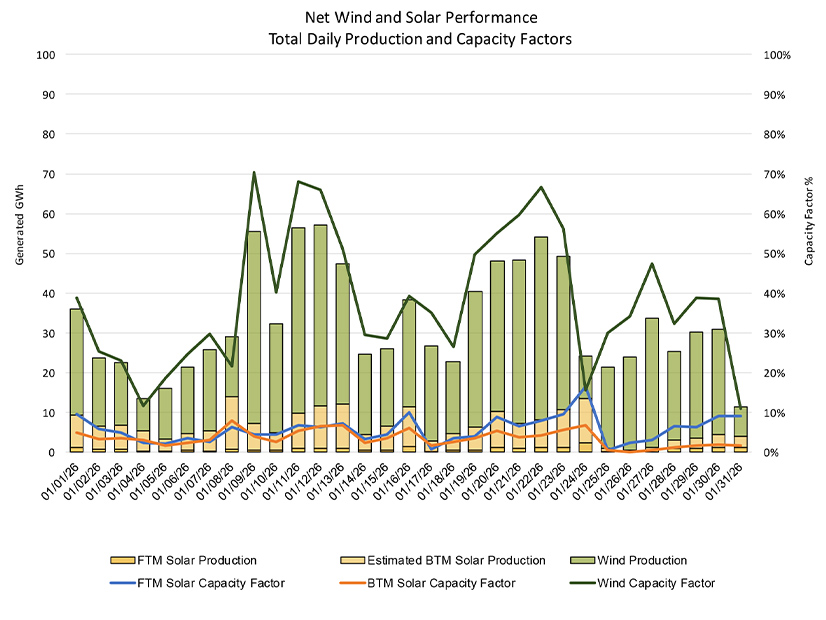
Wind performed “as expected” during the month. Roughly 2.4% of wind generation was curtailed during January. Solar always performs worse in winter but was basically unavailable for the worst of the month. Nelson pointed to Jan. 25, the start of Winter Storm Fern, when snow and heavy cloud cover began blanketing most of the state.
“Solar drops down entirely,” Nelson said. “You had a significant snowstorm and then it stayed cold, so you had snow on panels, and you did not get behind-the-meter solar generation.”
The peak of winter consumption occurs in the early evening, which she said made the issue even worse. Without solar to blunt it during the day, fuel demand remained high both on- and off-peak, straining resources.
“So much of managing a winter event is managing scarce energy,” Nelson said. “The fact that you have less solar production during the day with snow on panels makes managing those liquid fuels and scarce energy that much more important and challenging.”
She segued into a discussion of unavailable resources in the day-ahead market during the same period. Fuel shortages, inclement weather and difficult travel conditions forced many dual-fuel units offline. (See NYISO Recounts Challenges During January.) This continued into early February, Nelson said.
“You can see some pretty high numbers here, ranging from about 1,000 MW to up to 2,000 MW on a daily basis throughout,” she said.
Kevin Lang, representing New York City, asked whether this was comparable to prior winter storms. Nelson said it was about the same.
“If what we’re seeing is consistent with prior storms, that actually is good news that we’re not seeing a falloff in production or performance,” Lang said.
Aaron Markham, vice president of operations for NYISO, said that while it was broadly “good” news, it was still challenging to manage the high number of forced outages in both the real-time and day-ahead markets.
Another stakeholder said that while the number of forced outages might be roughly on par with what was seen before, it was important to remember that New York had fewer resources overall to call on, which made system conditions more stressful.
“I want to highlight the extraordinary efforts that were taken this time to keep units running, things like climbing up and knocking ice off fans in sub-zero weather,” said Doreen Saia, a lawyer from the Greenburg Traurig law firm representing generation interests. “I think we need to be careful. … It was a significant test for the system.” She said she didn’t want anyone to walk away from the meeting thinking things were fine.
Another stakeholder pointed out that external control areas actually received roughly 1,000 MW of exports from NYISO.
“I think it’s time we review how generous we can be under these cold snap conditions,” they said. “It’s a mess. We can’t have all these alerts and no major emergencies. That tells me something is going on.”
Stakeholders requested that the ISO identify which zones the outages were concentrated in and what the causes of the outages were. Nelson said that Markham was planning on covering the causes of the outages in his upcoming incident report.
Nelson said NYISO was not planning on identifying where these outages occurred. Other stakeholders asked whether the ISO could present the data in an anonymous form so they could understand the outages better.
Another stakeholder asked whether the ISO could highlight what system conditions were causing wind curtailments during the periods of high demand. They said it would be helpful for identifying necessary system upgrades.